

On this page
Kwabena Boahen builds silicon chips that work the way neurons do, and he keeps asking one question: how does the brain do so much on so little power? Here is how his chips work and how to check his numbers yourself.
Who is Kwabena Boahen?
Boahen grew up on the University of Ghana's Legon campus, where his father taught African history and his mother ran the cafeteria, he said in a Stanford Engineering interview. He took things apart on his father's desk and won a school science fair with a corn-planting machine he built with a classmate.
His interest in computers began with a BBC Micro his father brought back from England. Learning how it worked left him unimpressed: "So much work had to be done just to get the computer to multiply two numbers together," he recalled. He studied at Johns Hopkins, then did a PhD at Caltech, finishing in 1997, according to his Stanford profile; there he studied with Carver Mead. He is now a professor of bioengineering and electrical engineering at Stanford, where he directs the Brains in Silicon Lab.
What is a neuromorphic chip?
A neuromorphic chip is a silicon circuit designed to compute the way neurons and synapses do, rather than step by step like an ordinary processor. Boahen's lab "synthesizes neuromorphic electronic systems that scale energy-use with size as efficiently as the brain does", according to his Stanford profile.
The idea is a split borrowed from biology. Inside a neuron, signals arriving at the dendrites are combined as smoothly varying currents, which is analog computation. The neuron then sends a short all-or-none spike down its axon, which is closer to digital. Boahen's chips copy that split: his Stanford seminar abstract describes combining "analog dendritic computation with digital axonal communication".
How does Neurogrid copy the brain using so little power?
Neurogrid is a board about the size of an iPad, built from 16 custom chips called Neurocores, according to Stanford's 2014 announcement. Each Neurocore supports 65,536 neurons, so together the chips can simulate 1 million neurons and billions of synaptic connections. The chips were designed with power efficiency in mind: certain synapses share hardware circuits.
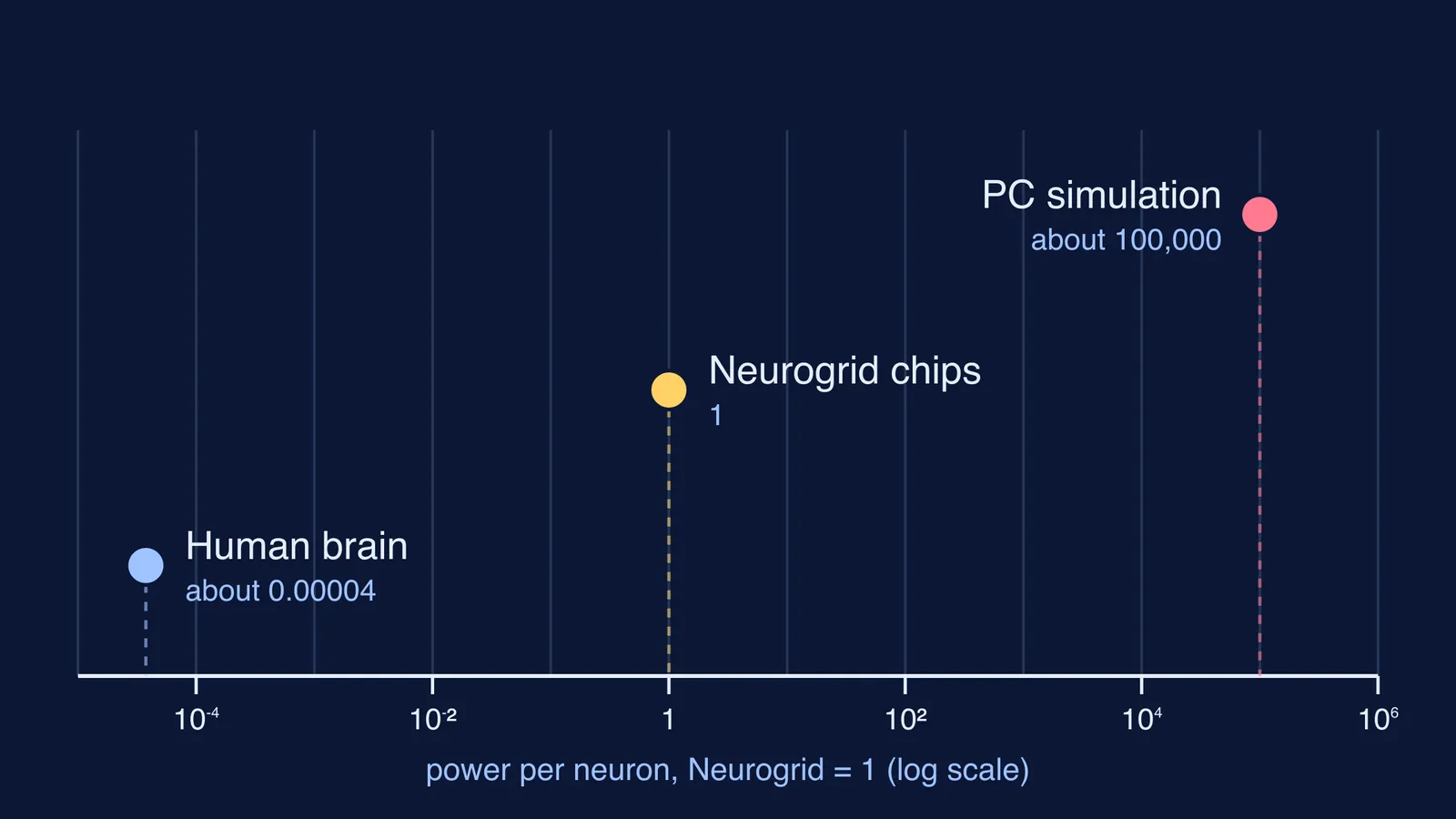
The design is described in a 2014 paper in the Proceedings of the IEEE by Ben Varkey Benjamin, Boahen and colleagues. In that paper, the release reports, Boahen notes that Neurogrid is about 100,000 times more energy efficient than a PC simulation of 1 million neurons. He still calls the brain the benchmark: "The human brain, with 80,000 times more neurons than Neurogrid, consumes only three times as much power," he writes.
He has since aimed at artificial intelligence. In a 2022 paper in Nature, he points out that AI now performs twice as many multiplications every two months, while chipmakers fit twice as many multipliers on a chip only every two years. His proposal is to learn the way dendrites do, so that AI could run "not with megawatts in the cloud but rather with watts on a smartphone", as he puts it in Stanford Bioengineering's summary.
How far is silicon from the brain?
You can check Boahen's comparison with Class 9 arithmetic, using only the figures from the 2014 release. Call Neurogrid's power P.
Neurogrid: 1,000,000 neurons on power P, so each neuron costs P / 10^6.
Brain: 80,000 times more neurons, which is 8 x 10^10 neurons, on power 3P. Each neuron costs 3P / (8 x 10^10), about 3.75 x 10^-11 P.
Divide: (P / 10^6) / (3.75 x 10^-11 P) is about 27,000. A brain neuron runs on roughly 27,000 times less power than a Neurogrid neuron.
A PC simulation uses about 100,000 times Neurogrid's energy, so the brain beats the PC by roughly 100,000 x 27,000, close to 3 billion times per neuron.
That gap is the problem Boahen is chasing. In his interview he compares today's chips to the sprawl of Los Angeles, where information must travel long distances, and says chips need a model "more like Manhattan", built up rather than spread out.
How can a student start on this path?
Neuromorphic engineering joins physics, biology and computing. Try this plan:
Biology: learn how ions crossing a membrane make an action potential, starting with Hodgkin, Huxley and the squid axon.
Physics: learn how a transistor controls current, through John Bardeen's work on the transistor.
Careers: see what chip designers study in our guide to a career in VLSI chip design.
An action potential is easier to see than to read about. The Fermi Simulation Lab has interactive simulations for ideas like this. If a word such as "synapse" or "semiconductor" is still fuzzy, the Fermi Concept Library gives each concept its own lesson.
Boahen's own advice to students is to recover the curiosity of early childhood: "if you can go back to that time when you were curious and confident in your own ability to figure it out, it's the way forward to new knowledge," he told Stanford Engineering.


