

On this page
In 1611, Johannes Kepler was working in Prague as the Imperial Mathematician. Looking for a New Year's gift for his patron, Baron Wackher von Wackhenfels, he found himself short of money. He noticed snowflakes falling on his coat on the Charles Bridge and struck upon a Latin pun: the word for snow (*nix*) sounded like the German word for nothing (*Nichts*).
He decided to give his patron a gift of "nothing"—a 24-page scientific pamphlet titled *The Six-Cornered Snowflake* (*Strena Seu de Nive Sexangula*) (Wikipedia). In it, he asked a simple but profound question: why do snowflakes never have five or seven sides, but always six?
Why are snowflakes six-cornered?
Kepler reasoned that the macroscopic shape of a snowflake must be determined by the microscopic arrangement of its smallest parts. Though atoms and molecules would not be proven for centuries, he imagined water as a collection of tiny, identical globules.
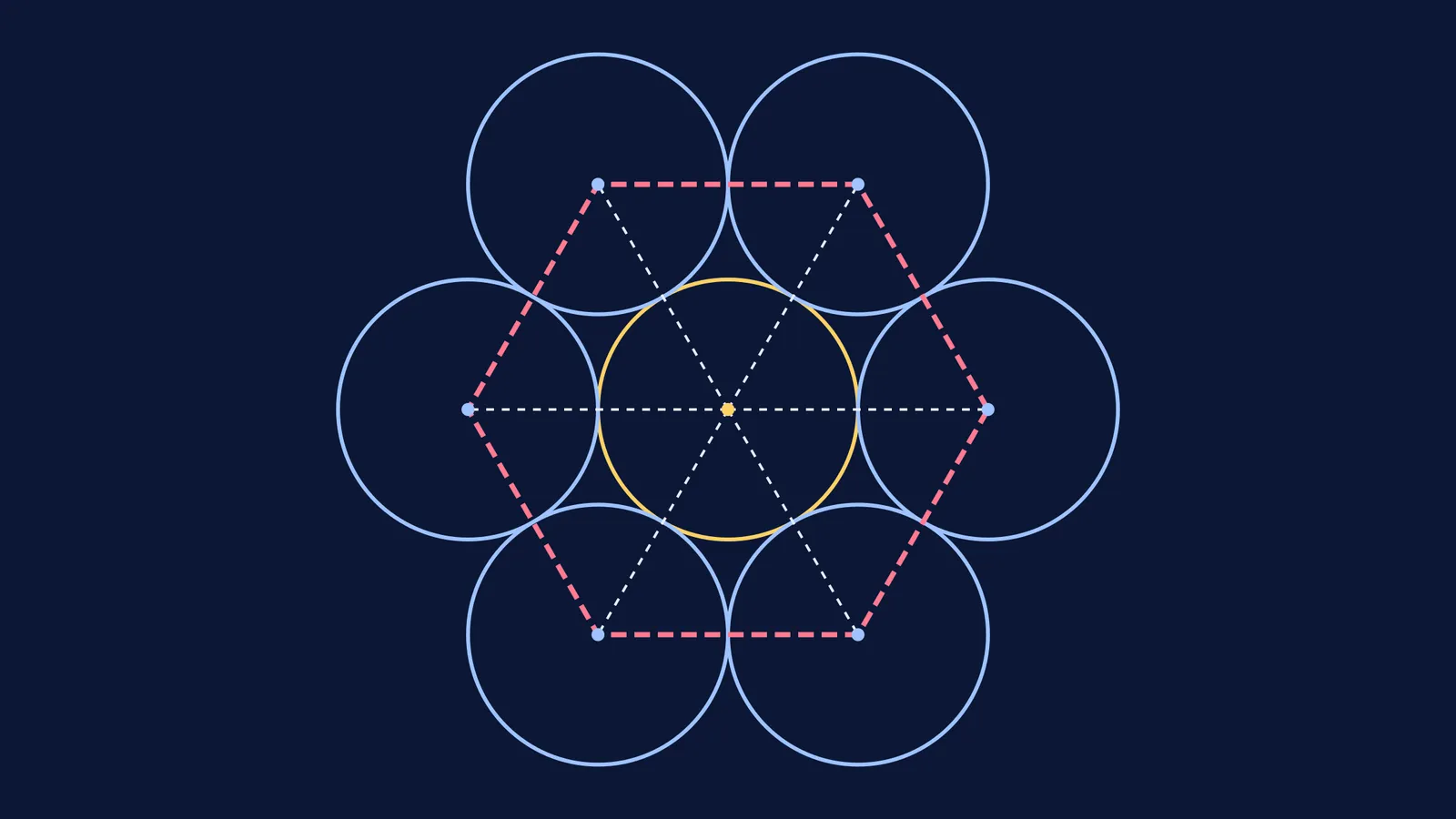
He observed that if you place a set of identical spheres on a flat surface and pack them as tightly as possible, one central sphere will naturally be surrounded by exactly six others. Connecting the centres of those six outer spheres draws a perfect hexagon. Kepler argued that this geometric fact was the hidden cause of the six-cornered snowflake.
This atomistic approach laid the foundation for modern crystallography, showing that the visible beauty of natural forms arises from invisible mathematical rules.
From snowflakes to stacking cannonballs
Thinking about how circles pack on a flat surface led Kepler to think about how spheres pack in three-dimensional space. A few years earlier, in 1606, Kepler had been corresponding with the English mathematician Thomas Harriot.
Harriot had worked for the explorer Sir Walter Raleigh, who had asked him a practical maritime question during a 1585 voyage to Roanoke Island: what is the most efficient way to stack cannonballs on the deck of a ship? Harriot worked out the mathematics of close-packing spheres and shared his ideas with Kepler in their letters (Wikipedia).
Expanding on this, Kepler stated in his 1611 essay what is now known as the Kepler conjecture: the densest possible way to arrange spheres is in a face-centred cubic or hexagonal close-packed lattice. This is exactly how greengrocers stack oranges and sailors stack cannonballs.
Kepler proposed that this arrangement achieves a maximum density of approximately 74.05% (or π / 3√2) (Wikipedia). If you were to drop spheres randomly into a box, they would only reach a density of about 65%.
How was the Kepler conjecture finally proved?
Proving the conjecture was uniquely difficult because mathematicians had to show that out of an infinite number of possible irregular arrangements, not a single one could beat the 74.05% density of the regular stack.
It took nearly 400 years for a solution. In 1998, the mathematician Thomas Hales announced a proof by exhaustion. His method required a computer to check over 5,000 different sphere configurations and solve about 100,000 linear programming problems (Wikipedia).
The proof was so massive—containing 3 gigabytes of computer data and programs—that a panel of 12 reviewers for the *Annals of Mathematics* reported they could only be "99% certain" it was correct. To eliminate all doubt, Hales launched the Flyspeck project. In 2014, his team finally confirmed the result using formal proof assistants, establishing the Kepler conjecture as an absolute mathematical truth.
When you are working through a tough proof and hit a dead end, Fermi's AI tutor can hold a line of reasoning and build a plan for the session.
Calculating the density of a simple cubic packing
If you want to understand why Kepler's stacking is so efficient, try calculating the density of a less efficient method: simple cubic packing. In this arrangement, spheres are stacked directly on top of one another, forming a grid of straight lines and sharp corners.
Imagine a cubic unit cell where the spheres touch along the edges.
Let the radius of each sphere be r.
The side length of the cube a is equal to two radii (a = 2r).
The volume of the cubic cell is a³ = (2r)³ = 8r³.
A simple cubic cell contains the equivalent of 1 full sphere (8 corners, each holding 1/8 of a sphere).
The volume of one sphere is 4/3 πr³.
The packing density is the sphere volume divided by the cube volume: (4/3 πr³) / 8r³ = π/6.
This simple cubic arrangement gives a density of about 52.36% (Wikipedia). By shifting the rows so the spheres sit tightly in the natural dips of the layer below, Kepler's cannonball arrangement leaps to 74.05%, leaving far less empty space.
If you are stuck on a geometry problem or trying to picture how atoms pack, the Fermi Simulation Lab has interactive simulations for the ideas that are easier to see than to read. You might also explore how patterns appear in other materials by reading about Dan Shechtman and quasicrystals: the symmetry that was banned or see another example of nature's shapes in D'Arcy Thompson and the mathematics of growth and form.


