

On this page
What did Julius Plücker discover in 1858?
In 1858, German mathematician and physicist Julius Plücker set out to examine how electric currents pass through gases under low pressure. Working at the University of Bonn with glassblower Heinrich Geissler, who invented a mercury vacuum pump in 1855, Plücker used sealed glass cylinders fitted with platinum electrodes. When he connected these Geissler tubes to a Ruhmkorff induction coil, the gas glow faded as the vacuum deepened. In its place, a greenish phosphorescence appeared on the glass walls near the cathode.
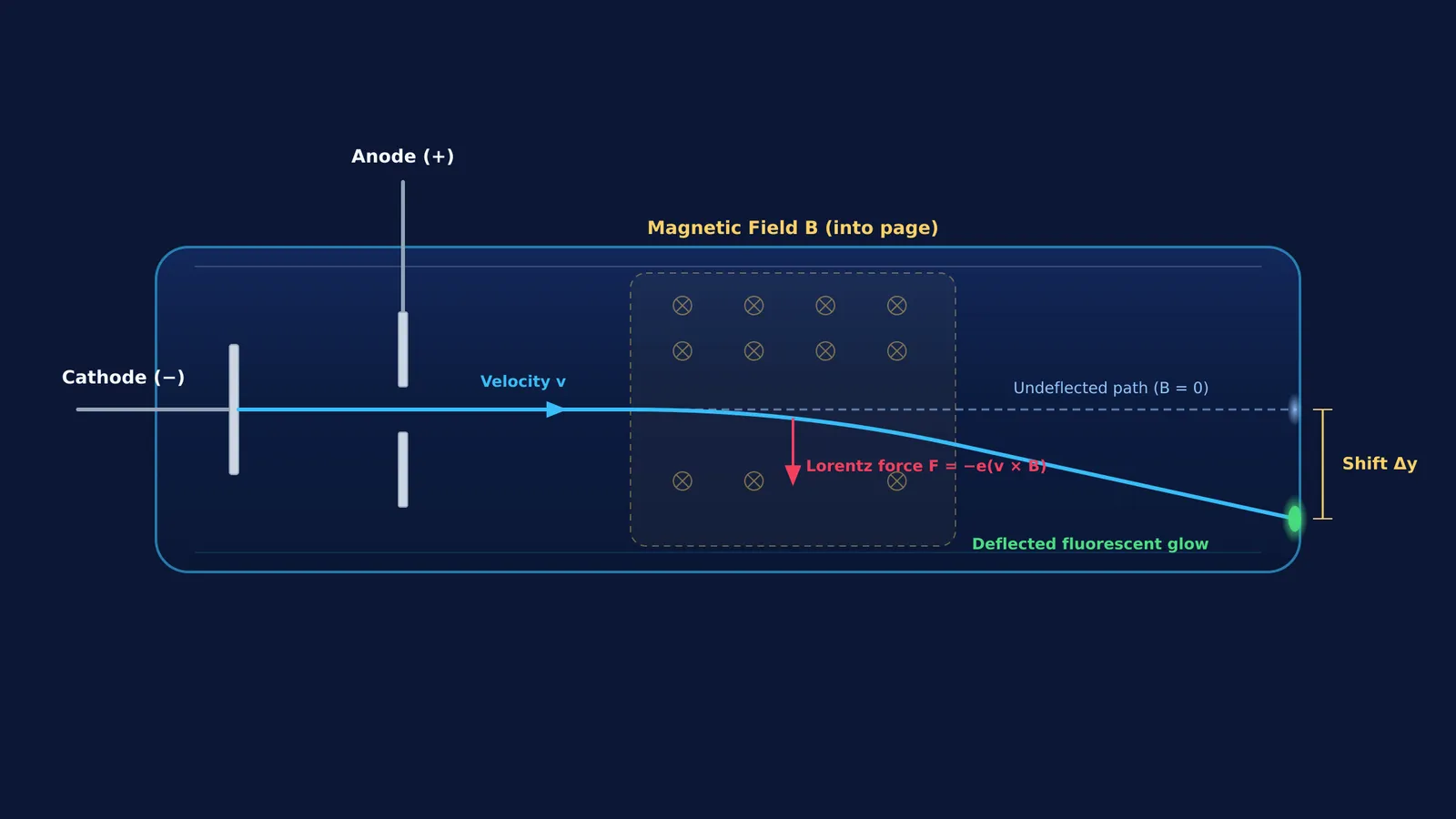
Plücker brought an electromagnet close to the tube and observed that the glowing patch on the glass shifted immediately. As he moved the magnetic poles, the fluorescent curve followed the magnetic lines of force that Michael Faraday had mapped with iron filings decades earlier. Plücker reported his observations in *Annalen der Physik und Chemie* and later in the *Philosophical Magazine*, noting that the discharge behaved like a flexible electric conductor carrying a current.
This single observation transformed nineteenth-century physics. If the discharge had consisted of immaterial optical light waves, an external magnetic field would have produced no deflection whatsoever. By demonstrating that the rays bent under magnetic influence, Plücker delivered the earliest experimental clue that whatever streamed from the cathode carried an electric charge.
Why does a magnetic field bend cathode rays?
The deflection Plücker witnessed is governed by the magnetic Lorentz force. When a particle carrying an electric charge q moves with velocity v through a magnetic field B, it experiences a deflecting force given by:
F = q(v × B)
Because this magnetic force acts at right angles to both the particle's velocity and the magnetic field lines (F ⊥ v), the field does zero mechanical work on the charge. The speed and kinetic energy of the particle remain constant, but its direction of motion continuously changes.
When electrons enter a uniform magnetic field at a right angle, this perpendicular force acts as a centripetal force:
e v B = m v² / r
Solving for the radius of the resulting circular trajectory gives:
r = (m v) / (e B) = p / (e B)
Here m represents the particle mass, p is its linear momentum, and e is its elementary charge. For negatively charged electrons, the direction of curvature is determined by the right-hand rule for magnetic forces, inverted because the electron carries a negative sign.
How to calculate magnetic deflection in an electron beam?
In standard JEE Main and CBSE Class 12 physics problems, calculating cathode ray deflection requires three steps: finding beam velocity from the accelerating potential, computing the radius of curvature in the magnetic field, and determining the transverse displacement across the screen.
Consider an electron with specific charge e/m ≈ 1.7588 × 10¹¹ C/kg (NIST CODATA) accelerated from rest through potential difference V = 2,500 V entering a perpendicular magnetic field B = 1.5 × 10⁻³ T across path length L = 0.060 m:
Calculate entry velocity: Equating kinetic energy to electric work gives (1/2) m v² = e V, yielding v = √(2 e V / m):
v = √(2 × 1.7588 × 10¹¹ × 2,500) ≈ 2.965 × 10⁷ m/s
Compute radius of curvature: Balancing the Lorentz force against centripetal acceleration gives:
r = v / [(e/m) B] = (2.965 × 10⁷) / (1.7588 × 10¹¹ × 1.5 × 10⁻³) ≈ 0.1124 m = 11.2 cm
Determine transverse deflection: For path length L << r, transverse deflection y is:
y ≈ L² / (2 r) = (0.060)² / (2 × 0.1124) ≈ 0.0160 m = 1.6 cm
For step-by-step problem sets, the Fermi Problem Library has worked problems with a step-by-step solver that explains the reasoning rather than printing an answer. When 3D field orientations are hard to picture, the Fermi Simulation Lab provides interactive simulations for ideas that are easier to see than to read.
How did Plücker's discovery lead to the electron?
Plücker's 1858 discovery opened a four-decade line of inquiry that uncovered the electron:
In 1869, Johann Wilhelm Hittorf placed solid obstacles in the tube and saw sharp shadows on the glass, proving in *Annalen der Physik* that cathode rays travel in straight lines without external fields.
In 1876, Eugen Goldstein introduced the term *Kathodenstrahlen* (cathode rays) for radiation leaving the negative electrode.
In 1879, William Crookes showed cathode rays turn paddle wheels and deflect in magnets, arguing they formed radiant matter. Read our guide to William Crookes's evacuated tube experiments for his full apparatus.
In 1897, J. J. Thomson balanced electric and magnetic deflections to measure the charge-to-mass ratio e/m in the *Philosophical Magazine*, identifying subatomic corpuscles. Explore J. J. Thomson's step-by-step discovery of the electron for the complete derivation.
When connecting electromagnetism to atomic structure, Fermi's AI tutor can work out what you already know and build a plan for the session, holding a line of reasoning across topics rather than answering isolated questions.


