

On this page
Every bulb question in your physics book, from "which glows brighter?" to "how much does it cost to run?", goes back to a hot thread glowing inside a glass bubble. In Britain the person who made that thread last was Joseph Swan, a chemist in Newcastle. This post covers who he was, why early bulbs failed, where his lamps were first used, a worked power example, common mistakes and what you can take from how he worked.
Who was Joseph Swan?
The Royal Society's record gives his birth as 31 October 1828 at Pallion Hall near Sunderland, and his death on 27 May 1914 at Warlingham, Surrey. It lists him as a chemist and inventor, elected a Fellow on 7 June 1894, at 66. Newcastle University's Northern Innovation exhibit adds that he also worked on photography and was knighted in 1904.
Why did early light bulbs fail?
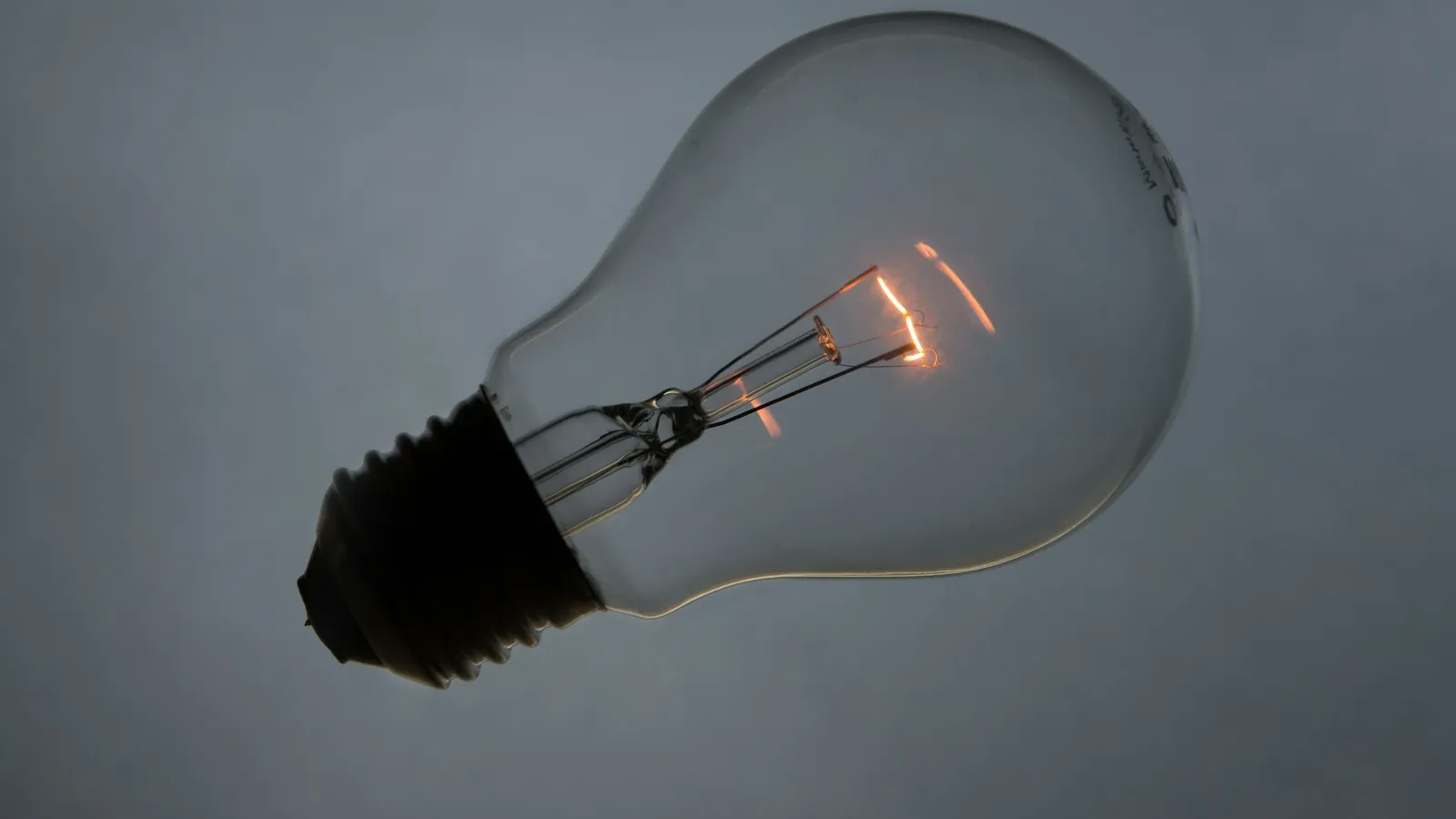
An incandescent lamp works by heating a thin conductor until it glows. The trouble is that a white-hot carbon thread in air simply burns, reacting with oxygen to form carbon dioxide. Even a little oxygen left in the bulb wears the filament away and blackens the glass.
Newcastle University's account says Swan made a lamp with a partly evacuated bulb in 1860, but it failed because the vacuum pumps of the day did not remove enough air. He came back to the problem in the mid-1870s, when better pumps were available. By about 1880 he had a bulb with an almost complete vacuum and a carbonised thread filament. With so little oxygen left, the filament could glow white hot without burning through or blackening the glass.
The Science Museum Group holds a carbon filament lamp made around 1879 by the Swan Electric Light Company in Benwell, Newcastle, which it describes as an early commercial bulb of the type Swan patented.
Where were Swan's lamps first used?
Newcastle University says that in 1880 Mosley Street in Newcastle became the first public road lit by electricity, and that Benwell was home to the first light bulb factory. The National Trust's history of Cragside, the house of the industrialist William Armstrong, says that in 1880 its library saw the first domestic installation of Swan's incandescent bulbs, mounted on adapted vases that still stand on the bookcases.
Swan was not alone. Thomas Edison was working on the same problem in the United States. According to Newcastle University, Edison held the patent in the US and Swan in the UK, and after another lamp maker lost a patent case to Swan, Edison chose to negotiate. The Edison and Swan United Electric Light Company, known as Ediswan, was set up in 1883. You can read about another of Edison's inventions in our post on the phonograph.
Worked example: what the filament does in a circuit
Sample numbers: a lamp is rated 100 V, 60 W.
Current at rated voltage. I = P/V = 60/100 = 0.60 A.
Hot resistance. R = V²/P = 100²/60 = 167 Ω (166.7 Ω).
Energy in an evening. Five hours at 60 W is 60 × 5 = 300 Wh, or 0.30 kWh. In joules that is 0.30 × 3.6 × 10⁶ = 1.08 × 10⁶ J.
Two lamps in series on 100 V. If the resistance stayed at 166.7 Ω, each lamp would get 50 V. Power in each = 50²/166.7 = 15 W. Half the voltage gives a quarter of the power, and both lamps together use 30 W.
Step 4 has a catch. A filament's resistance changes with temperature, so a lamp run at half voltage is cooler and its resistance is not the same as at full brightness. Exam questions usually say "assume resistance is constant" for this reason. Our post on the temperature coefficient of resistance explains the effect.
What mistakes do students make with bulb problems?
Assuming power stays at the rated value. Use the rating to find R, then recalculate.
Using the wrong formula for the circuit. In series, current is the same, so compare I²R. In parallel, voltage is the same, so compare V²/R.
Mixing kWh and joules. 1 kWh = 3.6 × 10⁶ J.
Forgetting why the bulb needs a vacuum. It is chemistry, not just physics: hot carbon reacts with oxygen.
The JEE (Main) 2026 syllabus lists "electrical energy and power" and "temperature dependence of resistance" in its current electricity unit. Check your own year's syllabus. For more practice, see our guide to bulb brightness and power ratings.
If series and parallel power problems keep tripping you up, the Fermi Problem Library has worked problems with a step-by-step solver that explains the reasoning rather than printing an answer.
What can a student take from Swan's way of working?
Come back when the tools improve. His 1860 lamp failed because of the pump, not the idea. Fifteen years later he tried again.
Find the failure mechanism. Once the enemy was clearly oxygen, the fix was clear too: remove it.
Settle rivalries with work, not only argument. Ediswan joined two inventors who had reached the same answer.
Next step: find the power of a 100 V, 40 W lamp and a 100 V, 60 W lamp in series on 100 V, assuming constant resistance, and say which glows brighter.


