On this page
Today you can record a voice note in a second. In 1877 no machine anywhere could record a voice and play it back. Thomas Edison's phonograph was the first that could. This post traces how he got there from telegraph equipment, what the first machine did, a worked example on the physics of its grooves, and what a student can learn from his way of working.
How did a telegraph inventor end up recording sound?
Edison (1847-1931) began his career in the telegraph industry and, according to Encyclopaedia Britannica, went on to hold 1,093 patents and set up an early industrial research laboratory at Menlo Park, New Jersey.
The US National Park Service's history of the phonograph explains the link. Telegraph offices already recorded incoming dots and dashes on paper tape so they could be replayed later, slower or faster. Edison had designed an Embossing Translating Telegraph for exactly this in 1876. When he started improving Alexander Graham Bell's telephone, he asked the obvious next question: could a voice be stored the same way?
By mid-July 1877 he wrote in his notes that he was sure he could "store up and reproduce automatically at any future time the human voice perfectly". His assistant Charles Batchelor later recalled the first test, quoted on the same NPS page: they spoke "Mary had a little lamb" while pulling waxed paper under a needle on a diaphragm. What came back was "not fine talking, but the shape of it was there".
What did the first phonograph look like?
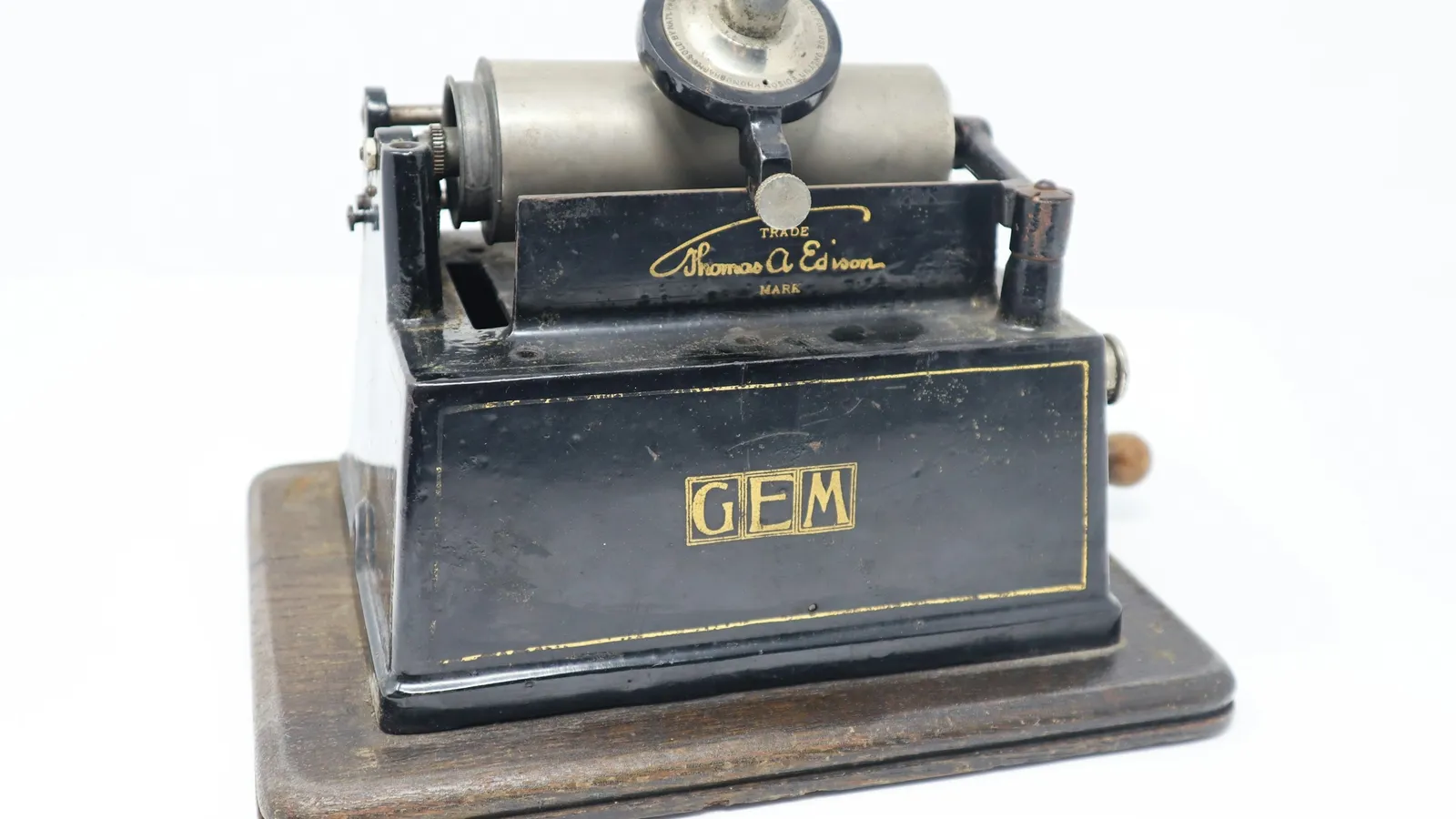
By August Edison was calling the invention a phonograph. Late in November 1877, sketches were drawn for a machine that recorded on tinfoil wrapped round a turning cylinder, built by the mechanic John Kruesi. On 7 December, the NPS says, Edison carried it into the office of Scientific American, turned the crank, and the machine asked the editors how they were.
His patent, US 200,521, was applied for on 24 December 1877 and granted on 19 February 1878. It describes a diaphragm with a hard point at its centre, a cylinder with "a helical indenting groove cut from end to end, say, ten grooves to the inch", and a recording material that is "preferably metallic foil". Speak into the mouthpiece and the point dents the foil in step with the sound. Run the point over the dents again and the diaphragm vibrates the same way, reproducing the voice.
The NPS adds an important detail about who came first. Edouard-Leon Scott de Martinville had already recorded sound, but as traces to be read by eye, and Charles Cros had suggested playing sound back. Edison's machine was the first to do both.
Worked example: how fine were the grooves?
The groove pitch comes from the patent. The cylinder size and turning speed below are sample numbers for practice, not measurements of Edison's machine.
Pitch: ten grooves per inch, and 1 inch = 25.4 mm, so each turn moves the needle 25.4 / 10 = 2.54 mm along the cylinder.
Surface speed (sample): a circumference of 30 cm turned once per second gives a surface speed v = 0.30 m/s.
Spacing of the dents: a 500 Hz note makes 500 dents per second, so the gap between dents is v/f = 0.30 / 500 = 0.0006 m = 0.6 mm. For a 2,000 Hz note it is 0.30 / 2,000 = 0.15 mm.
Recording time (sample): a 10 cm length of cylinder holds 100 / 2.54, about 39 turns, which is about 39 seconds at one turn per second.
Why does replay speed matter? The dents are fixed in the foil, so their spacing does not change. If you turn the cylinder twice as fast, the needle meets twice as many dents each second, and every frequency doubles. The voice comes out higher. Batchelor's test shows they knew this: he said he pulled the paper through "as nearly at the same speed" as before.
Common mistakes to avoid:
Mixing up two frequencies. The cylinder turns once per second; the sound is 500 Hz. They are different things.
Forgetting unit conversion. Ten grooves per inch is not ten per centimetre.
Using f = v/λ backwards. Higher frequency means smaller spacing, not larger.
Why does the phonograph still matter?
Every later recording medium, from records to digital files, stores a sound wave as a pattern and plays it back. Edison also noticed the Edison effect in his light bulbs in 1883, which later led to the Fleming valve and the start of electronics. And the telephone work that started it all is the subject of our post on Alexander Graham Bell.
What can a student take from how Edison worked?
Reuse an idea in a new setting. Recording telegraph signals on tape led straight to recording voices.
Test a rough version fast. The first trial used paper and a needle within an hour of the idea, and it was good enough to show the principle worked.
Write things down. The July 1877 note is how we know what he was thinking.
Work as a team. Britannica notes he collaborated closely with machinists and designers; Kruesi built the machine and Batchelor ran the first test.
If the relation between frequency, speed and wavelength still trips you up, the Fermi Concept Library covers every concept in physics, so you can go back to the idea underneath a problem.
Next step: rework the example for a cylinder turning twice per second and find the new spacing for a 500 Hz note (it should be 1.2 mm).