

On this page
In 1954, years before the first satellite was launched, a Bell Labs engineer named John Robinson Pierce proposed using satellites as relay stations for radio signals, according to his obituary in Physics Today. Eight years later, a Bell Labs satellite built on his ideas sent live television across the Atlantic.
Who was John Pierce?
Pierce was born on 27 March 1910 in Des Moines, Iowa, earned a PhD from Caltech in 1936 and joined Bell Labs the same year, according to Physics Today. From 1945 to 1955 he perfected the travelling-wave tube, a microwave amplifier invented by his colleague Rudolf Kompfner.
He also coined the word "transistor" for his Bell Labs colleagues, wrote science fiction as J. J. Coupling, and was described by Arthur C. Clarke as one of the two fathers of the communications satellite, as his Wikipedia biography records.
What was the Echo balloon satellite?
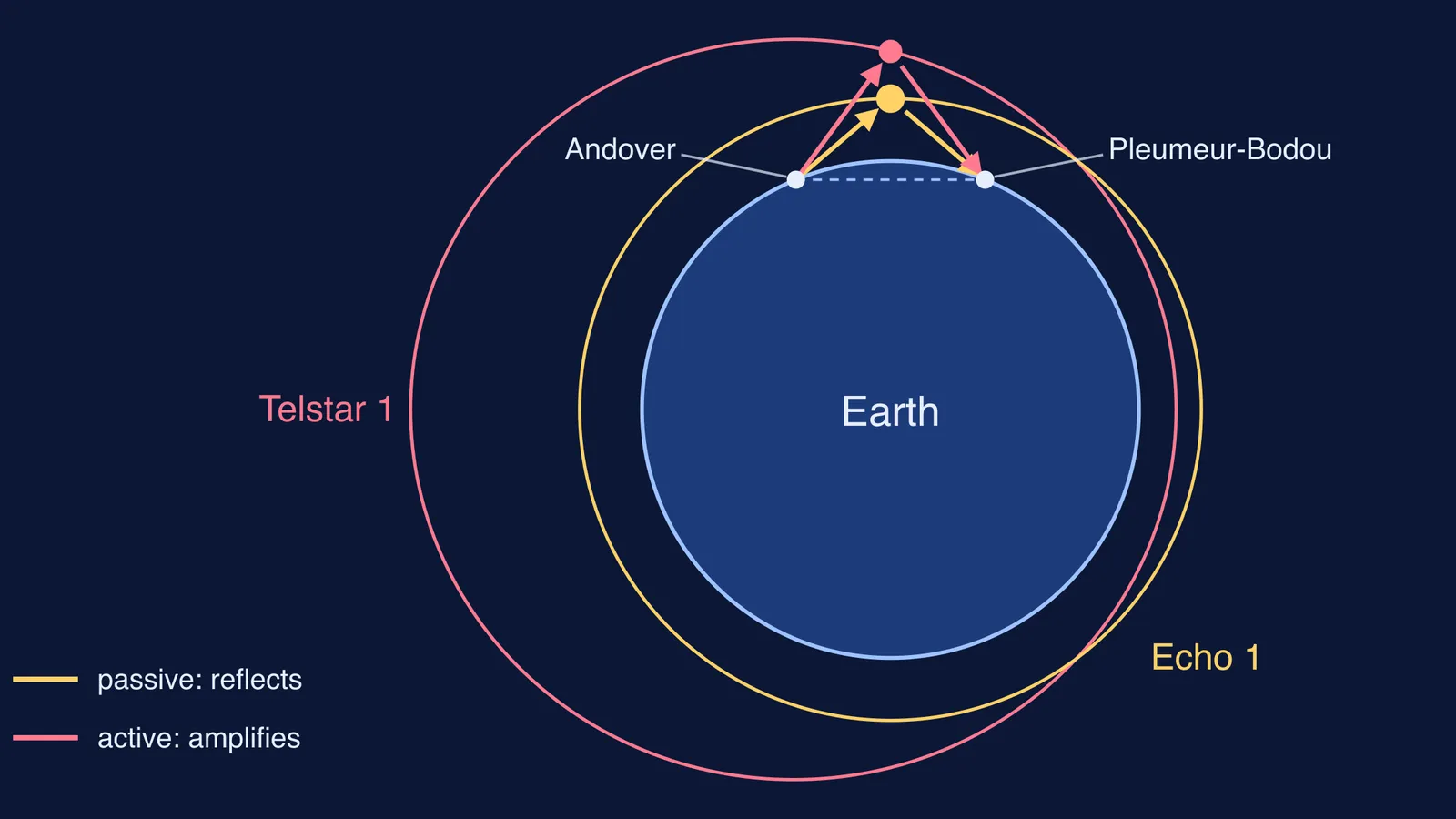
In April 1955 Pierce published "Orbital Radio Relays" in the journal Jet Propulsion, which discussed both passive and active satellite repeaters and outlined the idea that became Echo 1, says the Satellite Today timeline. In October 1958, Pierce and Kompfner made the case for reflecting balloons at a national symposium on space communication (Project Echo).
Echo 1 launched on 12 August 1960 from Cape Canaveral (Project Echo). It was a balloon 30 metres across, with a skin of Mylar just 12.7 micrometres thick, orbiting between about 1,519 and 1,687 km up. The first signals bounced off it the same day, from Goldstone in California to a Bell Labs horn antenna at Crawford Hill in Holmdel, New Jersey. On 15 August it carried a two-way telephone conversation.
How did Telstar relay live TV across the Atlantic?
Telstar 1 lifted off from Cape Canaveral at 2:35 a.m. on 10 July 1962, NASA records. Bell Labs designed and built it and AT&T paid for it, making it the first privately financed satellite. It was a 34.5-inch sphere weighing 171 pounds, covered in solar panels. Within hours it relayed live pictures of a US flag outside the Andover station in Maine to Pleumeur-Bodou in France.
The first public transatlantic broadcast followed on 23 July 1962 (Telstar 1); viewers in North America and Europe saw part of a baseball game and remarks from President John F. Kennedy, IEEE Spectrum reports. Physics Today notes that Telstar depended on Pierce's insights and his management.
Telstar listened at 6.39 GHz and transmitted at 4.17 GHz (Telstar 1). Its orbit was a stretched ellipse, 952 km up at its lowest and 5,933 km at its highest, taking 2 hours 37 minutes per lap. Because it moved across the sky, it was available for only about 18 minutes at a time (NASA). In November 1962, radiation from the Starfish Prime high-altitude nuclear test began to disrupt its command channel, and its transmitter failed on 21 February 1963. A satellite that stays fixed over one spot needs a much higher orbit, the idea in our post on how Arthur C. Clarke calculated the geostationary orbit.
Why couldn't the signal go straight across the ocean?
Microwaves travel in straight lines, and the Earth curves away underneath them. You can work out how much with class 11 geometry.
Earth's mean radius is 6,371 km (NASA Earth fact sheet).
Andover sits at 44.63° N, 70.70° W (Andover Earth Station) and Pleumeur-Bodou at 48.79° N, 3.52° W (Pleumeur-Bodou Ground Station).
The spherical law of cosines gives the angle between them at Earth's centre: cos θ = sin φ1 sin φ2 + cos φ1 cos φ2 cos Δλ, so θ is about 44.7°, or roughly 4,970 km along the surface.
A relay halfway between them must see both, so it must sit at a height h where cos(θ/2) = R / (R + h). With θ/2 = 22.4°, h = 6,371 × (1/cos 22.4° − 1), which is about 520 km.
No tower can be 520 km tall. A satellite can: Echo, at about 1,600 km (Project Echo), could see out to about 37° from the point beneath it, enough to cover both stations at once.
If you want the force side of the story, read how satellites stay in orbit without falling. Orbits and horizons are easier to see than to read, which is why we built the Fermi Simulation Lab of interactive simulations. For the gravitation behind it, each idea has its own lesson in the Fermi Concept Library.
What can a student take from Pierce?
Pierce worked out the idea before the hardware existed, then argued for the simplest version first: a balloon before an amplifier in orbit. When you meet a hard problem, try the same order: sketch the geometry, find the number that matters, and start with the plainest version that could work.


