

On this page
In late 1937, at a roadhouse near the Mississippi River, physicist John Atanasoff jotted four ideas for a computing machine: electronics instead of mechanical parts, binary numbers, a separate memory of capacitors refreshed to hold a 0 or a 1, and direct 0-1 logic. That account comes from John Gustafson's paper; he was on the Iowa State team that rebuilt the machine Atanasoff and graduate student Clifford Berry completed by 1942.
What problem was the Atanasoff-Berry Computer built to solve?
Atanasoff needed to solve systems of simultaneous linear equations. In his manuscript describing the machine, he wrote that "an expert [human] computer takes about eight hours to solve a full set of eight equations in eight unknowns", and that twenty equations "should thus require 125 hours", as quoted in Gustafson's reconstruction paper.
Iowa State University's Atanasoff archive holds his 24 March 1939 request for grant money, and records that the machine was completed in 1942 in the basement of Physics Hall, weighed more than 700 pounds, and contained 280 vacuum tubes and 31 thyratrons, with 1,600 capacitors in each of its two memory drums.
How did the ABC use binary numbers and capacitor memory?
The ABC kept its numbers on two rotating drums; each drum stored 30 numbers, and 30 add-subtract circuits worked on them side by side, according to the Computer History Museum.
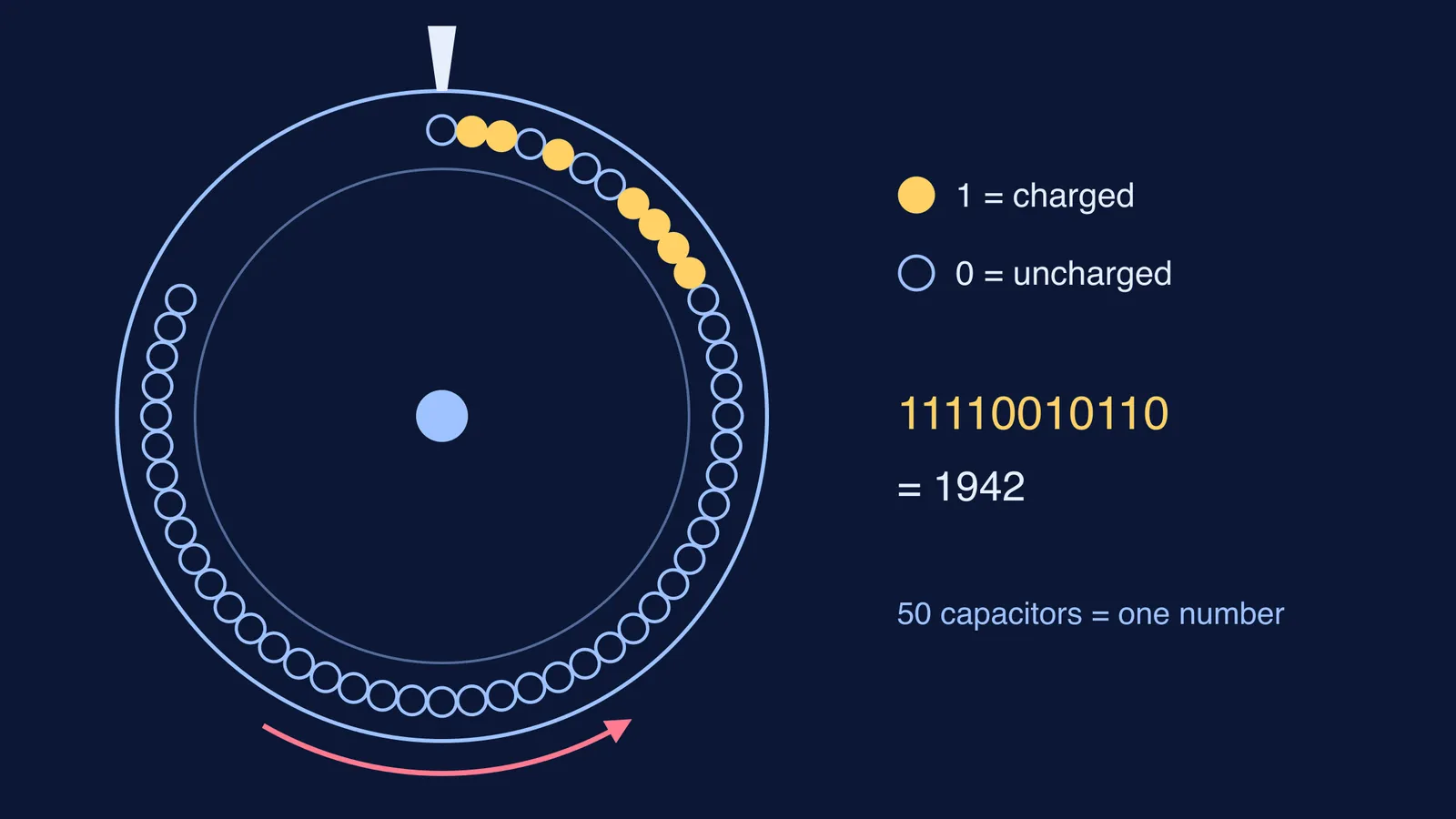
Every number was a 50-bit binary number, and each bit was held by one small capacitor (Gustafson). Capacitors leak charge, so the machine kept restoring them, a process Atanasoff called "jogging", as Iowa State's ABC site explains. Gustafson sums it up: the memory "used refreshed capacitors like DRAM yet spun mechanically like a disk".
The arithmetic was done one bit at a time, with the carry held in a capacitor until the next step. The 60 Hz mains supply was the clock, so one 50-bit number was added or subtracted in 5/6 of a second, with 1/6 of a second idle: 50 bits at 60 steps per second (Gustafson).
How did the ABC add two binary numbers?
Write 13 as 01101 (8 + 4 + 1) and 6 as 00110 (4 + 2). Work one bit at a time, starting with the rightmost bit, and carry from one step to the next:
Bit 1: 1 + 0 = 1, carry 0
Bit 2: 0 + 1 = 1, carry 0
Bit 3: 1 + 1 = 10, write 0, carry 1
Bit 4: 1 + 0 + carry 1 = 10, write 0, carry 1
Bit 5: 0 + 0 + carry 1 = 1, carry 0
The answer is 10011, which is 16 + 2 + 1 = 19. The ABC did this for 50 bits, one step per tick of the mains, on 30 pairs at once (Computer History Museum).
Why didn't the ABC change computing straight away?
It "could solve a variety of problems but was not programmable", says the Computer History Museum. Intermediate results were burned into paper cards with high-voltage arcs, and Gustafson cites an estimate of roughly one error in every 10,000 to 100,000 bits, probably not good enough for its largest problem, 29 equations in 29 unknowns. Arthur Burks estimated that problem would take about 25 hours, including operator time; by Atanasoff's cube rule, a human would need about (29/8)³ × 8 ≈ 380 hours.
Then the war intervened. Atanasoff left for Maryland, and the machine was cut apart because it was 0.07 m too wide to go through the door, Gustafson writes; one drum is all that remains at Iowa State, according to its Atanasoff archive. The rebuilt replica was demonstrated on 8 October 1997.
Was the Atanasoff-Berry Computer the first electronic computer?
A court weighed in. John Mauchly, later a builder of ENIAC, examined the ABC in June 1941. On 19 October 1973, the US District Court for the District of Minnesota declared the ENIAC patent invalid, finding it was derived from Atanasoff's invention, as EDN reports. Read how ENIAC was built in Mauchly, Eckert and the ENIAC computer.
Gustafson argues that "the ABC was fully electronic in its calculation and in its storage of data". Still, the fair answer depends on what you mean by "computer". Ask three questions whenever a quiz asks which machine came first:
Did it compute with electronics, or with gears and relays? The ABC was electronic.
Could it be programmed for different tasks? The ABC could not.
Did it work in binary with a separate memory? The ABC did both.
Konrad Zuse's relay machines had full floating-point arithmetic and a real instruction set, Gustafson notes; see Konrad Zuse and the Z3 relay computer.
The refreshed-capacitor idea returned in silicon decades later; see Robert Dennard and the one-transistor memory cell. If capacitors or binary feel hazy, the Fermi Concept Library has a lesson on every concept in physics, mathematics and computing, and the Fermi Simulation Lab has interactive simulations for ideas that are easier to see than to read. Then try this: convert your birth year to binary, as the drum in the diagram at the top does for 1942.


