On this page
The story of our universe—how it expanded, cooled, and clustered into galaxies—was once a subject of philosophical guesswork. Today, it is a precise mathematical science. Much of this transformation is thanks to James (Jim) Peebles, who won half of the 2019 Nobel Prize in Physics for his theoretical discoveries in physical cosmology.
By calculating how matter and radiation interacted in the moments after the Big Bang, Peebles showed that the universe we can see makes up just a tiny fraction of what actually exists.
What is physical cosmology?
Physical cosmology is the study of the universe's origin, evolution, and large-scale structure using the laws of physics. Before the mid-1960s, cosmology was largely speculative, with many competing theories about how the cosmos operated but very little concrete data to prove them.
Over two decades, Jim Peebles built the theoretical framework that turned cosmology into a rigorous, quantitative branch of physics. According to the Nobel Prize press release, his calculations laid the foundation for our modern understanding of the universe's history. He demonstrated that the geometry and evolution of the universe could be measured and predicted with mathematical precision, moving the field from philosophical debates into the realm of testable, observable science. This shift is a perfect example of learning physics from first principles rather than just memorizing isolated facts.
How did Jim Peebles use the cosmic microwave background?
In 1964, scientists discovered an "ancient radiation" known as the cosmic microwave background (CMB) filling the universe. While other researchers observed this signal, Peebles provided the crucial theoretical tools to interpret it correctly.
He recognized that this radiation was the leftover heat from the Big Bang, an afterglow of the universe's unimaginably hot and dense infancy. Peebles realised that the radiation's temperature could reveal how much matter was created in the early universe. Furthermore, he understood that the release of this light played a decisive role in how matter could later clump together to form galaxies and galaxy clusters.
What did we learn about dark matter and dark energy?
Perhaps the most astonishing outcome of Peebles' framework is what it revealed about the overall composition of our universe. When his theoretical models were combined with modern observational data, the results were staggering.
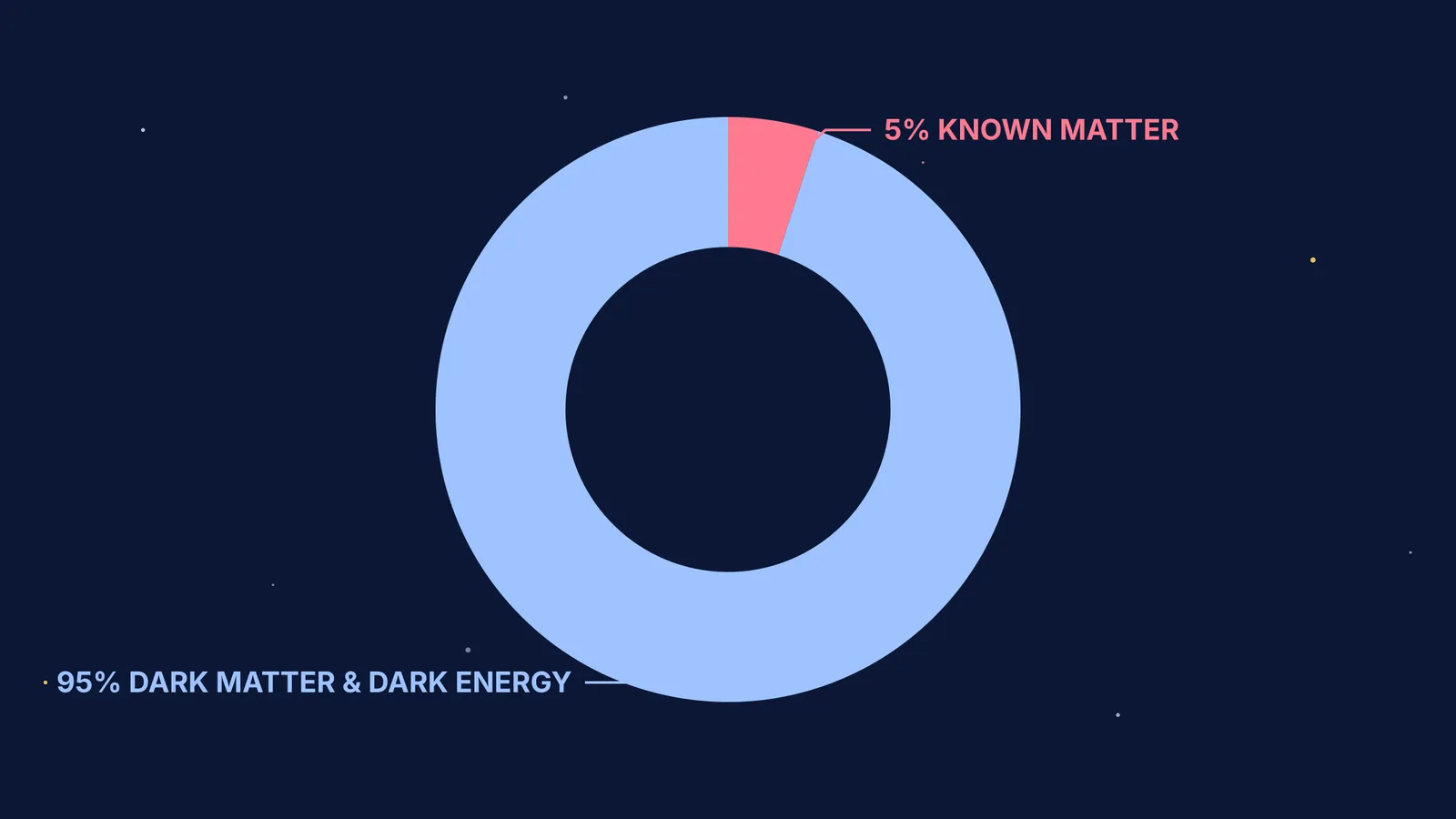
According to the Nobel Prize press release, his results showed that only 5% of the universe's content is known matter—the material that makes up stars, planets, trees, and us. The remaining 95% consists of completely unknown dark matter and dark energy. Dark matter is invisible but exerts a powerful gravitational pull that holds rapidly spinning galaxies together, while dark energy acts as a mysterious repulsive force driving the accelerated expansion of the entire universe.
Understanding these forces conceptually can be a challenge for students. If you want to visualize unseen gravitational interactions, the Fermi Simulation Lab has interactive simulations for the ideas that are easier to see than to read.
How to study physical cosmology effectively?
Theoretical cosmology involves profound, abstract ideas that can be highly intimidating at first glance. If you are a student tackling physical cosmology, astrophysics, or general relativity, relying on rote memorization will not work. Instead, try this three-step study framework to build a robust understanding:
Start with the intuition: Before diving into the complex mathematics of the expanding universe, you must get a solid conceptual grasp of what the equations describe. Seek out the intuition before the formula. Understand *why* the universe must be expanding—and what evidence supports that—before attempting to calculate the rate of expansion.
Ask "what if" questions: The best way to test your understanding of a theoretical framework is to gently push its boundaries and see what happens. Asking what if questions to understand physics deeply—such as "What if dark energy did not exist?" or "What if the cosmic microwave background was hotter?"—will rapidly expose any gaps in your underlying knowledge.
Trace the history of the discovery: Read about the actual experiments and theoretical leaps, exactly like Jim Peebles' interpretation of the CMB. Seeing how mathematical models were systematically built to solve real physical mysteries gives you context that a textbook formula alone cannot provide.
By approaching the universe's mysteries the way Jim Peebles did—with a foundation of solid physical principles and a willingness to follow the math wherever it leads—you can transform abstract cosmological concepts into rigorous, understandable science.