On this page
Shine light through a polarising filter and its vibrations are confined to a single plane. Pass that light through a tube of sugar water, and the plane comes out turned through an angle. That twist is called optical rotation, and a substance that causes it is called optically active. If polarisation itself is new to you, start with our piece on how Étienne-Louis Malus discovered polarisation.
Who discovered optical activity, and when?
According to the history of optical rotation, François Arago first observed the rotation in quartz crystals in 1811, and Jean-Baptiste Biot then observed it in liquids and in vapours of organic substances such as turpentine.
Biot (1774–1862) was a Paris physicist and mathematician who also worked on astronomy, magnetism and heat. He received the Royal Society's Rumford Medal in 1840 for his work on polarised light passing through chemical solutions, according to this Florida State University biography of Biot.
A detailed early account comes from Louis Pasteur. In his 1860 lecture to the Société Chimique of Paris, he called it "Biot's most remarkable discovery" in this area: "the deviation of the plane of polarisation produced by a number of natural organic products, such as oil of turpentine, solutions of sugar, of camphor, and of tartaric acid." Pasteur added: "The first mention of this fact occurs in the bulletin of the Société Philomatique for December 1815."
Why did a liquid twisting light matter so much?
Quartz only rotates light as a crystal. Pasteur noted that quartz which is dissolved, or solid but not crystallised, "lacks the property". Sugar behaves differently: it rotates light in solution, and tilting the tube does not change the rotation for the same thickness of liquid (Pasteur, 1860).
From this, Pasteur wrote, "Biot quite definitely concluded that the action produced by the organic bodies was a molecular one, peculiar to the ultimate particles and depending on their individual constitution." The twist is built into each molecule, not into how molecules are stacked. That idea set up Pasteur's own work, told in our story of how Pasteur separated tartrate crystals and found molecular handedness.
How does a polarimeter work?
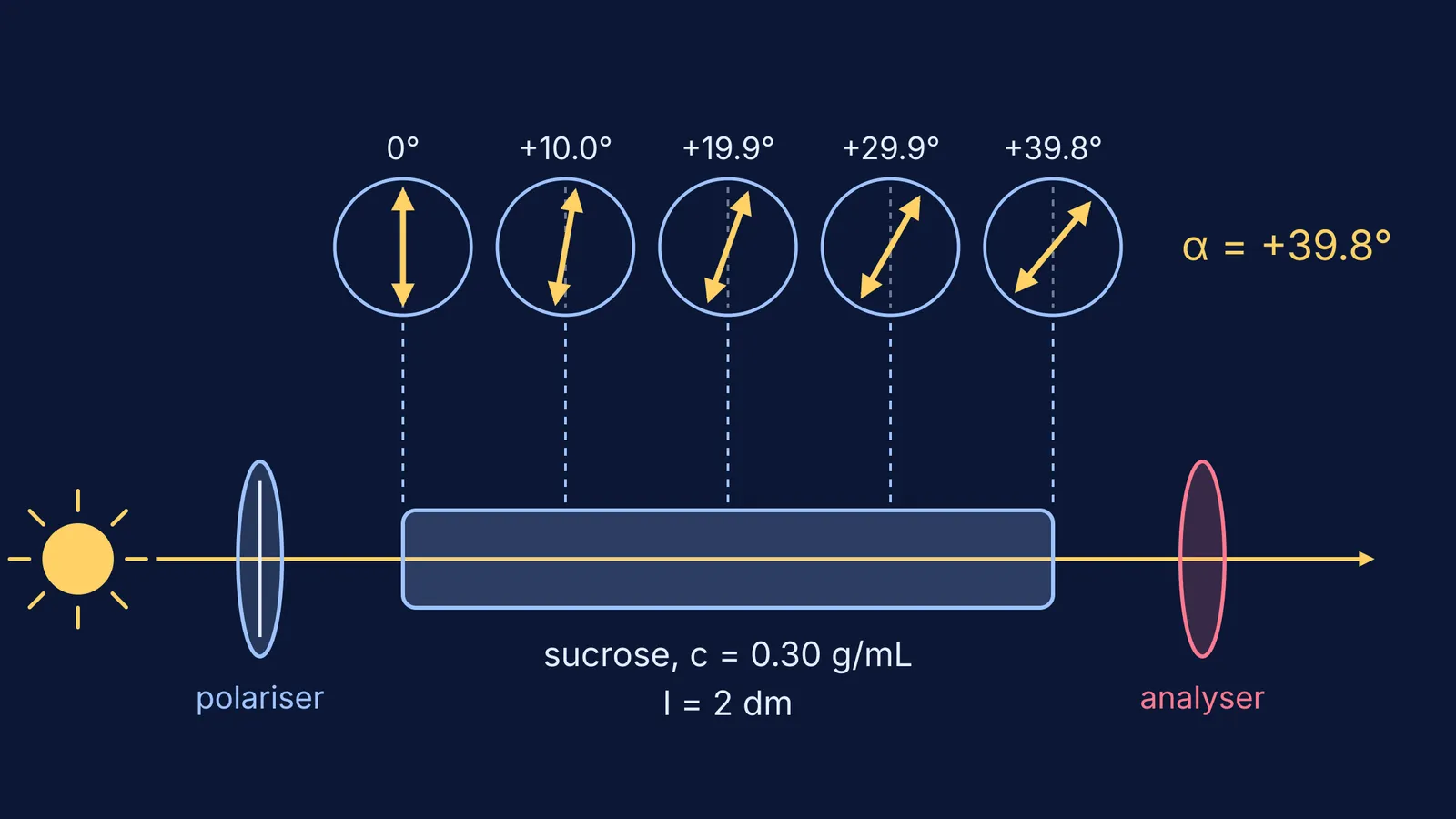
A polarimeter is Biot's experiment made precise. In order:
A lamp gives light of one colour, usually the yellow sodium D line at 589 nm (specific rotation).
A polariser lets through only light vibrating in one plane.
The light crosses a tube of the sample, of length l.
A second filter, the analyser, is turned to find the new plane; the angle it turns through is the observed rotation α.
Looking towards the light source, clockwise rotation is called dextrorotatory and written (+); anticlockwise rotation is levorotatory, written (−). Sucrose and camphor are dextrorotatory (optical rotation).
For a given substance and wavelength, the rotation is proportional to the path length and, for a solution, to the concentration (optical rotation). That is why the polarimeter became important to anyone trading sugar syrups in bulk.
Specific rotation is [α] = α / (l × c), with l in decimetres and c in grams per millilitre (specific rotation). For sucrose at 20 °C with the sodium D line, the specific rotation is +66.37° (same source).
Worked example: how much sugar is in the tube?
We will use sucrose, with [α] = +66.37° from the specific rotation table.
Forward. You dissolve 30 g of sucrose and make it up to 100 mL, so c = 0.30 g/mL. A 20 cm tube means l = 2 dm. Then α = 66.37 × 2 × 0.30 = +39.8°. The diagram at the top shows the plane turning steadily, about 10° per half-decimetre.
Backward. The same 2 dm tube reads +8.0° for an unknown sucrose solution. Then c = 8.0 / (66.37 × 2) = 0.060 g/mL, or about 6.0 g of sugar per 100 mL.
Check. In a 1 dm tube the same solution should read +4.0°, half as much, because rotation is proportional to length.
Checklist before you answer:
Convert the tube length to dm (10 cm = 1 dm).
Convert concentration to g/mL (grams per 100 mL, divided by 100).
Keep the sign: + for clockwise, − for anticlockwise.
Note the wavelength and temperature, since specific rotation is quoted for both.
For mixtures of mirror-image forms, see our guide to finding enantiomeric excess from specific rotation.
Where can you practise this?
A turning plane of vibration is hard to picture from a flat figure. The Fermi Simulation Lab has interactive simulations for ideas that are easier to see than to read. If your numbers keep coming out wrong, the Fermi Problem Library has worked problems with a step-by-step solver that explains the reasoning rather than printing an answer.
Every polarimeter reading is, at heart, Biot's 1815 tube of sugar water with a scale attached.