

On this page
Jan Baptist van Helmont, a chemist, physiologist and physician from Brussels who lived from 1580 to 1644, asked a question you could test on a balcony: when a plant grows, where does the new material come from? The obvious suspect was the soil, so he weighed it (Wikipedia). His account was published after his death, in the collected works *Ortus medicinae* (1648), edited by his son Franciscus Mercurius van Helmont.
It still teaches two lessons: how to rule out an idea with a balance, and how a careful experiment can reach the wrong conclusion.
What did van Helmont do with the willow tree?
An English translation of his account, credited to a 1965 article in the journal Isis, is reproduced on a College of Saint Benedict and Saint John's University biology page. In it, van Helmont describes the set-up:
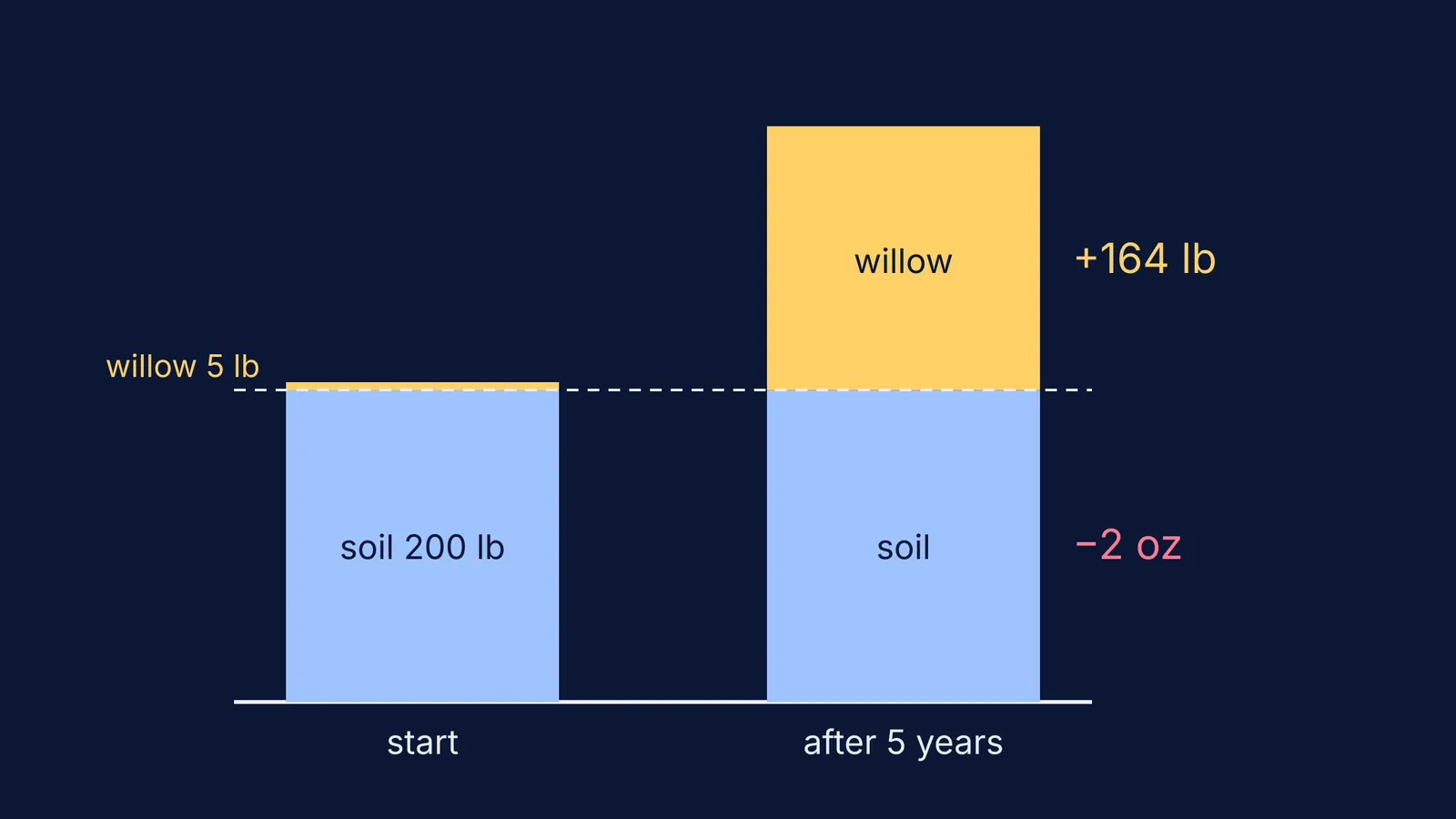
He dried 200 pounds of earth in an oven and put it in a large earthen pot.
He moistened it with rain water and planted a willow shoot weighing five pounds.
For five years he watered it with rain water or distilled water only.
A tin-plated iron lid with holes covered the pot "to keep air-borne dust from mixing with the earth".
At the end, the tree weighed 169 pounds and about three ounces. He dried the earth again and found "the same 200 pounds, less about 2 ounces".
His conclusion, in the same translation: "Thus, 164 pounds of wood, bark, and roots had arisen from water alone." He also admits one gap: he did not weigh the leaves that fell in each of the four autumns, so the tree really made even more material than he measured.
What did the willow tree experiment actually show?
It showed that soil was not the main source of a plant's mass, using a simple mass budget.
Here is the arithmetic, using the numbers in his account (translation):
Mass gained by the tree: 169 lb 3 oz minus 5 lb = 164 lb 3 oz, which is 2,627 ounces (one pound is 16 ounces).
Mass lost by the soil: about 2 ounces.
Share of the gain the soil could explain, at most: 2 ÷ 2,627, about 0.08%.
In metric units, the tree gained about 74 kg while the soil lost about 57 grams (Wikipedia). Soil supplied less than a thousandth of the new wood.
Why was van Helmont's conclusion wrong?
He counted only soil and water. His lid kept dust out, but air reached the leaves freely, and he never weighed what it contributed.
Photosynthesis is the missing step. In it, six carbon dioxide molecules and six water molecules make one sugar molecule and six oxygen molecules, using light energy (OpenStax Biology 2e). Carbon dioxide enters through stomata, small regulated openings in the leaf.
Nearly half of dried wood is carbon. A review of 253 species-specific records found that stem wood of flowering trees averages 47.7% carbon by dry mass (Thomas and Martin, 2012, Forests). Willows are flowering trees, and that carbon came from carbon dioxide in the air, not from the soil or the water. Water does matter: it supplies hydrogen, and a living tree holds a lot of it. His account mentions drying the earth but not the tree, so part of his 164 pounds was probably water held in the living wood.
The twist is that van Helmont introduced the word "gas", and he recognised that the "gas sylvestre" from burning charcoal was the same gas given off by fermenting must. We call it carbon dioxide (Wikipedia; McGill Office for Science and Society). He had named the very gas his tree was taking up.
The next steps came from others. You can follow them in our posts on Joseph Priestley and the air that made a candle blaze and Jan Ingenhousz and the role of light in photosynthesis.
How can you use van Helmont's method in your own answers?
When a question hands you an experiment and asks what it proves, use this four-line mass budget:
List every input that could cross the boundary: soil, water, air, light, dust.
Mark which ones were measured. Van Helmont measured soil, not water or air.
Compare the change in each measured input with the change in the output.
State only what the numbers rule out (soil) and name the inputs left open (water, air).
Applied to his figures, a strong answer reads: "The soil lost about 2 ounces while the tree gained about 164 pounds, so soil was not the main source. Air was not measured, so the experiment cannot show that water alone was the source."
If the light and carbon steps still feel shaky, the Fermi Concept Library has a lesson for every concept in biology, each with its place in the map. Our guide to light reactions, the Calvin cycle and C4 plants picks up where van Helmont's pot leaves off.


