

On this page
If you check today's weather forecast, two numbers lead the report: maximum and minimum temperature. In India, bulletins from the India Meteorological Department track these diurnal extremes to monitor heatwaves and seasonal shifts. For centuries, capturing them required an observer to watch a thermometer for 24 hours to catch the exact moment the mercury peaked or bottomed out.
That limitation ended in 1782 when English scientist James Six published his design for a self-registering thermometer in the Philosophical Transactions of the Royal Society. By combining two liquids in a U-shaped tube, Six created an instrument that recorded temperature extremes during an observer's absence. Today, Six's thermometer remains a staple in greenhouses, schools, and weather stations worldwide.
Why was measuring daily temperature extremes so difficult before 1782?
By the late 1700s, Daniel Gabriel Fahrenheit had established reproducible mercury scales, as noted in Daniel Fahrenheit and the thermometers that finally agreed. Yet as taught in Temperature and its measurement in Class 6, standard thermometers show only instantaneous equilibrium: as temperature shifts, the liquid column moves, erasing earlier readings.
In his 1782 paper in the Philosophical Transactions, Six lamented that finding daily extremes required an observer's eye on the glass the instant the mercury peaked. Because peak afternoon heat and pre-dawn chill vary daily, an unobserved extreme was lost. Earlier recording devices used clumsy floats and cords that jammed. Six sought a sealed glass tube without external linkages.
How does James Six's thermometer work?
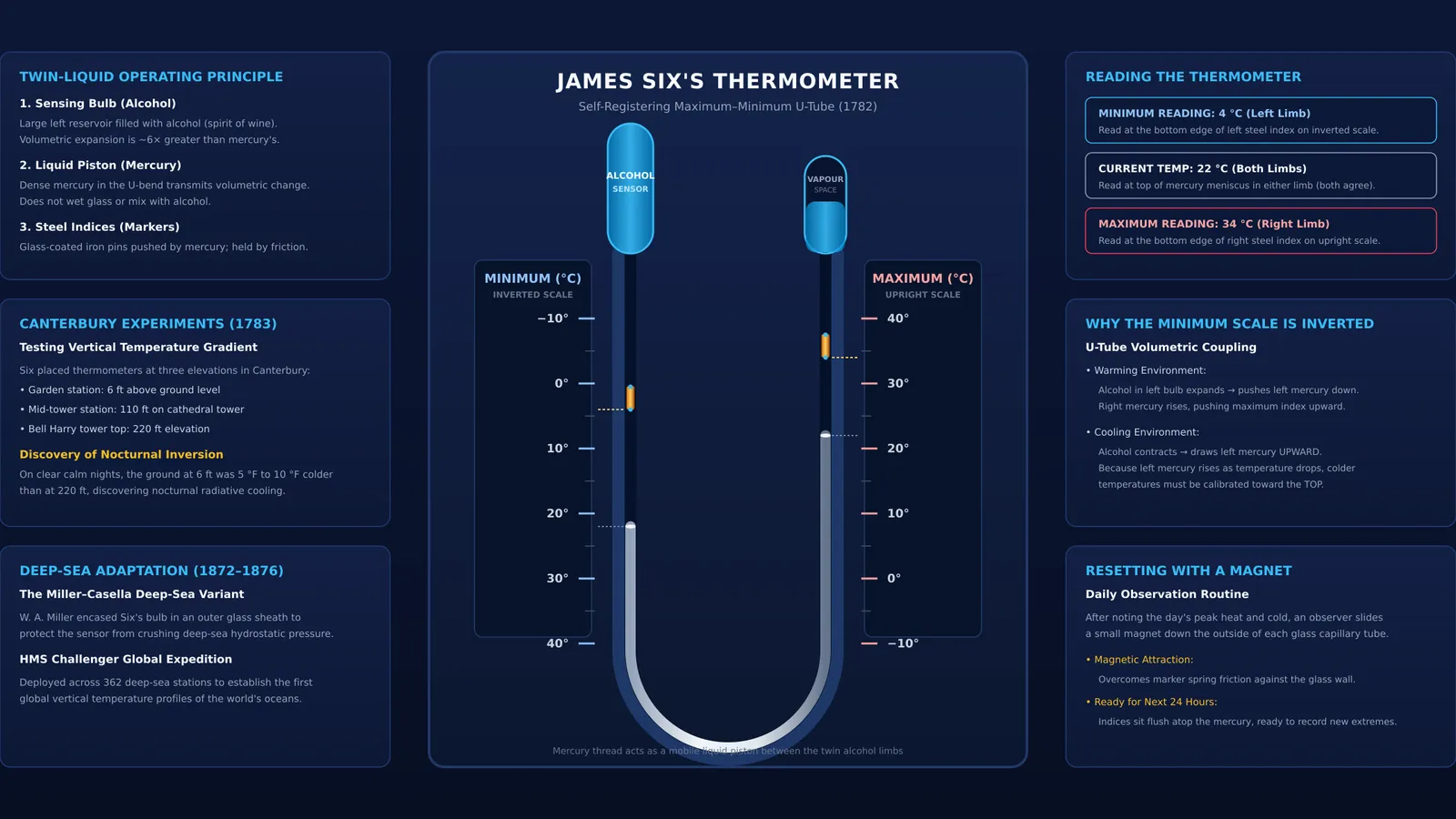
Six paired two immiscible liquids—alcohol and mercury—in a design detailed in the Philosophical Transactions. The thermometer consists of a U-shaped capillary tube flanked by two bulbs:
Sensing bulb: The large left bulb is filled with alcohol, the primary sensor whose volumetric expansion coefficient is roughly six times greater than mercury's.
Mercury piston: A mercury thread fills the U-bend. Because mercury does not wet glass or mix with alcohol, it acts as a piston pushing both indicators.
Expansion bulb: The right bulb contains alcohol and a vapour space for fluid displacement.
Steel indices: Inside the tube above each mercury column sits a glass-coated steel marker with a tiny friction spring. Rising mercury pushes the marker up; when mercury retreats, friction holds the marker at the peak.
For thermal phenomena that are easier to see than to read, the Fermi Simulation Lab offers interactive simulations that show fluid expansion and meniscus movement dynamically.
Why is the minimum temperature scale inverted?
The most counter-intuitive feature of Six's thermometer is the inverted left-hand scale: lower temperatures sit higher up the tube. This follows from U-tube geometry, connecting to Thermal expansion problems:
Warming: Alcohol in the left bulb expands, driving left mercury down and right mercury up. The right maximum scale is upright, increasing upward.
Cooling: Alcohol contracts, drawing left mercury up. Because the column rises as the environment cools, the left scale must place smaller numbers toward the top.
If you are reviewing thermal properties, the Fermi Concept Library organizes every concept in physics, chemistry, biology, mathematics and computing, each with its own lesson and its place in the map.
What did James Six discover at Canterbury Cathedral?
Six immediately put his invention to work. In September 1783, he placed thermometers at three elevations in Canterbury, published in the Philosophical Transactions of the Royal Society: atop Canterbury Cathedral's Bell Harry tower at 220 feet, at the tower base at 110 feet, and in his garden at 6 feet.
Scientists assumed air always cooled with height. Instead, Six found that on clear, calm nights, his garden thermometer at 6 feet was consistently 5 °F to 10 °F colder than the one 220 feet up. He had discovered nocturnal radiative cooling and temperature inversions, proving ground radiates heat into clear skies.
Decades later, oceanographers adapted Six's design for extreme environments. On the HMS *Challenger* expedition (1872–1876), scientists deployed the pressure-shielded Miller-Casella variant across 362 deep-sea stations to map abyssal temperatures. Today, guidelines from the World Meteorological Organization continue to standardize diurnal temperature extreme measurements across global observing networks.
How do you read and reset a maximum-minimum thermometer?
Reading and resetting Six's thermometer follows four straightforward steps:
Read maximum: Check the right limb. Read the value at the bottom edge of the steel marker on the upright scale.
Read minimum: Check the left limb. Read the value at the bottom edge of the steel marker on the inverted scale.
Note current temperature: Check either mercury meniscus; both indicate current temperature.
Reset markers: Slide a small magnet down each limb to draw the steel markers flush against the mercury.
When solving numerical exercises involving expansion coefficients and hydrostatic balances, the Fermi Problem Library provides a step-by-step solver that explains the reasoning rather than printing an answer.


