

On this page
In 1817, London physician and geologist James Parkinson published a 66-page booklet that changed medical history (Project Gutenberg). Titled *An Essay on the Shaking Palsy*, the text provided the first clear clinical description of a condition Parkinson termed *paralysis agitans*. Today, it is recognized globally as Parkinson's disease.
Parkinson was a man of many talents. Beyond his medical practice, he was a radical political activist and a renowned paleontologist who had several fossils named after him. Yet, his most enduring legacy came from his keen eye for medical observation. The essay is famous not just for its accuracy, but for its method. Parkinson did not rely on complex laboratory tests or autopsies; he observed everyday people going about their lives.
What did James Parkinson describe in his 1817 essay?
Parkinson's essay defined the core features of the condition with remarkable precision. He described the disease as an "involuntary tremulous motion, with lessened muscular power, in parts not in action and even when supported," according to the text preserved by Project Gutenberg.
He also documented the characteristic stooped posture and what is now known as a festinating gait. He wrote that patients had a "propensity to bend the trunk forwards, and to pass from a walking to a running pace." This shuffling walk, where a patient feels irresistibly impelled to take quicker and shorter steps to avoid falling, remains a hallmark diagnostic sign today.
Crucially, he noted that "the senses and intellects being uninjured." While modern medicine now recognizes that cognitive changes and dementia can occur in later stages of the disease, Parkinson's early distinction helped separate the motor disorder from other conditions that immediately impaired the mind.
How did Parkinson observe the six cases?
The essay is built on just six case studies, and Parkinson only formally examined a few of them. The others were people he simply observed walking in the streets of London, tracking their movements to understand the disease's progression.
Case I was a gardener, "rather more than fifty years of age," whose tremor was noted alongside his remarkable temperance and sobriety. Case II involved a 62-year-old man who had suffered from the disease for eight to ten years. Parkinson carefully noted the man's history, observing how the tremors steadily eroded his ability to function. Case III was a 65-year-old former sailor whose posture was so severely bent that he had to walk in a "continued run," using his stick to push himself upright every five or six steps.
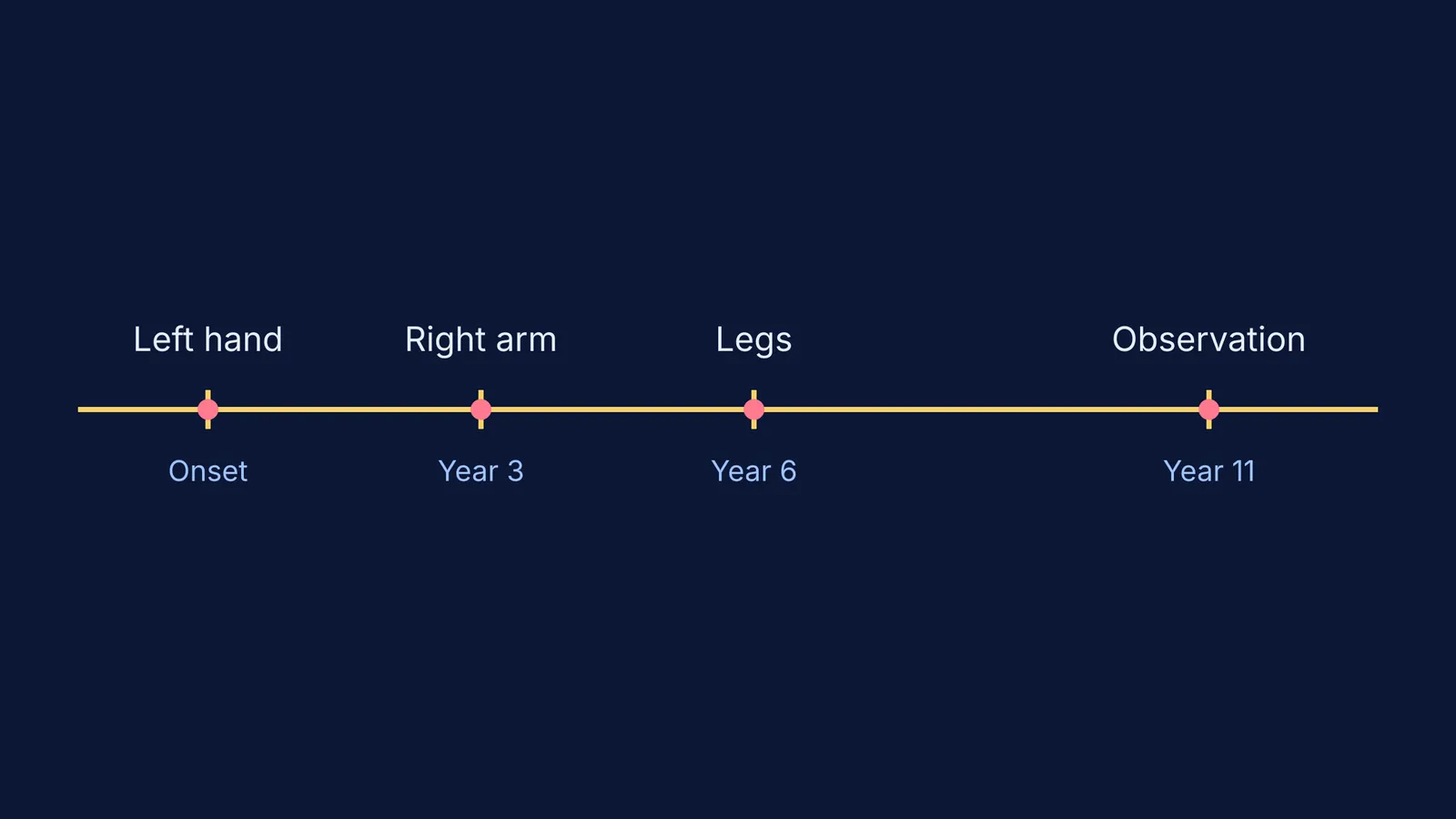
Case VI detailed the slow, relentless progression of the disease. The 72-year-old patient told Parkinson his symptoms began 11 or 12 years prior with weakness in his left hand. The tremor spread to his right arm three years later, and finally to his legs after another three years. Parkinson also recorded that in advanced stages, the trembling continued during sleep, becoming so violent it sometimes shook the very floor and window sashes of the room.
How to study neurological disorders?
Today, observing and classifying symptoms remains the foundation of medical diagnosis. When learning about the nervous system, mastering the signs of neurological disorders requires understanding the underlying anatomy, much like how we study Alois Alzheimer and the plaques in a patient's brain. The Fermi Concept Library contains detailed lessons on the nervous system—such as Parts of the human brain: forebrain, midbrain and hindbrain roles—helping you map classic motor symptoms to the specific neural pathways that fail.
If you are preparing for exams and need to understand the nervous system:
Start with anatomy: Map the physical structures of the brain. For example, Parkinson's disease specifically affects the midbrain.
Connect structure to function: Understand how different regions of the brain control motor movements and reflexes. This is a key part of Control and coordination in Class 10: reflexes, brain and hormones.
Trace the pathway: When studying any neurological disease, trace the primary symptom (like a resting tremor) back to the specific neurotransmitter involved (like dopamine) and the specialized cells that produce it.
By breaking down the body's systems step by step, you can turn a seemingly random list of symptoms into a clear, logical map of how the human nervous system works.


