On this page
In the 1830s, Britain could build huge steam engines but could not forge the thick iron shafts they needed. James Nasmyth's answer began as one sketch: a hammer that could shape white-hot iron like clay, yet tap an eggshell.
Who was James Nasmyth?
James Nasmyth was born in Edinburgh on 19 August 1808 and died on 7 May 1890, according to his Wikipedia biography. In 1829 he joined Henry Maudslay's workshop, home of the lathe that made accurate screws, at 10 shillings a week. In 1836 he and Holbrook Gaskell opened the Bridgewater Foundry at Patricroft, near Manchester, to build machine tools.
Much of what follows comes from his 1883 book, James Nasmyth, Engineer: An Autobiography. It is his side of the story, so we flag where others disagree.
Why did James Nasmyth invent the steam hammer?
The trigger was a ship. Francis Humphries, engineer of the Great Western Steamship Company's new Great Britain, needed a wrought-iron paddle shaft 30 inches across. In a letter Nasmyth received on 24 November 1839, Humphries wrote that "there is not a forge hammer in England or Scotland powerful enough" to make it (autobiography).
Nasmyth saw the real problem. Old forge hammers were enlarged hand hammers. Put a thick forging on the anvil and the hammer had almost no room to fall, so it was "gagged" just when the job needed the hardest blow. His fix: lift a heavy block straight up, high above the work, and let it drop. He said he drew the whole design in his Scheme Book in little more than half an hour.
The twist: the Great Britain switched to a screw propeller, and the shaft was never forged.
How did the steam hammer work?
Nasmyth's first sketch had three parts: a massive anvil, an iron hammer block, and an upside-down steam cylinder with the block fixed to the end of the piston rod (autobiography).
Steam enters below the piston and lifts the block.
The operator opens a slide valve to let the steam out.
The block falls under gravity onto the hot iron.
By controlling how fast steam entered and escaped, the operator chose the force of each blow or stopped the block mid-air; Nasmyth wrote that the workman could "think in blows". In 1843 he also admitted steam above the piston to aid gravity.
How much energy was in one blow?
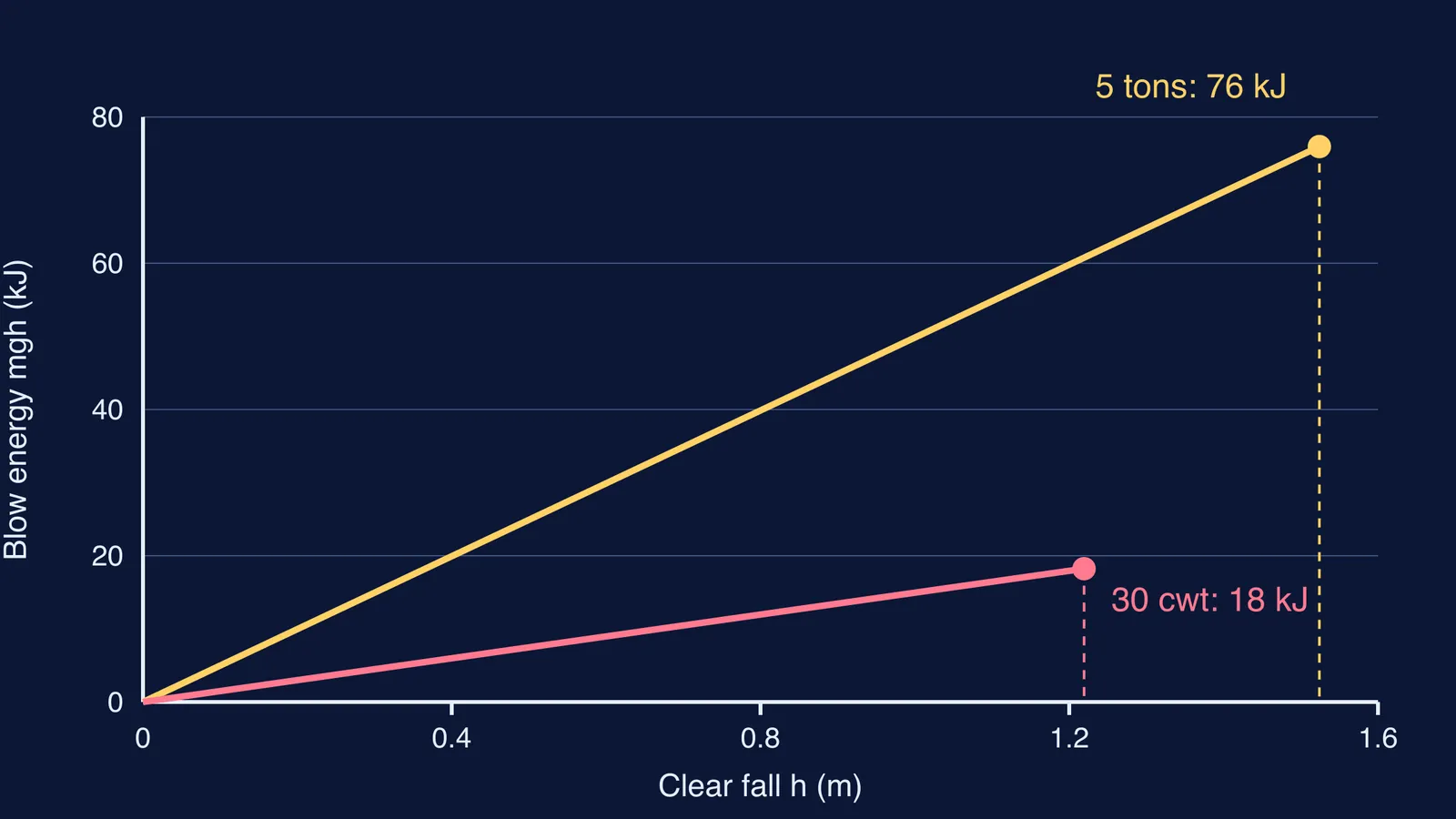
Nasmyth's first demonstration hammer at Patricroft had a 30-hundredweight block and a clear fall of 4 feet; by his account his first order, for Rushton and Eckersley of Bolton, had a 5-ton block and a 5-foot fall (autobiography). UK law defines a hundredweight as 112 pounds, a ton as 2,240 pounds and a pound as 0.45359237 kg (Weights and Measures Act 1985, Schedule 1). Ignoring friction and air, the energy of a falling block is E = mgh.
30 cwt = 3,360 lb = 1,524 kg. Fall: 4 ft = 1.22 m. E = 1,524 × 9.81 × 1.22 ≈ 18 kJ. Impact speed v = √(2gh) ≈ 4.9 m/s.
5 tons = 11,200 lb = 5,080 kg. Fall: 5 ft = 1.52 m. E = 5,080 × 9.81 × 1.52 ≈ 76 kJ. Impact speed ≈ 5.5 m/s.
Energy grows in proportion to height, so a gagged hammer with a few centimetres of room delivers almost nothing. The speeds are modest; the energy comes from mass. And the gentle tap works because steam slows or stops the block, so it never falls freely. The same idea, force spread over a stopping time, is behind impulse and force-time graphs for catches and airbags.
If ideas like this are easier to see than to read, the Fermi Simulation Lab has interactive simulations built for them.
Did Nasmyth really invent it first?
Not simply. Nasmyth says François Bourdon of the Schneider ironworks copied the Scheme Book sketch at Patricroft, and that at Le Creusot in April 1842 he found it working. The steam hammer article on Wikipedia says Bourdon had drawn his own design in 1839 and built the world's first working steam hammer there in 1840, and that the two men argued over priority from 1843. It also says Nasmyth's first hammer under his 1842 patent went to the Low Moor Works, and that Robert Wilson, manager of Nasmyth's works, invented the self-acting motion that let the blow's force be adjusted.
The idea spread. Nasmyth notes that anchors could now be welded as a whole instead of bit by bit (autobiography), and Krupp's Fritz of 1861 delivered a 50-ton blow (Wikipedia).
What can a student take from Nasmyth?
Name the real constraint: not "hammers are too weak" but "hammers have no room to fall".
Check the numbers: run E = mgh on any machine you read about.
For an earlier steam story, read how Thomas Newcomen's 1712 atmospheric engine worked. When an energy numerical goes wrong at the method stage, the Fermi Problem Library has a step-by-step solver that explains the reasoning rather than printing an answer.