

On this page
Most of us learn DNA as a code: A pairs with T, G pairs with C. Jacqueline Barton, a chemist at Caltech, asked a different question. Can the middle of the double helix carry an electron from one end to the other, like a wire? Her answer was yes.
What did Jacqueline Barton discover about DNA?
Barton is a native New Yorker. She graduated from Barnard College in 1974, earned her PhD in inorganic chemistry at Columbia University in 1978, and joined Caltech's faculty in 1989, according to her Caltech biography. Her tools were metal complexes that slide between DNA's base pairs.
Picture DNA as a twisted ladder. The rungs are base pairs, flat rings stacked on top of each other like a pile of coins. Their electron clouds (the π orbitals) overlap up and down the stack. Her 1996 paper in Nature notes that people had wondered for almost forty years whether this stack could carry charge over long distances.
In 1993, Barton's group attached a ruthenium complex to one end of a 15-base-pair DNA duplex and a rhodium complex to the other. When light hit the ruthenium, an electron moved to the rhodium over a distance of more than 40 ångströms, as the team reported in Science. The transfer was fast: the paper puts a lower limit of 10^9 per second on the rate.
How can DNA carry electrical charge?
The charge travels through the overlapping stack of bases, not along the sugar-phosphate backbone. In the 1996 study, a rhodium complex at one end of a DNA strand caused oxidative damage at guanine bases up to 37 ångströms away, according to the Nature paper. The same paper found that the amount of damage depended on π-stacking and oxidation potential, but not on distance.
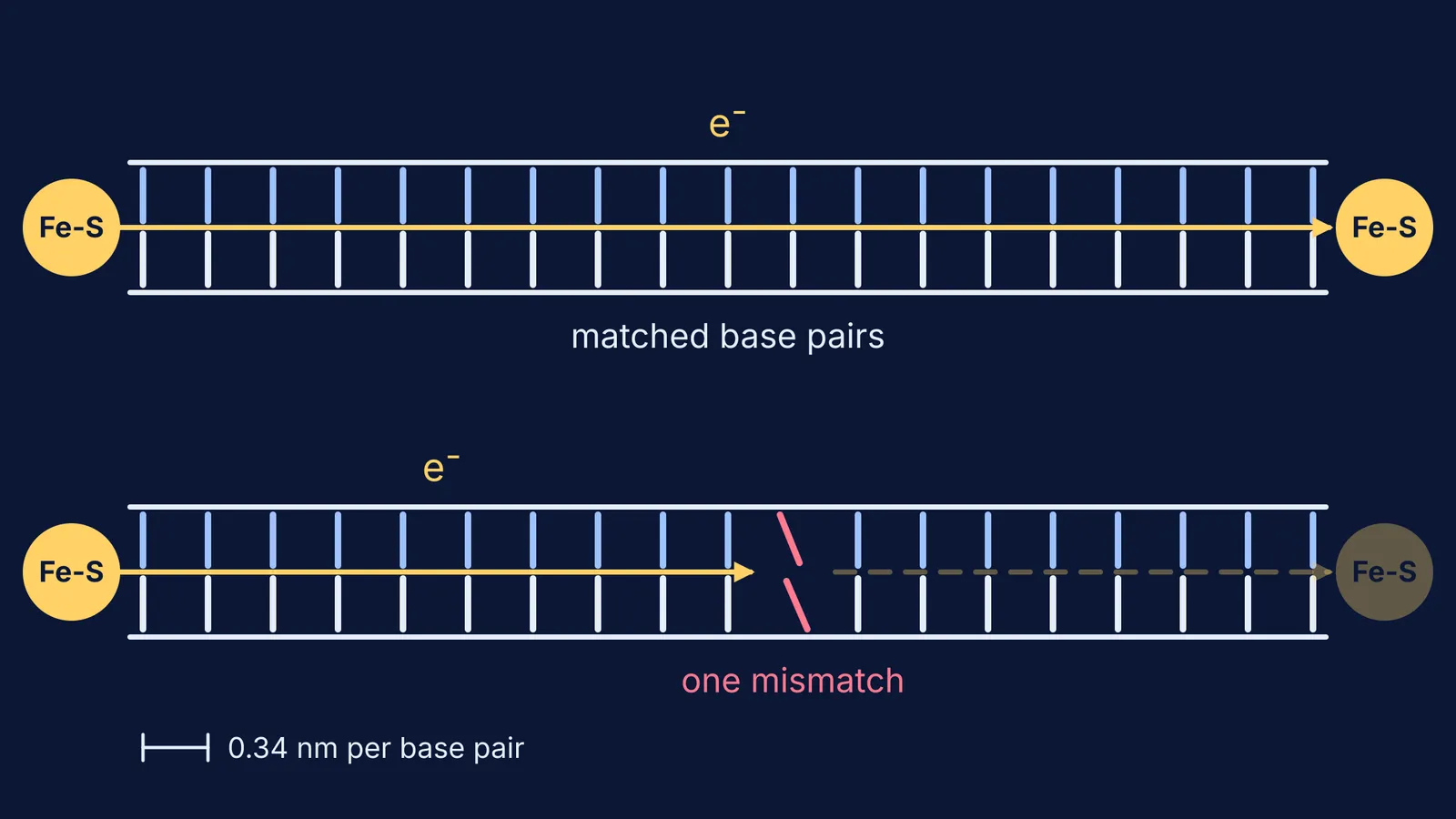
In 2011, her group sent charge through DNA 100 base pairs long, a distance of 34 nanometres, reported in Nature Chemistry. Adding a single mismatched base pair cut the signal roughly in half, wherever the mismatch sat, according to the full paper. One wrong rung weakens the wire.
How might cells use DNA charge to spot damage?
Your cells fix damaged DNA all the time; our post on how radiation damages DNA explains where much of that damage comes from. The puzzle is speed: a repair protein must find one bad base in a very long molecule.
Barton's team proposed an answer in a 2009 paper in PNAS. Two bacterial repair enzymes, EndoIII and MutY, each carry an iron-sulfur cluster that can give up or take in an electron. The idea is that these proteins send electrons to each other through the DNA. If the stretch between them is healthy, the charge gets through. If a damaged or mismatched base sits in between, the flow of charge is disrupted, and the proteins gather near the problem.
The team estimated that charge transfer over a few hundred base pairs would be enough to check the whole genome quickly. Using atomic force microscopy, they saw repair proteins shift onto DNA strands containing a single mismatch. In E. coli, the two enzymes helped each other as the model predicted, and a mutant protein that is poor at DNA charge transport broke that teamwork. The authors were careful: their results show how repair proteins "might" find damage. For a different repair system, read our post on Aziz Sancar and how cells repair damaged DNA.
The US National Science Foundation awarded Barton the 2010 National Medal of Science "for discovery of a new property of the DNA helix, long-range electron transfer," according to the official citation.
How far is 40 ångströms inside DNA?
Turn the numbers into something you can picture with this worked example.
Find the step size. The 2011 paper used 100 base pairs for 34 nanometres, so one base pair adds 0.34 nm.
Convert units. 1 ångström is 0.1 nm, so 40 Å is 4 nm.
Divide. 4 nm ÷ 0.34 nm is about 12 base pairs, which fits inside the 15-base-pair duplex of 1993.
Try the others. 37 Å is about 11 base pairs. A few hundred base pairs, say 300, is about 102 nm.
When you revise this for school chemistry or biology exams, try this checklist:
Draw the ladder and label two forces: hydrogen bonds across each rung, π-stacking between rungs.
Say in one sentence why a mismatch weakens the charge flow: it disturbs the stack.
Explain what an oxidised guanine is and why it counts as damage.
If π orbitals or oxidation are the shaky part, the Fermi Concept Library has a lesson for each concept in chemistry and biology, with its place in the map. And if you are not sure where to begin, Fermi's AI tutor works out what you already know and builds a plan for the session.
To see how the double helix itself was worked out, read how Watson and Crick built the DNA model.


