

On this page
Ionising radiation carries enough energy to strip electrons from atoms, disrupting the chemical bonds that hold biological molecules together (Source). When radiation passes through a living cell, its most critical target is the genetic code. If DNA is damaged beyond repair, the cell faces three paths: it may mutate, it may become cancerous, or it may trigger apoptosis (programmed cell death).
While low doses of radiation are part of natural background exposure, acute doses exceeding 1,000 mSv (1 Sievert) cause widespread cell death and Acute Radiation Syndrome. Even at lower acute doses exceeding 100 mSv, there is a statistically significant increase in long-term cancer risk (Source).
How does radiation damage DNA?
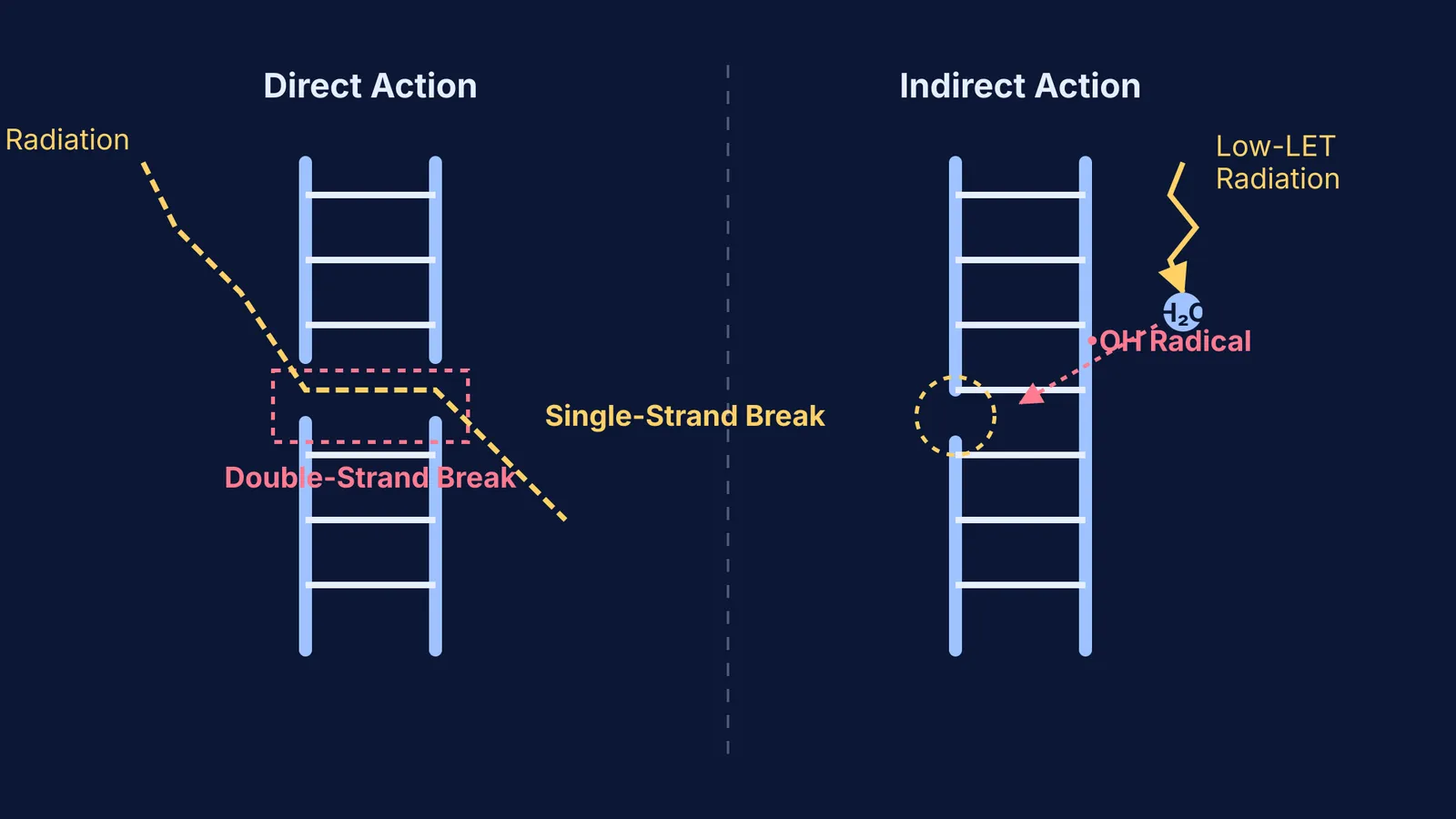
Whether the attack is direct or indirect, the result is structural damage to the DNA double helix. A dose of ionising radiation induces numerous single-strand breaks and a smaller number of double-strand breaks per cell.
Single-Strand Breaks (SSBs): A break occurs on only one side of the DNA ladder. Because the opposite strand remains intact, the cell's repair enzymes can use it as a template to accurately restore the broken segment. Read more about this process in our post on Aziz Sancar and how cells repair damaged DNA.
Double-Strand Breaks (DSBs): Both strands are severed within close proximity. These are the most lethal form of radiation damage because the cell loses its repair template. When enzymes attempt to fuse the broken ends back together, they often make errors, leading to chromosomal aberrations, genetic mutations, or cell death.
Does radiation hit DNA directly or indirectly?
Radiation does not always hit the DNA directly. The way it causes damage depends on the type of radiation, characterised by its Linear Energy Transfer (LET).
Direct action: High-LET radiation, such as alpha particles, dumps a massive amount of energy over a very short distance. It typically strikes the DNA molecule directly, physically severing the sugar-phosphate backbone.
Indirect action: Low-LET radiation, such as X-rays and gamma rays, primarily causes damage indirectly. Because cells are mostly water, the radiation usually ionises a water molecule (H₂O). This produces highly reactive free radicals, primarily the hydroxyl radical (•OH). These radicals diffuse rapidly and chemically attack the DNA strands.
Why do dose and exposure time matter?
The severity of biological damage depends on the rate at which the dose is delivered. A high dose delivered over a very short time completely overwhelms the cell's repair enzymes, leaving DSBs unrepaired.
However, if that exact same dose is spread out over months or years, the cell has time to fix SSBs before another radiation track hits the same location and turns a single break into a double break. This is why low-dose rate exposure is significantly less lethal to cells than acute exposure.
Vulnerability also depends on the cell cycle. Cells that are rapidly dividing have less time to pause and repair their DNA before replication. This makes a developing fetus highly sensitive; an acute dose exceeding 100 mSv between weeks 8 and 15 of pregnancy, or exceeding 200 mSv between weeks 16 and 25, can cause severe brain damage (Source).
Understand the units: The Gray (Gy) measures the raw energy absorbed per kilogram of tissue. The Sievert (Sv) scales this by how dangerous the specific type of radiation is (its biological effect).
Track the pathway: High-LET (alpha) = Direct damage = Double-strand breaks. Low-LET (X-rays) = Indirect damage via water radicals = Mostly single-strand breaks.
Connect to genetics: If you are revising DNA structure, tie this back to the base pairing rules. You can review this with Chargaff's rule numericals: strand-by-strand DNA base sums.
Test yourself: Review the physical and biological principles of radiation using the Fermi Concept Library.


