

On this page
Why did Jacinto Convit combine BCG with killed bacteria?
When Venezuelan physician Jacinto Convit began treating leprosy at the Cabo Blanco leprosarium in 1938, patients lived under police guard in forced isolation. Leprosy—caused by the slow-growing bacterium *Mycobacterium leprae*, discovered when Gerhard Armauer Hansen identified the leprosy bacillus in 1873—carried intense social stigma. Convit saw that compulsory confinement caused severe psychological harm without halting transmission, motivating his search for immunological solutions.
The primary obstacle in leprosy research was that *Mycobacterium leprae* cannot be grown on synthetic culture media. In the 1970s, researchers discovered that nine-banded armadillos (*Dasypus novemcinctus*) were susceptible to the bacterium and could produce sufficient bacterial mass for purification. Convit purified heat-killed *M. leprae* from armadillos to test whether anergic patients could be re-sensitised.
Patients with lepromatous leprosy lack specific cell-mediated immunity against *M. leprae*, registering a negative Mitsuda skin reaction. Convit hypothesised that introducing heat-killed bacilli alone would fail because host tolerance was established. By combining killed bacteria with live *Bacillus Calmette-Guérin* (BCG)—an attenuated strain of *Mycobacterium bovis* used against tuberculosis—he provided a potent immunological adjuvant. Live BCG triggered local macrophage activation and cytokine release, allowing dendritic cells to present *M. leprae* antigens and re-engage dormant T cells.
What did the 1992 Venezuela clinical trial discover?
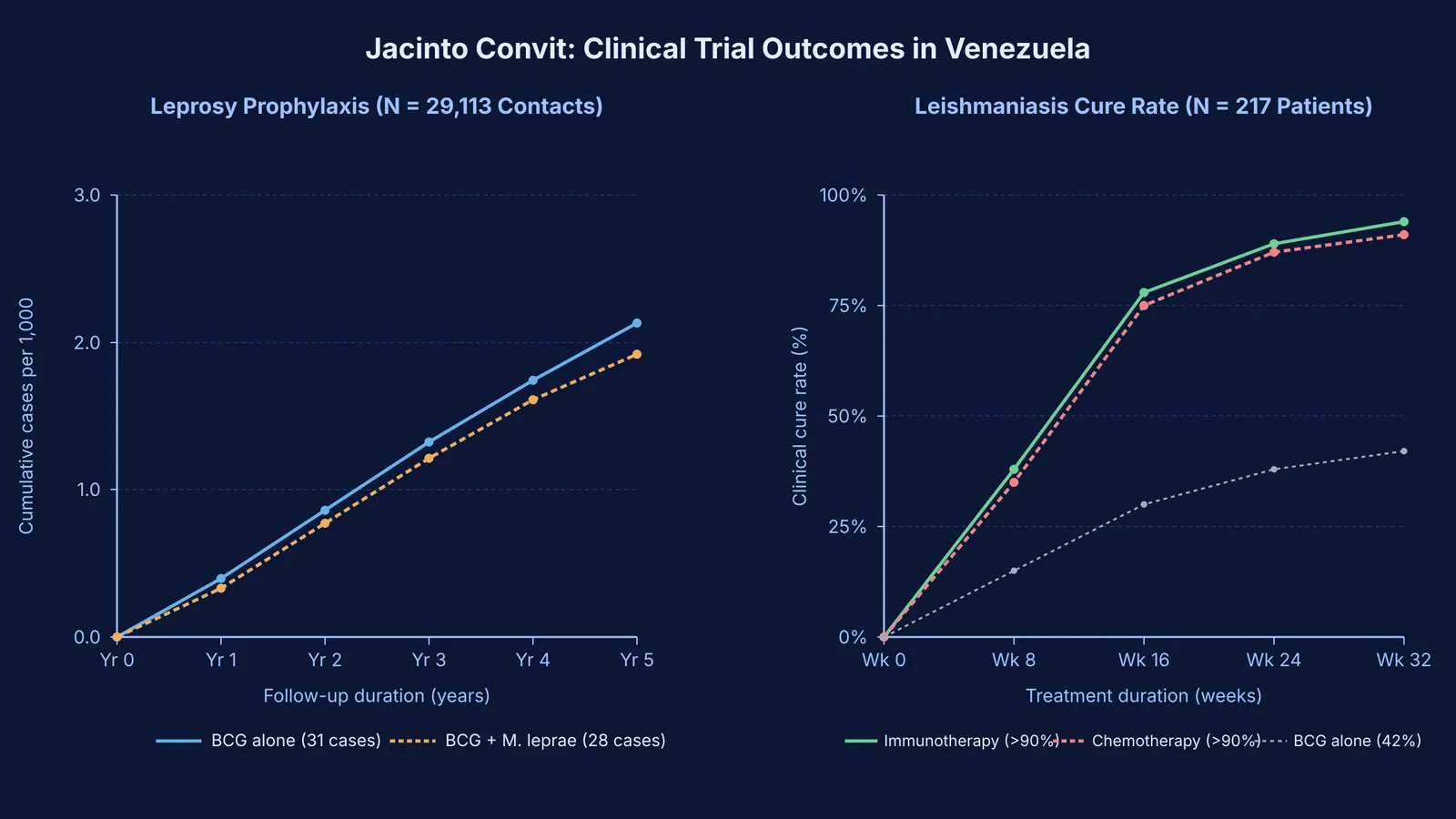
To test whether the combined formulation could prevent disease among high-risk populations, Convit organised a large-scale field trial in Venezuela beginning in 1983, later reporting preliminary findings in The Lancet91056-e). The study enrolled 29,113 close household contacts of diagnosed leprosy patients, randomly assigning them to receive either the standard BCG vaccine alone or BCG combined with heat-killed *M. leprae*.
Over five years of active monitoring, Convit and his colleagues recorded 31 leprosy cases in the BCG cohort and 28 cases in the combined vaccine cohort. Statistical analysis revealed that the addition of killed *M. leprae* offered no significant protective advantage over BCG alone.
While the trial showed that the dual vaccine did not surpass standard vaccination for prevention, retrospective analysis in The Lancet91056-e) estimated that BCG vaccination alone conferred 56% protection against leprosy. This finding confirmed that BCG cross-protection remained a valuable public health asset in countries with high mycobacterial disease burdens.
How did the immunotherapy successfully treat leishmaniasis?
Although the combined formulation did not replace BCG for leprosy prevention, Convit adapted the immunological mechanism to treat cutaneous leishmaniasis. Leishmaniasis is a disfiguring tropical infection caused by intracellular protozoan parasites transmitted through sandfly bites, a parasitic challenge paralleling Carlos Chagas's work on parasitic infections in Latin America.
Conventional chemotherapy relied on pentavalent antimonials like meglumine antimoniate, which required painful intramuscular injections and frequently induced cardiac arrhythmias, liver toxicity, and severe joint pain. In a clinical trial published in The Journal of Infectious Diseases, Convit evaluated an immunotherapy combining viable BCG with pasteurised *Leishmania mexicana amazonensis* promastigotes across 217 patients with localized disease.
The immunotherapy achieved a clinical cure rate greater than 90%, matching the efficacy of antimonial chemotherapy. Adverse reactions occurred in less than 5% of immunotherapy patients, compared to 49% among those receiving antimonials. A long-term study published in the Transactions of the Royal Society of Tropical Medicine and Hygiene90093-9) reviewed 11,532 patients treated in Venezuela between 1990 and 1999, confirming an average clinical cure rate of 95.7%.
How does cellular immunity fight intracellular pathogens?
Convit's work illustrates how cellular immunity overcomes intracellular survival strategies. Understanding these pathways relies on Jacques Miller's discovery of thymus-derived T cells, which coordinate macrophage activation.
You can analyze host responses to intracellular pathogens using a four-step framework:
Identify the cellular niche: Determine whether the microbe lives within macrophage phagolysosomes (such as *Leishmania* or *M. leprae*) where circulating antibodies cannot reach it.
Evaluate T helper polarization: A protective Th1 response releases interferon-gamma (IFN-γ) to activate macrophage enzymes, whereas an ineffective Th2 response yields antibodies that fail to eliminate intracellular microbes.
Assess adjuvant function: In anergic hosts, dead antigens alone fail to recruit lymphocytes; adding BCG supplies microbial ligands that stimulate pattern recognition receptors on antigen-presenting cells.
Track clinical markers: Monitor delayed-type hypersensitivity skin conversions alongside lesion clearance to verify systemic cell-mediated activation.
For students exploring how cellular immunity coordinates defense against intracellular microbes, the Fermi Concept Library covers every concept in biology, each with its own lesson and its place in the map.
To practice applying these principles to complex questions, the Fermi Problem Library provides worked problems with a step-by-step solver that explains the reasoning rather than printing an answer.
How did Convit's work replace leprosaria with public health?
Convit's immunological research directly supported his humanitarian mission. As recorded in The Lancet's biographical tribute61021-7), his work at the Instituto de Biomedicina in Caracas helped close isolated leprosaria in Venezuela, replacing quarantine with outpatient clinics.
When multidrug therapy (MDT)—combining rifampicin, dapsone, and clofazimine—became the global standard endorsed by the World Health Organization, Convit's outpatient infrastructure ensured that treatment reached rural communities. In India, the National Leprosy Eradication Programme uses early detection, free MDT, and post-exposure prophylaxis to eliminate the disease across districts. Convit passed away in 2014 at the age of 100, having demonstrated that medical science achieves its greatest impact when paired with social compassion.


