

On this page
On 4 January 1988, India's first baby conceived by gamete intrafallopian transfer, or GIFT, was born. The P. D. Hinduja Hospital profile of Dr Indira Hinduja records the date, and her Qimpro Platinum Standard citation calls her the pioneer of the GIFT technique that led to that birth. Here is the story, and how to answer GIFT questions in Class 12.
Who is Dr Indira Hinduja?
Indira Hinduja is a Mumbai gynaecologist and obstetrician. According to her Wikipedia biography, her PhD thesis at Bombay University was titled "Human in Vitro Fertilization and Embryo Transfer", and she delivered a test-tube baby at KEM Hospital in August 1986. Her hospital profile calls that baby India's first scientifically documented IVF baby, from a collaboration between KEM Hospital and ICMR.
The wording matters. A 2010 note in Indian Pediatrics says an IVF baby, Durga, was born on 3 October 1978 through the work of Kolkata scientist Subhash Mukhopadhyay. It calls Harsha, born in August 1986, India's "second (officially the first)" test-tube baby, first credited to Dr T. C. Anand Kumar of ICMR. After scrutinising Mukhopadhyay's records, Kumar handed him the credit for India's first successful IVF.
Hinduja received the Padma Shri in 2011, as her Jaslok Hospital profile notes.
What is gamete intrafallopian transfer (GIFT)?
GIFT is an assisted reproductive technology in which eggs and sperm are placed together in a fallopian tube, so fertilisation happens inside the woman's body instead of in a lab dish (Embryo Project Encyclopedia, Arizona State University).
The method came from Ricardo Asch's team in Texas. They reported the first GIFT pregnancy in The Lancet in November 198491127-9) and a GIFT birth in The Lancet in July 198590274-0). India's first GIFT baby arrived a little over three years after that first pregnancy report.
The ASU article describes these steps:
Hormone treatment helps eggs develop, much as in IVF.
Semen is collected two hours before the procedure.
Through a small cut near the navel, doctors use a laparoscope (a fibre-optic viewing device) to collect the eggs.
Two to five eggs and 100,000 to 500,000 motile sperm go into the fallopian tubes through a catheter.
GIFT needs at least one healthy fallopian tube, while IVF does not, according to the same ASU article. It was already uncommon in the US by 2004: citing a 2004 CDC report on 94,242 couples, the article says only 1% of them had GIFT.
How does NCERT define GIFT in Class 12?
The NCERT Class 12 Biology chapter "Reproductive Health" (Chapter 3, section 3.5 on infertility) describes GIFT as the transfer of an ovum collected from a donor into the fallopian tube of another female who cannot produce one but can provide a suitable environment for fertilisation and development.
The textbook centres on a donor ovum; in clinics, the woman's own eggs are also used. In a CBSE or NEET-UG answer, write the NCERT version, then add that fertilisation happens in vivo.
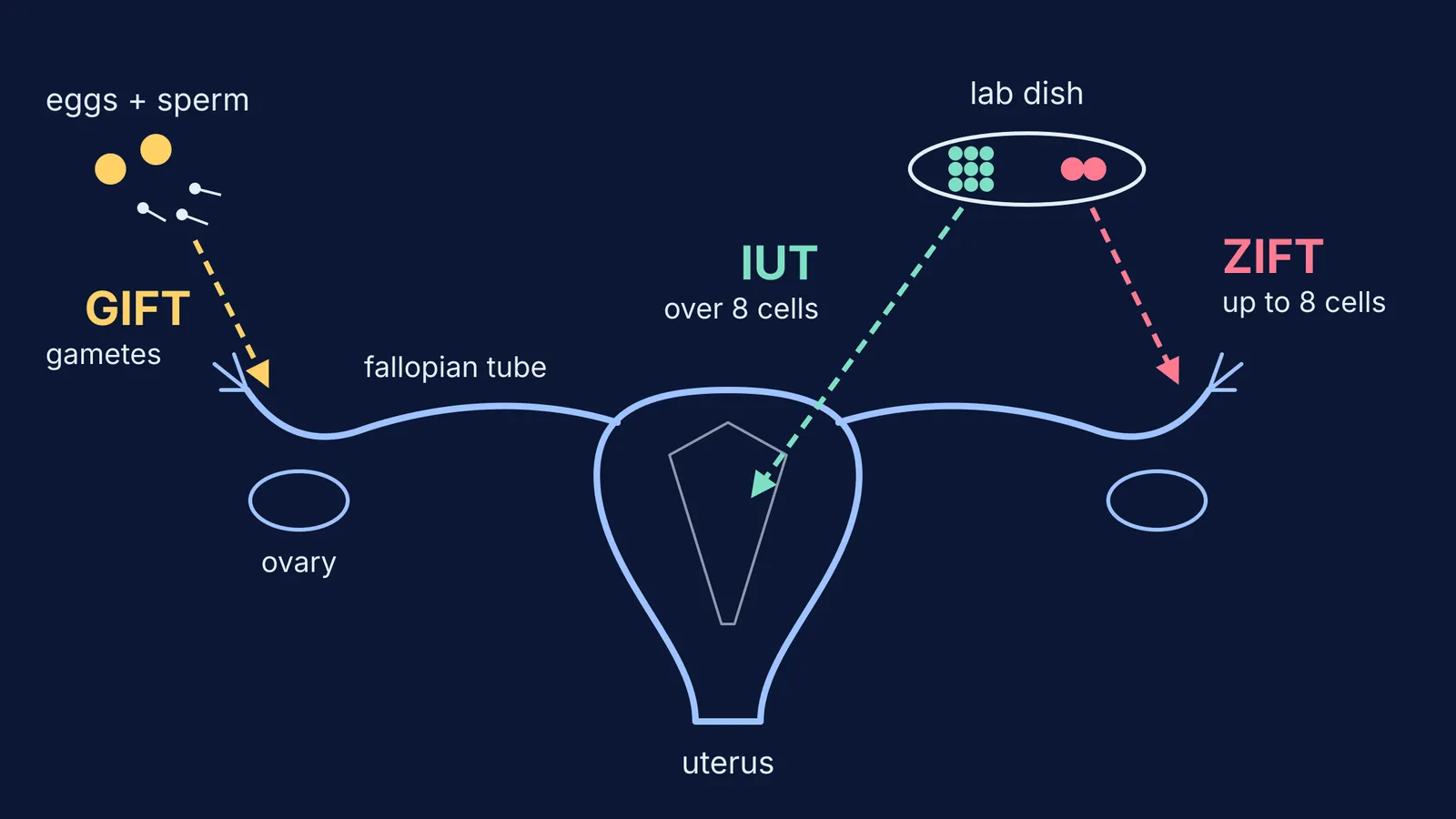
The same NCERT section says a zygote or early embryo with up to 8 blastomeres goes into the fallopian tube (ZIFT). An embryo with more than 8 blastomeres goes into the uterus (IUT).
How do you tell GIFT, ZIFT, IUT and IVF apart?
Ask three questions, in this order:
Where does fertilisation happen? In the lab: IVF, ZIFT, IUT, ICSI. Inside the body: GIFT, AI and IUI.
What is transferred? Gametes: GIFT. A zygote or embryo with up to 8 blastomeres: ZIFT. An embryo with more than 8: IUT. Semen: AI or IUI. A single sperm injected into an ovum in the lab: ICSI.
Where does it go? Fallopian tube: GIFT and ZIFT. Uterus: IUT and IUI.
NCERT adds that embryos formed by fertilisation inside the body can also be transferred, so check where the question says the embryo was made.
Worked example: "A woman cannot produce ova, but she can provide a suitable environment for fertilisation. Which technique does NCERT describe?" Fertilisation happens inside the body, the transfer is a donor ovum, and it goes to the fallopian tube. The answer is GIFT.
If the fallopian tube feels fuzzy, start with the four parts of the fallopian tube and where fertilisation happens, then practise labelling the female reproductive system diagram. For the lab science that made IVF possible, read how Min Chueh Chang pioneered IVF.
When a chapter is full of look-alike terms, the Fermi Concept Library gives every biology concept its own lesson and its place in the map, so you can see how topics like gametogenesis, fertilisation and assisted reproduction fit together.
Why does her story still matter?
The NCERT chapter notes that these techniques need specialised professionals and expensive instruments, so only very few centres offer them. Hinduja delivered the baby her hospital calls India's first scientifically documented IVF baby in 1986, and she pioneered the technique behind India's first GIFT baby in 1988. If your family has questions about infertility, ask a qualified gynaecologist, not a textbook.
Next time you write "GIFT", remember 1988, and run the three questions first.


