

On this page
In the early nineteenth century, domestic lighting relied on expensive whale oil or smoky tallow. Carpathian villagers had long collected surface petroleum seepages—locally called rock oil or *ropa*—to grease axles and treat leather. Historian Alison Frank documents that burning unrefined crude indoors routinely choked rooms with soot or caused violent explosions (Frank, 2005). Raw crude oil contains hydrocarbons spanning widely disparate boiling points; turning it into safe light required fractional distillation and aerodynamic burner design.
Why did raw crude oil explode in traditional lamps?
The hazard of burning raw petroleum in conventional lamps stemmed from molecular volatility. Light fractions like pentane and hexane boil below 150 °C with flash points below 0 °C (Frank, 2005), vaporizing at room temperature into an explosive fuel-air mixture that detonated near an open flame. Meanwhile, heavy bitumens boiling above 300 °C resisted vaporization and clogged cotton wicks, producing noxious soot. Because traditional burners were designed for thick plant and animal lipids with flash points above 150 °C (Frank, 2005), unrefined petroleum turned domestic lamps into fire hazards.
How did Łukasiewicz distill kerosene from seep petroleum?
The breakthrough came through pharmaceutical chemistry. Jan Józef Ignacy Łukasiewicz earned his master's degree in pharmacy from the University of Vienna on July 30, 1852, then returned to Lviv to work at Piotr Mikolasch's "Under the Golden Star" (*Pod Złotą Gwiazdą*) pharmacy alongside chemist Jan Zeh.
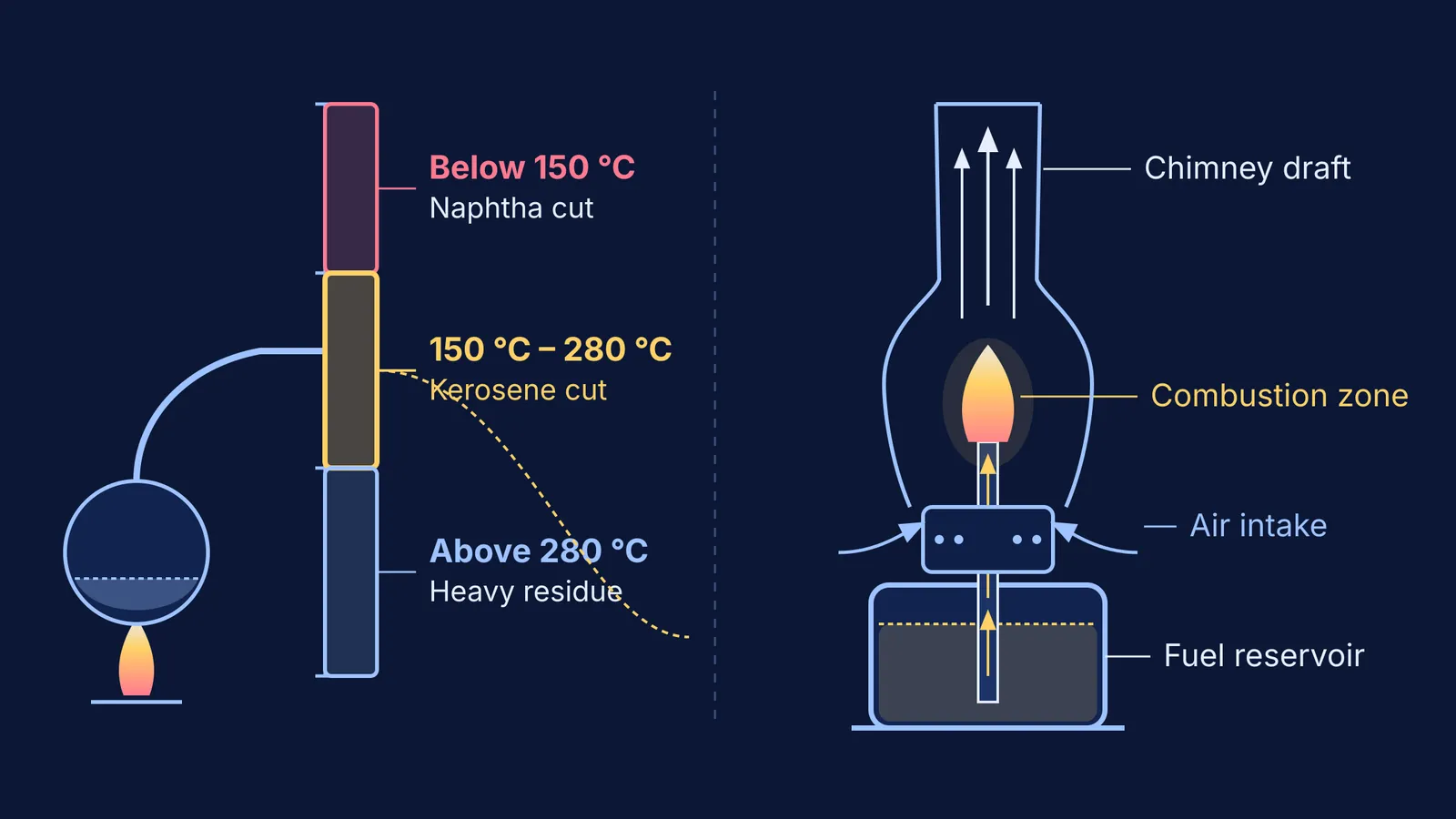
Using laboratory retorts, Łukasiewicz and Zeh fractionally separated crude petroleum into distinct cuts (Franaszek et al., 2019):
Light naphtha, boiling below 150 °C, was discarded to eliminate volatile explosion hazards.
An intermediate cut, condensing between 150 °C and 280 °C, yielded clean kerosene (predominantly C10 to C16 alkanes).
Heavy residue, remaining above 280 °C, was collected for asphalt and machine lubricants.
To remove sulfur odor and soot-forming impurities, Łukasiewicz washed the distillate with concentrated sulphuric acid (H₂SO₄), neutralized it with alkali, and rinsed it with water. This yielded an illuminant with a flash point safely above 38 °C. On December 2, 1853, Austrian authorities granted Jan Zeh and Ignacy Łukasiewicz a patent privilege for this purification method (Franaszek et al., 2019).
How did the 1853 lamp turn chemistry into safe light?
A refined fuel required an engineered burner. Standard lamps had fragile glass reservoirs that cracked under heat. In early 1853, Łukasiewicz and Lviv tinsmith Adam Bratkowski built a metal prototype with four safeguards (Franaszek et al., 2019):
A sheet-metal fuel reservoir resisting heat stress and accidental leakage.
An adjustable wick guide with a thumbwheel to control fuel delivery.
Perforated base apertures admitting fresh air directly into the combustion zone.
A tall glass chimney creating a buoyant thermal updraft.
As rising hot exhaust lowered internal pressure, fresh air was drawn through the perforations, ensuring complete combustion of vaporized kerosene (CₙH₂ₙ₊₂ + [(3n + 1)/2] O₂ → n CO₂ + (n + 1) H₂O) without soot.
The lamp's public validation arrived on July 31, 1853, at Lviv General Hospital (Franaszek et al., 2019). Surgeon Dr. Zaorski operated on patient Władysław Chołecki under Łukasiewicz's kerosene lamps, completing an urgent nighttime surgery that candles could not safely light.
From Bóbrka to Ulaszowice: how did early oil refining begin?
To expand illumination, Łukasiewicz lit the world's first public kerosene street lamp in Gorlice in 1854.
That same year, partnering with Tytus Trzecieski and Karol Klobassa-Zrencki, he founded the world's first industrial oil mine in Bóbrka (Museum of Oil and Gas Industry in Bóbrka). Hand-dug shafts tapped crude reserves: the Franek well reached 50 meters in 1860, while the Janina well reached 132 meters in 1878 and remains active today.
In 1856, Łukasiewicz built the world's first commercial refinery at Ulaszowice, refining Bóbrka oil into kerosene, lubricants, and asphalt (Museum of Oil and Gas Industry in Bóbrka). When fire destroyed Ulaszowice in 1859, he established larger facilities at Polanka in 1860 and Chorkówka in 1865.
In 1854, Łukasiewicz declared: "This liquid is the future wealth of the country, it's the wellbeing and prosperity of its inhabitants, it's a new source of income for the poor, and a new branch of industry which shall bear plentiful fruit" (Pruchnik, 2022). True to his vision, he refused to monopolize his distillation designs, sharing technical drawings freely to develop the region.
How do petroleum distillation cuts appear in STEM exams?
For students studying the fractional separation of petroleum fractions and combustion zones and fuel efficiency, Łukasiewicz's work illustrates foundational thermodynamics and transport physics (Frank, 2005):
Carbon chains and boiling points: Fractions separate by molecular weight. Light naphtha (C5–C8) boils below 150 °C, illuminating kerosene (C10–C16) condenses between 150 °C and 280 °C, and heavy oils (C16+) boil above 280 °C.
Flash point safety: Petrol's flash point sits below −40 °C, forming flammable vapors at room temperature. Kerosene's flash point between 38 °C and 52 °C prevents reservoir explosions while vaporizing smoothly at the wick.
Capillary lift: Fuel rises through Jurin's capillary relation (h = 2γ cos θ / (ρ g r)). Heavy tar clogs the wick, whereas kerosene's lower viscosity ensures steady upward flow.
This scientific synthesis established modern petrochemical refining decades before carbon filament incandescent lamps.
When reviewing hydrocarbon boiling trends and properties, the Fermi Concept Library illustrates each molecular structure across organic chemistry. If you are solving questions on convective fluid flow and combustion stoichiometry, the Fermi Problem Library explains the underlying reasoning across worked STEM problems.


