

On this page
Hunayn ibn Ishaq al-Ibadi (808–873) was a prolific translator, scholar and physician working in Abbasid Baghdad during the Islamic Golden Age. Known affectionately as the "Sheikh of the Translators", he played a pivotal role in bringing classical Greek science to the Islamic world. Hunayn mastered four distinct languages: Arabic, Syriac, Greek and Persian. This linguistic mastery allowed him to personally translate 129 works of the Greek physician Galen into Arabic and Syriac, preserving medical knowledge that might otherwise have been lost (Wikipedia).
Alongside his monumental translation efforts, he wrote 36 original books of his own on subjects ranging from grammar to medicine (Wikipedia). His most influential medical work, the *Book of the Ten Treatises of the Eye* (*Kitab al-Ashr Maqalat fil-Ayn*), stands as the first known systematic textbook of ophthalmology (Wikipedia).
What is the Book of the Ten Treatises on the Eye?
Written in the 9th century (Wikipedia), the *Book of the Ten Treatises on the Eye* is a comprehensive guide to the theory of vision and the structure of the human eye. While it drew heavily on Galen's medical theories, Hunayn's triumph was in organising the eye's complex parts logically and clearly explaining its diseases, symptoms and surgical treatments for practicing physicians.
Translated into Latin, the book provided a crucial bridge for medieval ophthalmologists in the West to understand classical Greek medicine. This rich tradition of detailed medical illustration and systematic physiological model-building was continued by later Islamic scholars, such as Al-Zahrawi and his surgical instruments and Ibn al-Nafis, who discovered pulmonary circulation.
How did Hunayn ibn Ishaq describe the anatomy of the eye?
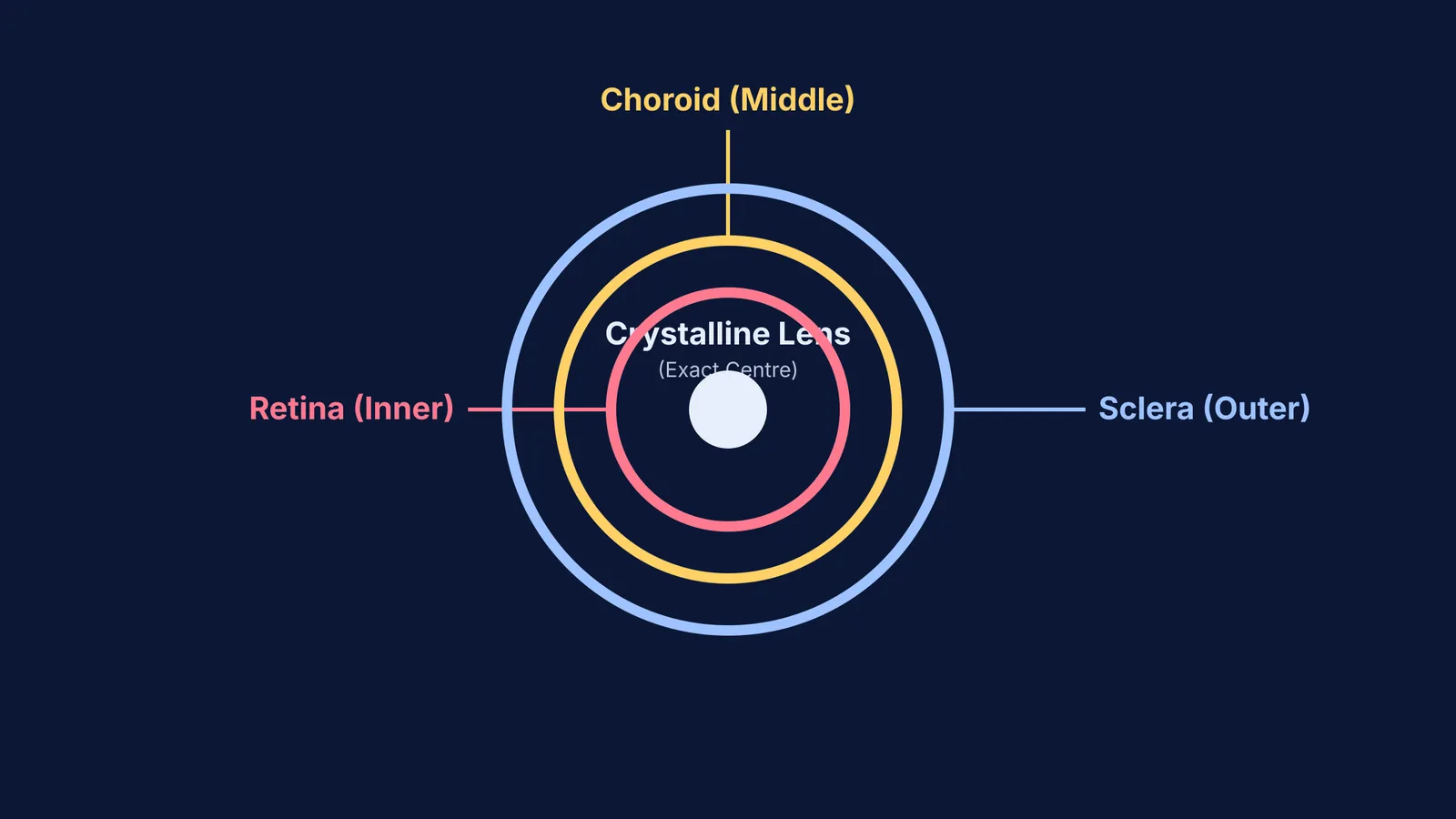
Hunayn described the eye as a hierarchy of concentric layers, starting from the protective outside and working inwards to the parts responsible for sight.
His idea that the crystalline lens sat in the exact centre of the eye remained widely accepted until the late 1500s (Wikipedia). He then mapped the layers surrounding it:
The sclera: A thick, hard outer membrane that protects the delicate inner nerves from injury.
The choroid: A soft middle layer filled with veins and arteries that provides nourishment to the overall structure of the eye.
The retina: The inner layer that transmits nutrients directly to the lens.
When you read about the retina or choroid in modern biology, you can explore their true cellular functions in the Fermi Concept Library.
How did early theories explain vision and pneuma?
In Hunayn's cosmological view, the brain was the source of "psychic pneuma", a highly fluid, ethereal substance essential for sight. This pneuma travelled from the brain down the optic nerve and into the eye, where the uvea concentrated it before it mixed with aqueous humor.
He theorised that this concentrated pneuma then extended outward through the air, acting remarkably like a blind person's walking stick to "touch" objects and send the sensation of shape and colour back to the eye (Wikipedia). While modern physics tells us that light travels into the eye rather than pneuma travelling out (as explored by later pioneers like Ernst Abbe), Hunayn's structural map of the eye remained a masterpiece of detailed observation. To see how light actually focuses through the cornea and lens today, you can run an optics model in the Fermi Simulation Lab.
How can you use clear structures in your own studies?
Hunayn succeeded by breaking a complex organ down into a clear, logical hierarchy: outer protection, middle nourishment and central function. You can apply this same "hierarchy" method to your own biology studies:
Draw the layers: Map out structures from the outside in (for example, the cell wall, cell membrane and cytoplasm).
Assign a primary function: Link every physical part to one clear job, just as Hunayn linked the choroid to nourishment.
Trace the pathway: Follow the path of blood, light or signals through the system step by step.
If you are stuck trying to memorise a difficult biological system and do not know where to begin, Fermi's AI tutor can work out what you already know and build a plan for the session, teaching you how to draw out these connections step by step.


