On this page
Most medical books in the year 1000 told you what to do. Al-Zahrawi's also showed you the tool to do it with. His surgery book drew instruments one by one, so a reader could see the shape of a hook, a knife or a cannula before trying to use or make one. This post covers who he was, what the book contained, the simple physics inside many of those tools, and what a student can learn from his approach.
Who was al-Zahrawi?
Abu al-Qasim Khalaf ibn Abbas al-Zahrawi is known in Latin Europe as Albucasis. A short biographical article in the Annals of Saudi Medicine (Amr and Tbakhi, 2007) gives his birth as 936 CE in Al-Zahra, a suburb northwest of Cordoba, the capital of Muslim Spain. He rarely travelled and spent most of his life there as a practising physician, pharmacist and surgeon. The same article says he served as court physician to Caliph al-Hakam II and died in 1013 at 77.
Around the year 1000 he finished Al-Tasrif. Amr and Tbakhi translate its full title as "The Clearance of Medical Science For Those Who Can Not Compile It" and describe it as thirty volumes summing up about fifty years of practice, covering medicine, surgery, midwifery, pharmacology, diet and more.
What did the surgery section of Al-Tasrif contain?
The US National Library of Medicine's exhibition Islamic Culture and the Medical Arts calls the lengthy surgical chapter "of major importance in the history of general surgery". According to the NLM:
Al-Zahrawi divided surgery into three parts: cautery, incisions and bloodletting, and bonesetting.
He included copious illustrations and descriptions of instruments, which made the treatise especially valuable, even though later scribes often misunderstood the drawings when copying them.
He combined Greco-Roman surgical ideas with his own observations, modified many earlier instruments and designed some new ones.
The NLM gives specific examples. He described a bevel-ended cannula, rather than the earlier straight one, for drawing off fluid in abdominal dropsy. He used a fine drill passed through the urinary passage for a stone stuck in the urethra. He designed a concealed knife for opening abscesses "in a manner that would not alarm the nervous patient". He also described variations of a speculum and forceps.
Amr and Tbakhi add that the final section of the work, on surgery, presented more than 200 instruments, including probes, knives, scalpels, hooks, scissors and forceps, and that his illustrations were among the earliest made for teaching how to use and make such instruments. Treat that number as their count, not an exact catalogue.
How did the book reach Europe?
The NLM notes that the illustrated surgery section circulated on its own and became influential in Europe through the Latin translation made in Toledo by Gerard of Cremona, about two centuries after it was written. Amr and Tbakhi list printed editions of the surgical chapters at Venice in 1497, Basel in 1541 and Oxford in 1778.
The NLM is also clear about the limits of the period. There was no antisepsis and no anaesthesia, and most operations followed accidents or battle wounds. The NLM describes Islamic surgical writers as showing "a sensible and humane reluctance" to attempt the riskiest and most painful operations. The step that tackled infection came more than eight centuries later, with Joseph Lister's antiseptic surgery.
What physics is hidden in a surgical instrument?
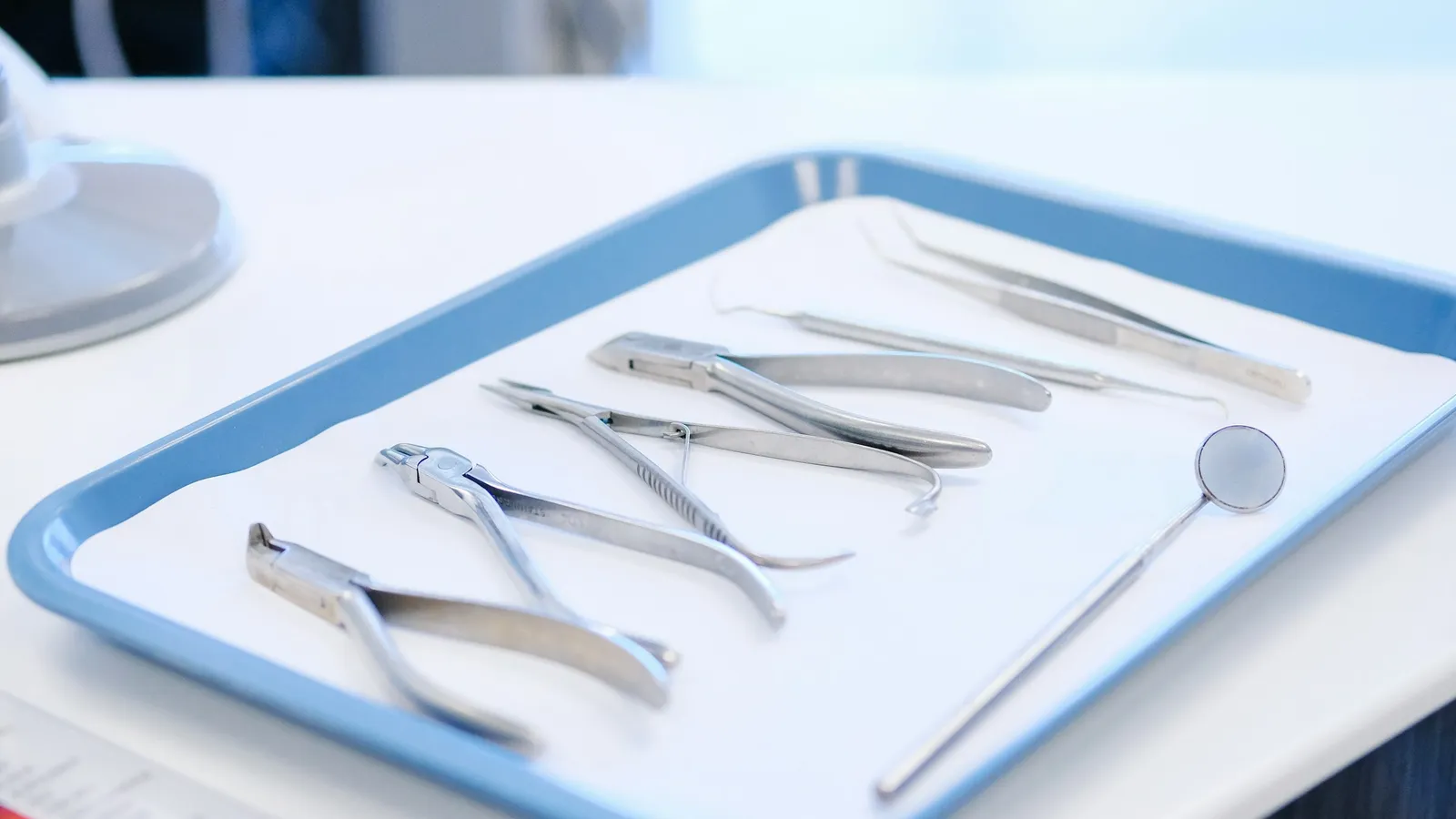
Many hand instruments are levers. Scissors are a pair of first-class levers, with the pivot between your fingers and the blades. Tweezer-style forceps are third-class levers, with your fingers pressing between the hinge and the tips. The rule for an ideal lever is the same as in your physics book: effort x effort arm = load x load arm.
Worked example (sample numbers, not measurements of his instruments).
Scissors: your fingers push 6 cm from the pivot and the cut happens 2 cm from it. Mechanical advantage = 6 / 2 = 3. A 10 N squeeze gives 10 x 6 / 2 = 30 N at the blades.
Forceps: your fingers press 4 cm from the hinge and the tips are 10 cm from it. Mechanical advantage = 4 / 10 = 0.4. A 10 N squeeze gives only 10 x 4 / 10 = 4 N at the tips.
The scissors multiply force for cutting. The forceps reduce it, but the tips move 2.5 times as far as your fingers, which gives fine control for holding delicate tissue. A designer chooses where to put the pivot depending on whether the job needs force or precision.
Common mistakes with levers
Measuring arms from the wrong point. Effort and load arms are distances from the pivot, not from the ends of the tool.
Thinking mechanical advantage below 1 is a bad design. It trades force for speed and range of movement, which is exactly what forceps and your own forearm need.
Mixing up the classes. Ask which sits in the middle: pivot (first class), load (second class) or effort (third class).
Our guide to machines and pulleys for ICSE physics has more practice on levers. If a lever problem keeps going wrong at the set-up, the Fermi Problem Library has a step-by-step solver that explains the reasoning, so you can see where your arms or pivot went wrong.
What can a student take from how al-Zahrawi worked?
Draw what you describe. He paired text with pictures of each tool. A labelled diagram in your notes does the same job for a mechanism or a pathway.
Improve on what you inherit. The NLM stresses that he modified many older instruments, such as straight cannulas, rather than only copying them.
Think about the person in front of you. The concealed knife was designed to spare a nervous patient fear, not just to cut.
Practice routine: pick three tools at home (scissors, tongs, a nutcracker), sketch each, mark pivot, effort and load, measure the arms with a ruler, and work out the mechanical advantage.
Next step: measure a pair of scissors tonight and calculate how much force reaches the blades for a 10 N squeeze.