

On this page
In the early 1900s, a deadly and mysterious illness known as "black measles" was devastating the Bitterroot Valley of Montana. The disease caused a severe purplish rash and high fever, but its origins were completely unknown.
In 1906, an American pathologist named Howard Taylor Ricketts arrived to investigate. Through rigorous field work and laboratory testing, he proved that the disease was transmitted by the bite of the Rocky Mountain wood tick (*Dermacentor andersoni*), publishing his initial findings in the Journal of the American Medical Association. This discovery changed the medical understanding of vector-borne diseases.
What is Rocky Mountain spotted fever?
Rocky Mountain spotted fever is a severe tick-borne illness. Ricketts discovered that the pathogen was a tiny, rod-like microorganism. Unlike typical bacteria that can grow freely in a petri dish, this pathogen is an obligate intracellular bacteria, meaning it can only survive and multiply inside the living cells of its host, Rickettsia rickettsii.
Because of their strange nature, these bacteria are sometimes confused with other pathogens. You can explore how unconventional organisms are classified in our guide to Viruses, viroids and lichens: the misfits of five-kingdom biology. When an infected tick bites a human, the bacteria invade the endothelial cells lining the blood vessels, causing the characteristic spotted rash.
How did Ricketts trace the disease?
Ricketts employed a systematic approach that combined field observation with animal models. Before his work, many scientists believed diseases like Rocky Mountain spotted fever were caused by contaminated water or soil. By systematically isolating the variable—the tick—and reproducing the disease in an animal model, Ricketts created a definitive chain of evidence. His approach mirrored Koch's postulates but was specifically adapted for a vector-borne illness.
He collected ticks from the wild and placed them on healthy guinea pigs and monkeys, proving that the bite alone could transmit the fever. Crucially, he also discovered transovarial transmission. He observed the microorganism in the eggs of infected female ticks, proving that the bacteria were passed down from one generation of ticks to the next, allowing the tick population to act as a permanent reservoir for the disease in nature even during the harsh winters when adult ticks were dormant.
Understanding the transmission cycles of complex pathogens requires you to connect ecology, cellular biology, and medicine. Fermi's AI tutor can work out what you already know and build a plan for the session, so you sit down to a clear next step when revising these systems.
Why is the bacteria named Rickettsia?
Ricketts was known for his dedication, sometimes even injecting himself with pathogens to study their effects. In 1909, he travelled to Mexico City to study an outbreak of epidemic typhus, another mysterious fever. He and his assistant Russell Wilder proved that typhus was transmitted by the human body louse. Tragically, Ricketts contracted the disease during his research and died from it in Mexico City in 1910.
In 1916, Brazilian scientist Henrique da Rocha Lima named the genus of these intracellular bacteria *Rickettsia* to honour Ricketts' sacrifice and pioneering work. The specific agent causing Rocky Mountain spotted fever was named *Rickettsia rickettsii*.
If you want to understand what the pathogen encounters once it enters the circulation and the body's immune system begins to respond, read our detailed breakdown of the formed elements of blood. The Fermi Concept Library also holds every concept in biology, helping you map out how vector-borne diseases trigger immune responses.
What is the Ricketts method for pathogen tracing?
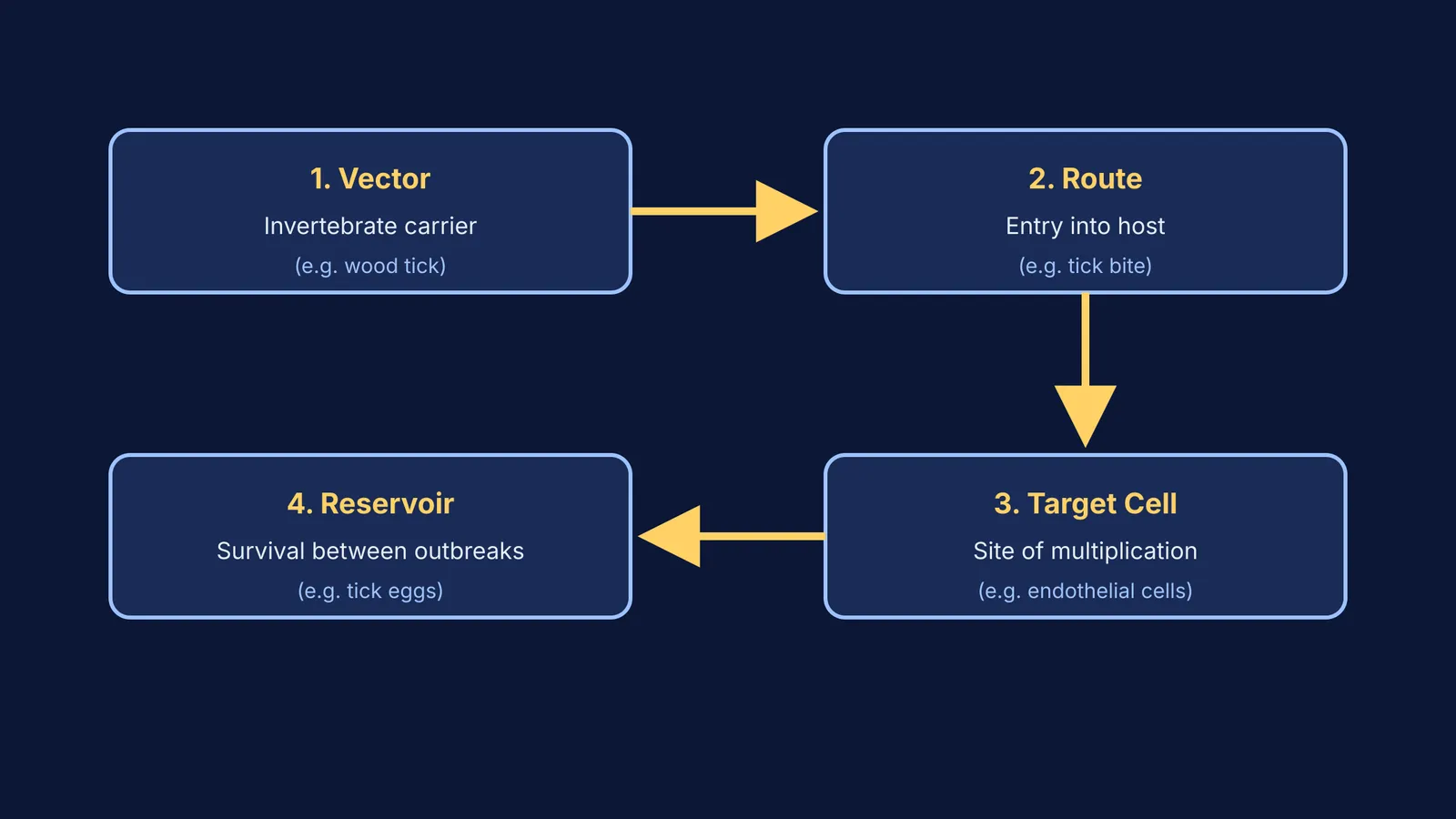
When studying infectious diseases for your exams, you can use a four-step framework based on Ricketts' historical workflow to map out and memorize any new pathogen. This framework is not just history; it is the exact logic scientists use today when a new vector-borne virus or bacteria emerges. By breaking a disease down into its vector, route, target, and reservoir, you can organize complex biological lifecycles into a logical sequence that is easy to recall during a test:
The Vector: What invertebrate carries the pathogen? (e.g., the wood tick).
The Transmission Route: How does it enter the host? (e.g., a tick bite).
The Target Cell: Where does it multiply inside the body? (e.g., endothelial cells of blood vessels).
The Reservoir: Where does the pathogen survive between outbreaks? (e.g., tick eggs via transovarial transmission).


