On this page
In the 18th century, Japan’s borders were tightly closed to most of the world, but scientific curiosity still found a way in. In 1776, the polymath Hiraga Gennai successfully rebuilt a broken Dutch machine to create the "elekiter", bringing static electricity to curious crowds. His device did not just make sparks fly; it ignited Japan's early interest in physics and engineering.
What is the elekiter and how did it reach Japan?
The elekiter (derived from the Dutch word *elektriciteit*) is an early friction-based electrostatic generator. Its story in Japan began when Gennai acquired a broken Dutch model in Nagasaki in 1770. Without manuals or formal physics training, he spent 6 years reverse-engineering and repairing the machine, finally demonstrating a working version in 1776.
Gennai's elekiter became a popular spectacle, as he traveled and amazed crowds with visible electric sparks. Today, the IEEE recognizes his long effort as a global milestone in electrical engineering, and only 2 original devices made by him are known to survive.
Understanding how invisible forces work often requires seeing them in action. Today, you can explore abstract concepts like electric fields instantly; Fermi Simulation Lab has interactive simulations for the ideas that are easier to see than to read.
How did the elekiter adapt to Japan?
The machine Gennai acquired originally came from Zenzaburo Nishi, an interpreter for the Dutch in Nagasaki. Because Japan's humid climate made generating static electricity difficult, Gennai had to adapt the original European design. Instead of relying on a traditional string-and-pulley drive, his restored elekiter used wooden gears for transmission. He also insulated the internal components with pine resin, ensuring the generated charge would not leak away into the moist air.
When finally demonstrated, the elekiter was viewed as both a medical marvel and a public spectacle. Rather than storing all the electricity in a simple glass Leyden jar, some demonstrations used a person sitting on a pedestal insulated by resin-filled wooden vases. The human body acted as a capacitor, building up charge until a visible spark could be safely drawn, amazing the onlookers.
How does an electrostatic generator work?
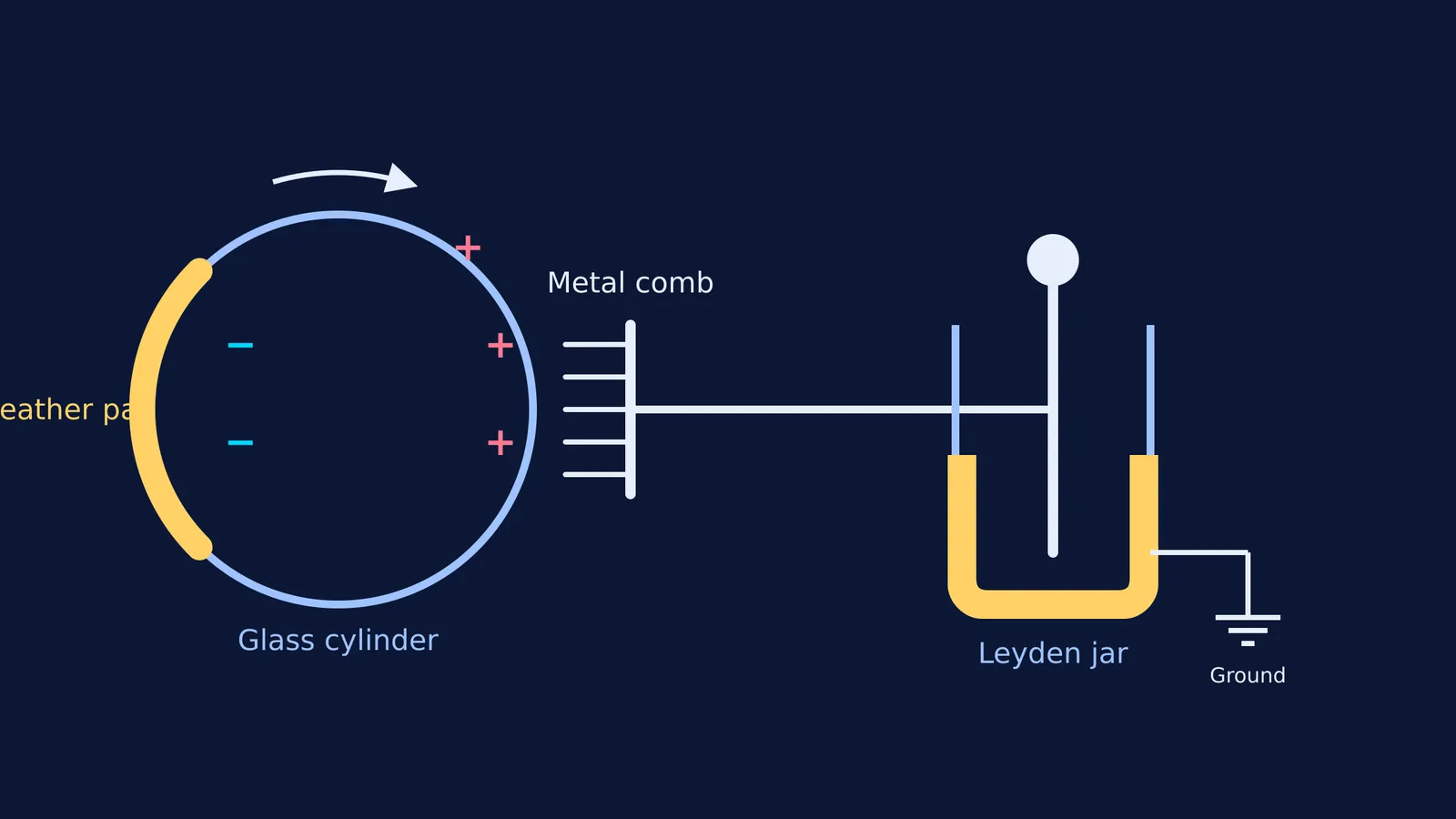
Friction is the key to generating static electricity. The elekiter produces charge mechanically using a few basic parts:
The moving part: A hand crank turns a glass cylinder inside a wooden box.
The rubbing surface: As the glass rotates, it rubs against a leather pad, stripping away electrons and generating a static charge through the triboelectric effect.
The collector: A metal comb positioned near the rotating glass collects this built-up charge.
The storage: The collected electricity is stored in a Leyden jar until it builds enough potential to discharge as a spark.
You can experiment with modern versions of these storage systems by predicting voltage drops in our guide to RC circuit simulations.
How to study static electricity today?
You do not need an antique elekiter to understand the principles of static charge. Whether you are observing a modern Wimshurst machine in a school lab or studying for exams, you can use this checklist to spot the essential mechanisms of any static electricity generator:
Find the friction source: Identify the moving part (like a rubber belt or glass plate) and the rubbing pad that separates the charges.
Locate the charge collector: Look for metal brushes or combs that gather the static electricity.
Identify the capacitor: Find where the charge is stored before it discharges, such as a metal dome or a Leyden jar.
Observe the discharge: Watch the spark gap where the accumulated charge finally bridges the air.
Just as Gennai used his elekiter to bring a hard-to-picture idea to life, visualizing physics remains a powerful way to learn. If you struggle to picture how charges and forces interact, try our framework for visualising hard physics ideas to make your study sessions clearer.