

On this page
Before sine and cosine had names, astronomers used the chord. Hipparchus, a Greek astronomer of the second century BC, tabulated chords to turn angles in the sky into numbers. It is the earliest trigonometric table we know of.
Who made the first trigonometric table?
The MacTutor History of Mathematics archive states that the first known table of chords was produced by Hipparchus in about 140 BC. His MacTutor biography gives his birth as 190 BC in Nicaea (now Iznik, in Turkey) and places him in Rhodes in 127 and 126 BC.
The table itself is lost. Theon of Alexandria later wrote that Hipparchus produced a work on chords in 12 books, the same biography reports. MacTutor calls Hipparchus the first person whose systematic use of trigonometry we have documentary evidence for, and says it is "highly probable" he was the first to build a chord table.
He is also known for a star catalogue and for discovering precession; we cover those in Hipparchus: a lost star catalogue, precession and chord tables.
What is a chord table?
A chord is the straight line joining two points on a circle. A chord table lists, for each central angle, how long that line is in a circle of a fixed radius.
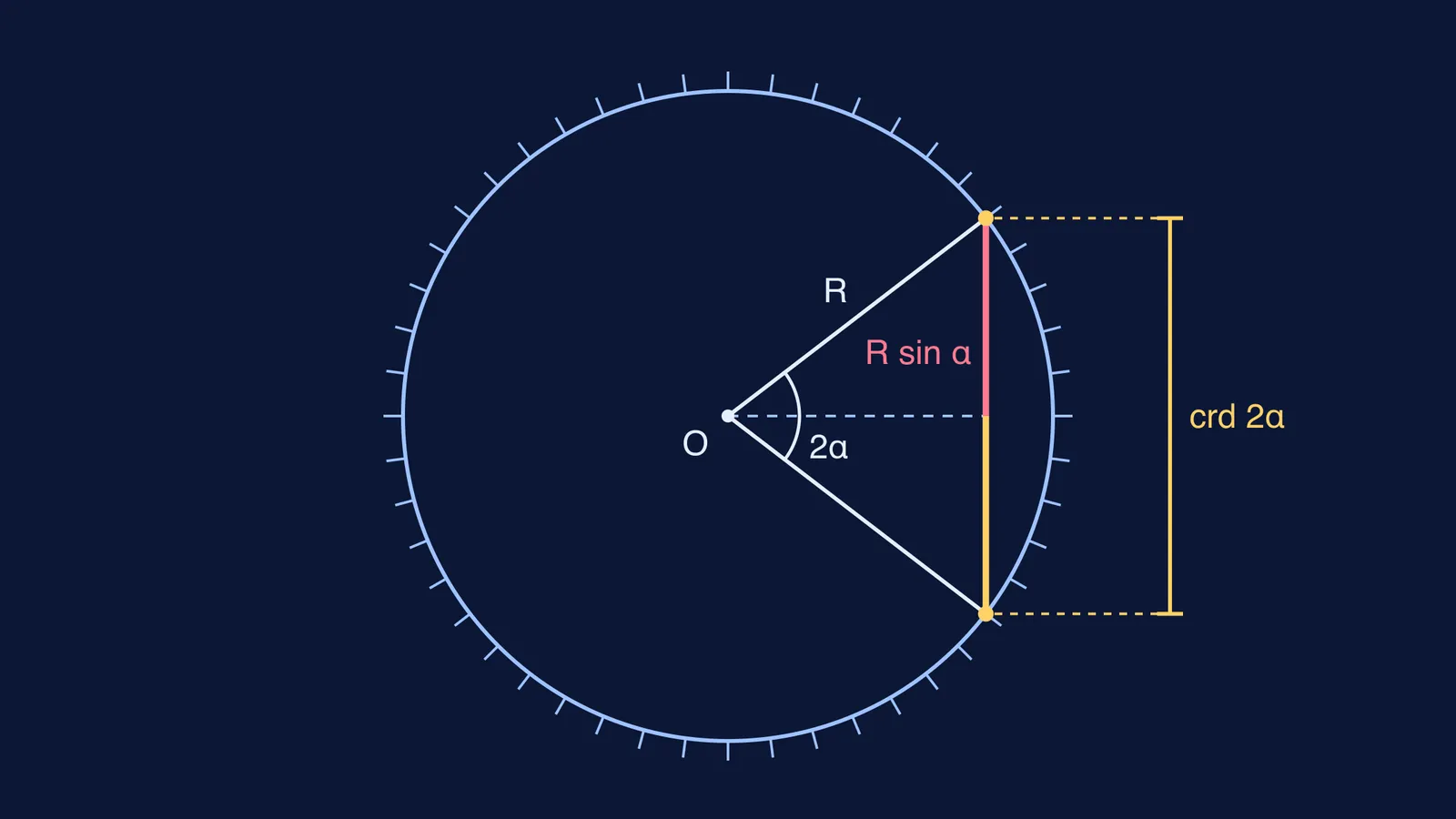
For a circle of radius R, the chord of a central angle θ is crd θ = 2R sin(θ/2); MacTutor's history of the trigonometric functions gives this relation for a circle of unit radius. So half the chord of 2α is R sin α: the bridge from Hipparchus's chords to the sines of Class 10 and 11.
The MacTutor biography reports Toomer's claim that Hipparchus defined his chord function at 7.5° intervals, 1/48 of the circle, on a circle of radius 3438 minutes of arc, because 360 × 60 / 2π ≈ 3438. That choice makes the radius and the arc measured in the same unit, the same idea behind radians.
This reconstruction comes from the historian G. J. Toomer's paper The chord table of Hipparchus and the early history of Greek trigonometry in the journal Centaurus. The Starry Messenger pages at Cambridge's history of science department summarise it: the table was probably computed for a radius of 3438′ and is the ancestor of a sine table found in ancient Indian astronomical works. Not everyone agrees: a 2005 paper by B. Klintberg in the Indian Journal of History of Science proposes a 3600′-based table.
How did chords become sines?
Ptolemy kept the chord. His MacTutor biography describes a table of chords at intervals of half a degree, and the trigonometric functions history notes that he divided the diameter into 120 parts. You can read more about that book in Ptolemy's Almagest: the textbook that ran astronomy for 1,400 years.
The change came in India. The same MacTutor history says Aryabhata, in about 500, gave tables of half-chords, "which now really are sine tables", and used the word jya. Jya became jiba in Arabic, was later read as jaib (a fold), and was translated into Latin as sinus. That is where "sine" comes from. The full journey is in From jya to sine: how Aryabhata's table travelled the world.
How do you read a sine from a chord table?
Take R = 3438, the radius in Toomer's reconstruction as reported by MacTutor, and use crd θ = 2R sin(θ/2).
Chord of 60°: two radii and this chord form an equilateral triangle, so crd 60° = R = 3438.
So sin 30° = crd 60° ÷ 2R = 3438 ÷ 6876 = 0.5, the value you memorised.
Chord of 90°: the two radii form a right angle, so by Pythagoras crd 90° = R√2 ≈ 4862, and sin 45° = 4862 ÷ 6876 ≈ 0.707.
The first step in a 7.5° table: crd 7.5° = 6876 × sin 3.75° ≈ 449.7, about 450 units.
The rule to remember: halve the angle, halve the chord, divide by R.
Try it yourself: a 20-minute chord table
You need a compass, a protractor and a ruler.
Draw a circle of radius 10 cm and mark its centre.
From one radius, mark central angles of 30°, 60°, 90° and 120°.
Measure each chord with the ruler. With exact drawing you should get about 5.18 cm, 10.00 cm, 14.14 cm and 17.32 cm.
Divide each chord by 20 cm (that is 2R). You now have sin 15°, sin 30°, sin 45° and sin 60°.
Compare with a calculator.
A one-millimetre slip moves your answer in the third decimal place, which is why a table worked out by geometry beats one measured by hand.
If the step from chord to sine still feels slippery, the Fermi Concept Library has a lesson for every concept in mathematics, so you can go back to the idea underneath. For ideas easier to see than to read, try the Fermi Simulation Lab.
Next time you press sin on a calculator, remember the first version was a list of lengths across a circle.


