On this page
In the 1780s, Britain could smelt plenty of cast iron, but cast iron is brittle. Anything that had to bend rather than snap needed wrought iron. Henry Cort, who ran a rolling mill at Fontley in Hampshire (Grace's Guide), found a way to make it in bulk. His method rests on one idea: take carbon out of a metal by oxidising it.
What did Henry Cort invent in 1783 and 1784?
Cort took out two patents. A 2025 paper by Oliver Jelf in Historical Metallurgy sums them up: in 1783 Cort set out a way of recycling scrap iron that included passing white-hot billets through grooved rollers, and in 1784 he introduced puddling, "a method of producing wrought iron in a reverberatory furnace".
A reverberatory furnace keeps the fuel and the metal apart: hot gases from the fire sweep over the iron, but the fuel never touches it (puddling overview).
Wrought iron has very little carbon (under 0.05%), while cast iron has between 2.1% and 4.5% (wrought iron overview). That carbon makes cast iron brittle.
How did the puddling furnace turn pig iron into wrought iron?
MIT metallurgists Merton Flemings and David Ragone explain the process in a 2009 paper. In Cort's original "dry" puddling, the iron sat in a coke-fired reverberatory furnace while a worker stirred it constantly, so oxygen from the air could burn off the carbon. As the carbon went, the iron became a pasty, semi-solid mass, which the puddler gathered into a ball for working.
Stirring did the real work, exposing fresh metal to the oxidising gases. The puddler used a long hooked bar called a rabble (puddling overview).
Dry puddling wasted iron. The furnace's sand bottom reacted with iron oxide to form slag, and as much as half the iron charged could be lost in it, Flemings and Ragone note. From 1811, Joseph Hall tried a furnace bottom made of iron oxide instead, and by 1830 his "wet puddling" was in commercial use. The oxide now supplied the oxygen: FeO + C → CO + Fe.
Why does iron go solid as the carbon burns off?
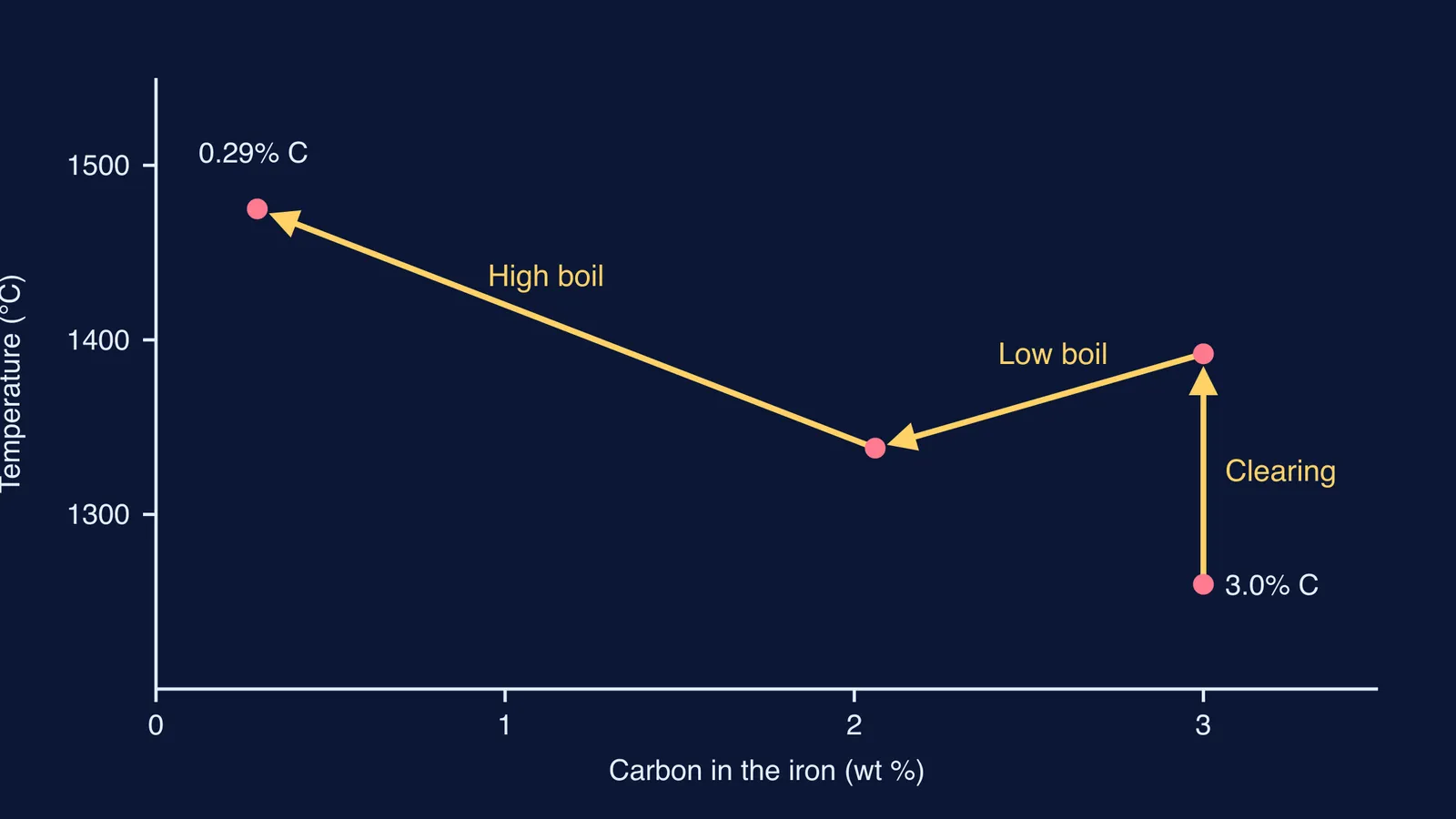
As the carbon content falls, the melting point of the iron rises (wrought iron overview), until the metal can no longer stay liquid at furnace heat. The diagram at the top of this page plots Flemings and Ragone's model of wet puddling, starting from 3.0% carbon at 1260 °C. The melt heats to about 1392 °C while silicon is removed (the "clearing"). It then cools to 1338 °C in the low boil, because the carbon reaction absorbs heat. Once solid iron starts to form, the heat released by freezing drives the high boil up to 1475 °C, with the carbon down to 0.29%. Puddlers judged all this by eye; the authors found no measurements of the bath's temperature.
Worked example: how much carbon does one charge lose?
In later wet puddling, a puddler loaded 500 to 600 lb (about 230 to 270 kg) of pig iron per heat, according to Flemings and Ragone. Take 250 kg and their model's figures:
Carbon at the start: 3.0% of 250 kg = 7.5 kg.
Carbon after the high boil: about 0.29% of 250 kg ≈ 0.7 kg (treating the metal's mass as roughly constant).
Carbon removed: 7.5 − 0.7 ≈ 6.8 kg, or 6800 ÷ 12 ≈ 567 mol.
By FeO + C → CO + Fe, that uses about 567 mol of FeO (567 × 71.8 g ≈ 40.7 kg) and releases 567 mol of CO (≈ 15.9 kg of gas).
The same reaction puts 567 mol of iron (567 × 55.8 g ≈ 31.7 kg) back into the metal.
Step 5 shows why Hall's oxide bottom helped: oxygen taken from iron oxide hands iron back to the metal, while dry puddling's sand bottom locked iron away in slag. If steps 3 and 4 tripped you up, the Fermi Problem Library has worked problems with a step-by-step solver that explains the reasoning rather than printing an answer.
What happened to Henry Cort, and to puddling?
The process won; its inventor did not. When Cort's backer Adam Jellicoe died in 1789, Cort's debts were called in and his patents passed to the government. Grace's Guide records that he got a government pension but "died a ruined man" in 1800.
After incremental improvements, puddling was widely adopted from the mid-1790s. British wrought iron output rose from 32,000 tons in 1788 to 150,000 tons by 1815, and steel output in Britain overtook wrought iron only in 1885 (Flemings and Ragone). Where Cort's rolling idea came from has been disputed. Jelf's 2025 paper concludes that the surviving records do not support the claim that he took it from enslaved metalworkers at a Jamaican foundry.
For earlier chapters, read about Abraham Darby's coke smelting and Benjamin Huntsman's crucible steel, or revise the syllabus side with extraction of metals for Class 10. To work through oxidation, reduction and phase changes one idea at a time, try the Fermi Concept Library.