

On this page
Long before textbooks spoke of water potential, a French doctor saw water force its way into tiny closed sacs and decided the effect needed a name. That name was endosmosis, and the idea behind it is the one you still use when you explain why a raisin plumps up in water.
Who coined the term endosmosis?
Henri Dutrochet (1776-1847) was a French medical doctor, botanist and physiologist (Wikipedia). In his 1826 book *L'agent immédiat du mouvement vital*, he wrote that this newly observed action needed a new name, and called it *endosmose* (Dutrochet, 1826, Internet Archive). A footnote builds the word from two Greek roots, *endon* (inside) and *ōsmos* (impulsion, or push).
So endosmosis literally means "a push inwards". A few pages later he named the opposite flow, outwards through the membrane, *exosmose*, or exosmosis. A 2006 review in The Plant Cell credits him with the shorter term osmosis too, citing his work of 1837 (Maggio and colleagues, The Plant Cell, 2006).
What did Dutrochet's chicken-gut experiment show?
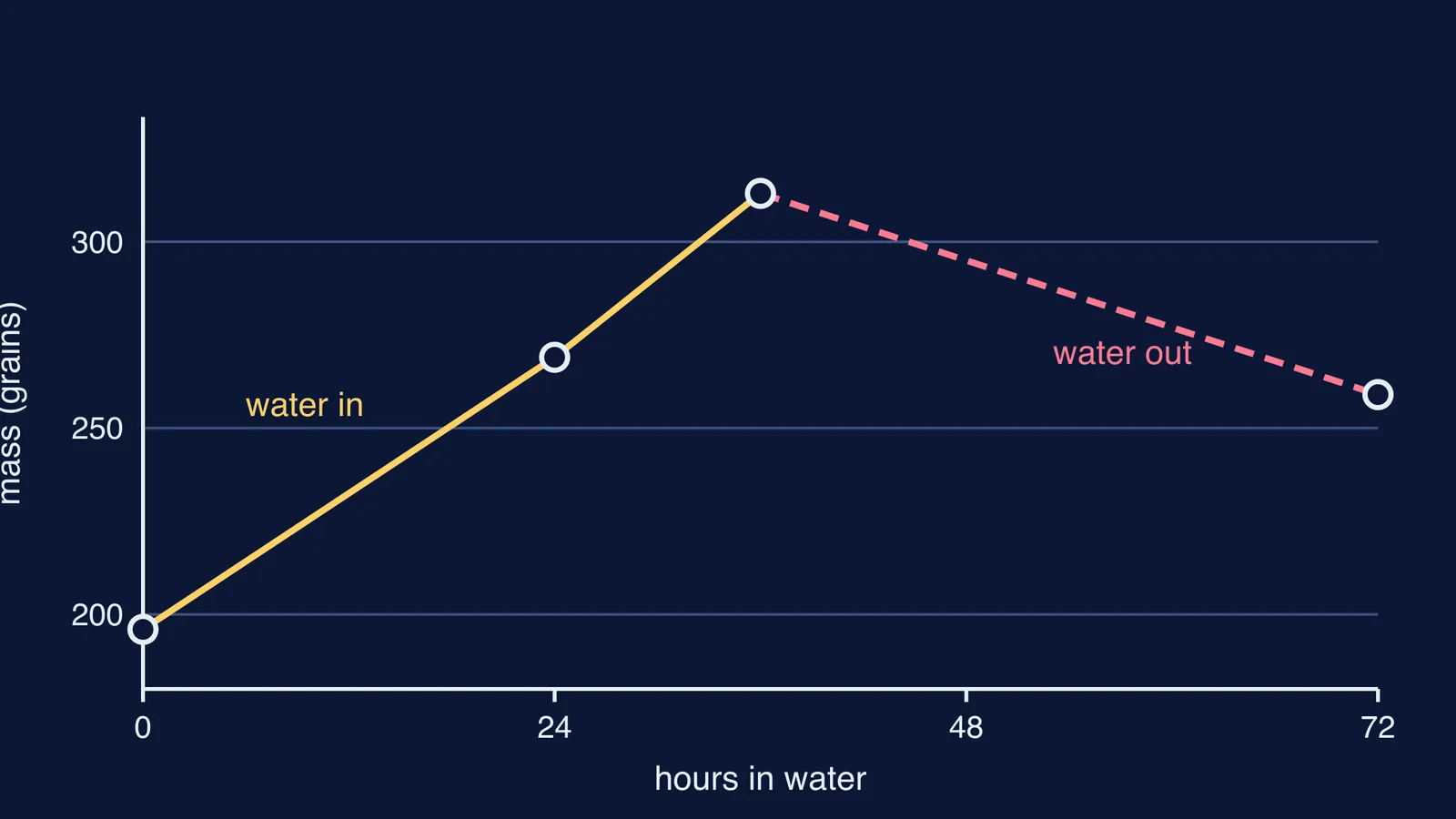
One clue came from a slug. Dutrochet put a slug's small sperm sac in water and saw water collect in its closed end, entering through the wall rather than the opening and pushing the sperm paste out. Once he had named the effect, he tested it. He took the caecum (a pouch of the gut) of a chicken about three months old, half-filled it with milk, tied it shut and put it in rainwater that he changed morning and evening (Dutrochet, 1826).
At the start, the caecum and milk weighed 196 grains, an old unit of mass.
After 24 hours: 269 grains.
After 36 hours: 313 grains. It had taken in 117 grains of water and had become very turgid.
Over the next 36 hours it lost 54 grains. When he opened it, the milk had curdled and gone putrid, and he linked the loss to that spoiling.
Then he reversed it. A caecum holding a weak gum arabic solution, moved into a stronger gum arabic solution, lost 30 grains in an hour and was almost empty within two hours. His rule: water flows through the membrane towards the denser of the two liquids (Dutrochet, 1826).
He then fixed a carp's swim bladder or a chicken caecum to a glass tube with a graduated scale behind it, a device he said could be called an endosmometer. Rising liquid meant endosmosis; falling meant exosmosis. With a strong salt solution inside, the liquid rose fairly fast, but he also found salt leaking into the outer water, shown with silver nitrate (Dutrochet, 1826).
How did Dutrochet link osmosis to plants?
In the book's plant section he described tissue as a mass of tiny vesicles, each doing its own endosmosis. A vesicle holding a liquid denser than the sap around it draws that sap in. He wrote that endosmosis draws sap into every growing part, and that flower corollas wither after flowering because they die and lose their endosmosis (Dutrochet, 1826).
A modern summary puts it this way: he found membranes that let water through but hold back dissolved molecules, and pointed to osmotic pressure as a possible cause of sap rising and of nutrient absorption in plants and animals (Vladislav Kruta's biography on Encyclopedia.com).
What did Dutrochet get wrong?
He thought the cause was electricity, comparing hollow organs to Leyden jars with permeable walls (Dutrochet, 1826). Later physics explained osmosis without it. He also spoke of "density" where we now talk about how much solute is dissolved.
Later work filled in the physics. Wilhelm Pfeffer made accurate measurements of osmotic pressure in 1877 using membranes described by Moritz Traube, and called the push of cell contents on plant cell walls turgor pressure (Maggio and colleagues, The Plant Cell, 2006). Jacobus van 't Hoff, winner of the 1901 Nobel Prize in Chemistry, linked osmotic pressure to solute concentration with an equation (same source).
How do you use Dutrochet's rule in an exam answer?
His rule still works if you swap "denser" for "more concentrated". Four checks for any osmosis question:
Name the liquid on each side of the membrane.
Find which side has more dissolved solute. Water moves towards it.
Ask whether the solute can cross too. If it leaks, as Dutrochet's salt did, the difference shrinks and the flow slows.
Predict the change in mass or volume before you look at the data, then compare.
Try it on our potato osmosis experiment with predictions and results, or on a shell-less egg in water and syrup, a close cousin of Dutrochet's caecum. If water crossing a membrane is hard to picture, read our osmosis simulation guide to predicting which way water crosses; the Fermi Simulation Lab has interactive simulations for ideas that are easier to see than to read.
If osmosis, diffusion and turgor still blur together, the Fermi Concept Library gives each concept in biology and chemistry its own lesson and its place in the map.
Next time you write "osmosis" in an answer, remember it began with a slug, a chicken gut, a vessel of rainwater and a careful set of scales.


