On this page
In 1847, a 26-year-old army surgeon named Hermann von Helmholtz presented a paper to the Physical Society of Berlin. Titled *Über die Erhaltung der Kraft* (On the Conservation of Force), it did not just report a single experiment. According to the Stanford Encyclopedia of Philosophy, it united mechanics, heat, electricity, magnetism, and biology under a single mathematical law.
We now know this as the first law of thermodynamics: the conservation of energy. Helmholtz was not the first to suggest that energy is conserved, but he was the first to give it a rigorous mathematical framework based on central forces.
What did the 1847 conservation of energy paper prove?
Before Helmholtz, scientists treated heat, electricity, and mechanics as separate subjects. Many biologists also believed in "vitalism"—the idea that living organisms were powered by a special "vital force" that did not follow the laws of physics.
As detailed in the Stanford Encyclopedia of Philosophy, Helmholtz started with a simple axiom: a perpetual motion machine is impossible. You cannot get work out of nothing. From this, he proved that all forces in nature must be conserved. He broke energy down into two types:
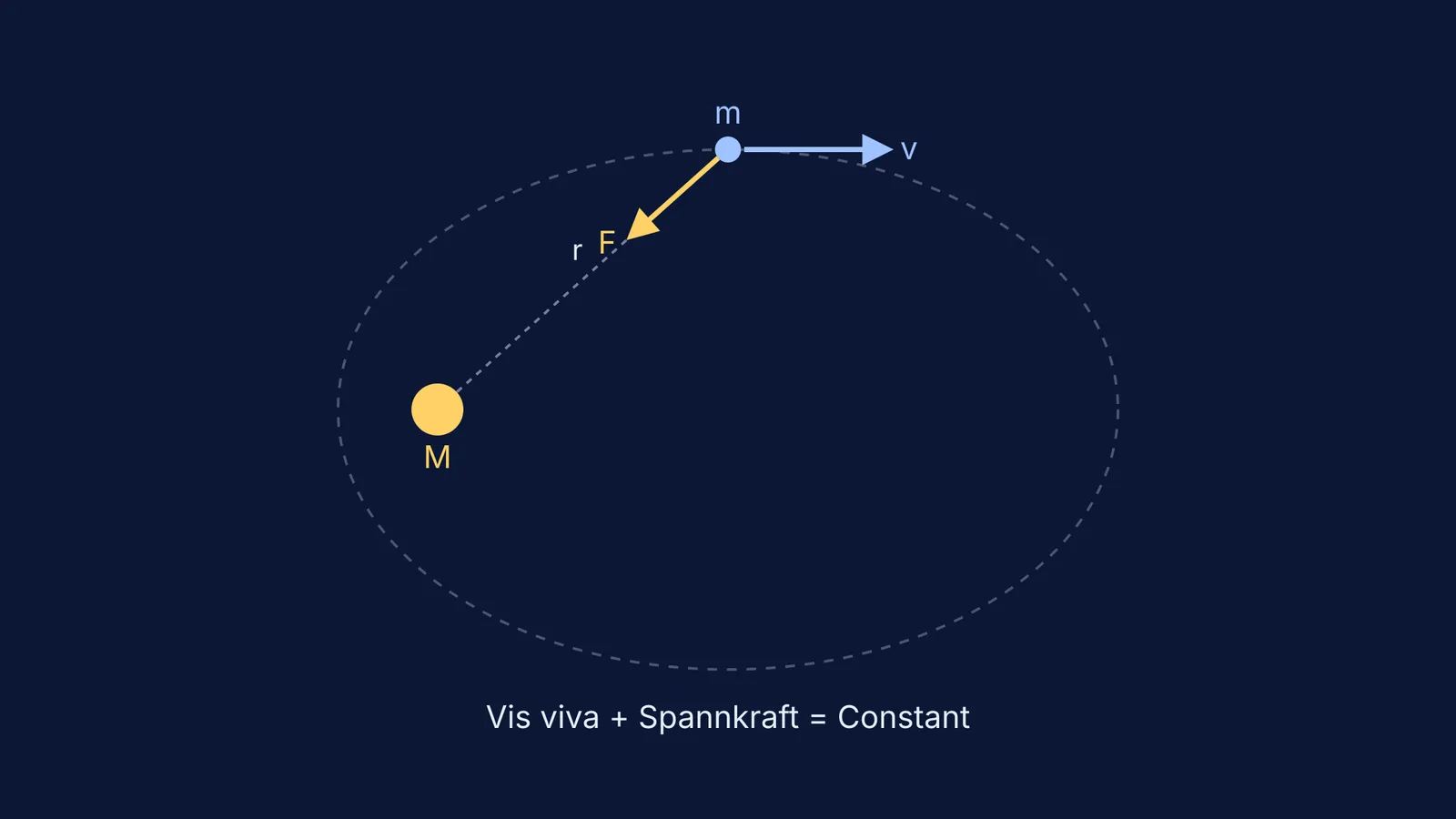
Vis viva ("living force"): What we now call kinetic energy.
Spannkraft ("tension force"): What we now call potential energy.
He showed mathematically that if forces act along the line between particles (central forces), the sum of *vis viva* and *Spannkraft* in a closed system is always constant. If a falling object gains kinetic energy, it must lose exactly as much potential energy.
He then applied this principle across disciplines. He argued that heat is just the motion of particles, and that the heat and muscle energy produced by animals comes entirely from the chemical energy in their food. This left no room for a mysterious vital force, effectively bringing biology under the laws of physics.
Why was Helmholtz's essay initially rejected?
Despite its brilliance, the paper was not immediately accepted by the scientific establishment. Helmholtz submitted it to *Annalen der Physik*, the leading German physics journal of the time, edited by Johann Christian Poggendorff.
According to the Stanford Encyclopedia of Philosophy, Poggendorff rejected the paper for being too speculative. At the time, the journal favoured experimental measurements, and Helmholtz's paper relied heavily on mathematical deduction from philosophical axioms. Undeterred, Helmholtz published *Über die Erhaltung der Kraft* as a private pamphlet in 1847. It was soon translated into English and became one of the most important scientific documents of the 19th century.
How to use energy conservation in problem solving?
In modern physics, the principle Helmholtz laid out is your most powerful tool. When a system only involves conservative forces (like gravity or electrostatic attraction), you do not need to calculate the complex forces at every point in the path. You only need to compare the start and the end. If you are struggling with when to use energy conservation instead of Newton's laws, the key is whether you care about time or just the initial and final states.
If you are stuck on setting up these equations, the Fermi Problem Library has worked problems with a step-by-step solver that explains the reasoning rather than printing an answer. It helps you spot whether a problem depends on the path taken (use forces) or just the start and end states (use energy).
A quick checklist for using conservation of energy:
Identify the system: What objects are involved? Is the system closed?
Check the forces: Are there non-conservative forces like friction or air resistance? If yes, the mechanical energy will not be conserved (some turns into heat).
Pick your states: Choose an initial state where you know the values, and a final state where you want to find a value.
Set your zero: Choose a convenient reference level where potential energy is zero (such as the ground).
Equate: Write K₁ + U₁ = K₂ + U₂ and solve.
If you want to visualise how kinetic and potential energy trade places, the Fermi Simulation Lab has interactive simulations for the ideas that are easier to see than to read. You can watch a pendulum swing or test understanding planetary orbits with a gravity simulation, and see Helmholtz's *vis viva* and *Spannkraft* perfectly balance each other at every point in the path.