

On this page
In 1909 a zoologist named Helen Dean King took one litter of four albino rats at the Wistar Institute in Philadelphia and began mating brother with sister, generation after generation. Her records challenged the old fear that such close inbreeding must weaken animals, and her nearly identical rats became prized research animals.
Who was Helen Dean King?
King was born in Owego, New York, in 1869, graduated from Vassar College in 1892 and earned a PhD at Bryn Mawr College in 1899 under Thomas Hunt Morgan, according to her Wikipedia biography and Bryn Mawr College. The Wistar Institute describes her as the first woman hired as a scientist at Wistar, where she worked from 1909, wrote more than 80 research papers and won the Ellen Richards Research Prize in 1932.
How did Helen Dean King breed inbred rats?
Her own account is in Studies on inbreeding III, published in the Journal of Experimental Zoology in 1918. The starting point was a litter of two males and two females from the Institute's general albino colony, picked only because the litter was large. Each female founded a line, called A and B.
Every breeding female was paired twice with a litter brother, which King called "the closest form of inbreeding possible in mammals". She then paired the same female twice with an unrelated stock male, so she could compare inbred litters with half-inbred ones.
By the 25th generation her sex records covered 3,408 litters and 25,452 rats, and later generations had about twenty breeding females per line (King, 1918).
Did inbreeding make her rats weaker?
At first it looked that way. The early generations suffered badly from poor feeding: many were sterile and any rat that would breed was used. Once the diet improved, around the fourth generation, the rats gained weight, litters got bigger and sterility almost disappeared (King, 1918).
The Encyclopedia.com entry on King reports that she kept the line going for more than 130 generations, and that after 50 generations her inbred rats beat stock controls on fertility, growth and lifespan, refuting Charles Darwin's view that inbreeding leads to degeneration. Her conclusion, it says, was that close inbreeding need not harm growth, fertility or vigour, provided the best animals from a large population are chosen to breed.
The historian Marilyn Ogilvie notes, in a 2007 paper in the Journal of the History of Biology, that King used her "nearly homozygous rats" as desired commodities, which gave her access to people and venues otherwise closed to her as a woman. The same paper covers a harder part of her story: she took part in the eugenics debates of her time.
Can selection change the sex ratio?
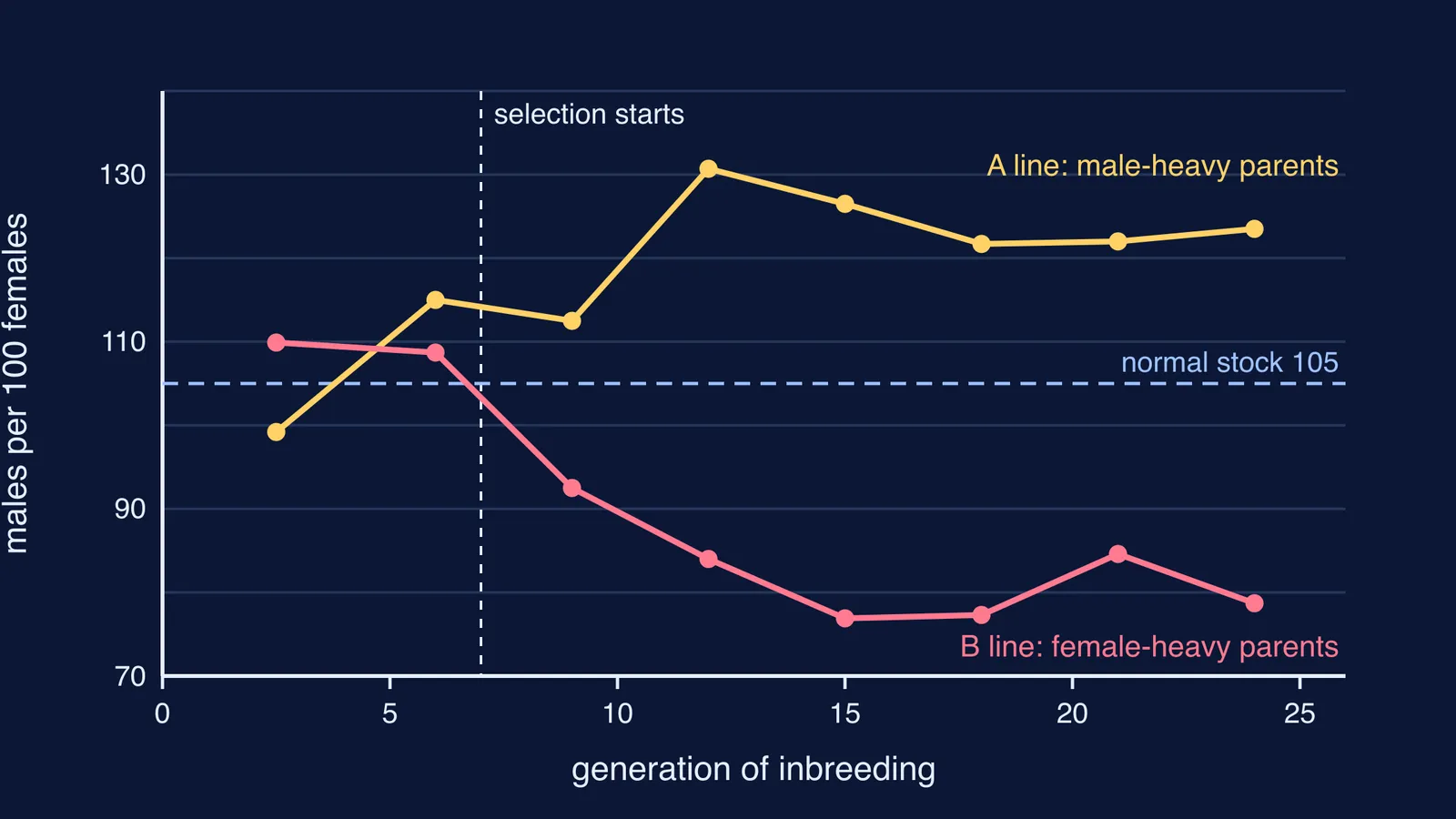
From the seventh generation, King took line A's breeding females only from litters with extra males and line B's only from litters with extra females. Her standard was the ordinary Wistar stock, which gave about 105 males per 100 females (King, 1918).
Over generations 8 to 25, the inbred litters of line A gave 122.3 males per 100 females, and line B gave 81.8 (King, 1918). Two lines from one litter had moved in opposite directions, each the way it was selected. King also found no cumulative effect: in later generations the ratios became steadier, but not more extreme.
For the chromosome side of the story, read our piece on Nettie Stevens and the chromosome count that showed how sex is set.
How can you check King's numbers yourself?
Here is a worked example using one row of her Table 7 (line B, generations 14 to 16): 888 young, 386 males and 502 females (King, 1918).
Sex ratio: 100 × 386 ÷ 502 = 76.9 males per 100 females.
Chance of a male at the normal ratio: 105 ÷ 205 = 0.512.
Males expected by chance: 888 × 0.512 ≈ 455.
Spread expected by chance (binomial standard deviation): √(888 × 0.512 × 0.488) ≈ 14.9.
Gap in standard deviations: (455 − 386) ÷ 14.9 ≈ 4.6.
A gap of more than four standard deviations is very unlikely to be luck. Now try line A, generations 11 to 13: 953 young, 540 males, 413 females. You should get about 130.8 and a gap of about 3.4 standard deviations the other way.
If the binomial standard deviation step is new, the Fermi Concept Library has a lesson for each concept in mathematics and biology, with its place in the map.
Why do Wistar rats still matter?
The Wistar rat was developed at the Institute in 1906, and the Wikipedia article on the Wistar rat credits the original colony to Henry Donaldson, Milton Greenman and King. More than half of all laboratory rat strains are thought to descend from it, including Long-Evans and Sprague Dawley. The logic is the one behind King's work: if every rat starts with nearly the same genes, a difference between groups is more likely to come from the experiment.
For what happens to genes in small, closed populations, read Sewall Wright and genetic drift. For how biologists choose a model animal, see why Drosophila is used in genetics experiments.


