On this page
Each protein your cells make has to end up somewhere specific. For a long time nobody knew how a new protein "knew" where to go, or how it crossed a sealed, fatty membrane. Günter Blobel, a cell biologist at the Rockefeller University in New York, answered both questions. He won the 1999 Nobel Prize in Physiology or Medicine "for the discovery that proteins have intrinsic signals that govern their transport and localization in the cell", as the Nobel Assembly's press release records.
If you are studying the cell for CBSE or NEET-UG, this is the idea that connects ribosomes, the rough ER and secretion into one story.
What is the signal hypothesis?
The signal hypothesis is the idea that a protein destined to leave the cell contains, as part of its own chain, a signal that directs it to and across the membrane of the endoplasmic reticulum (ER), according to the Nobel press release.
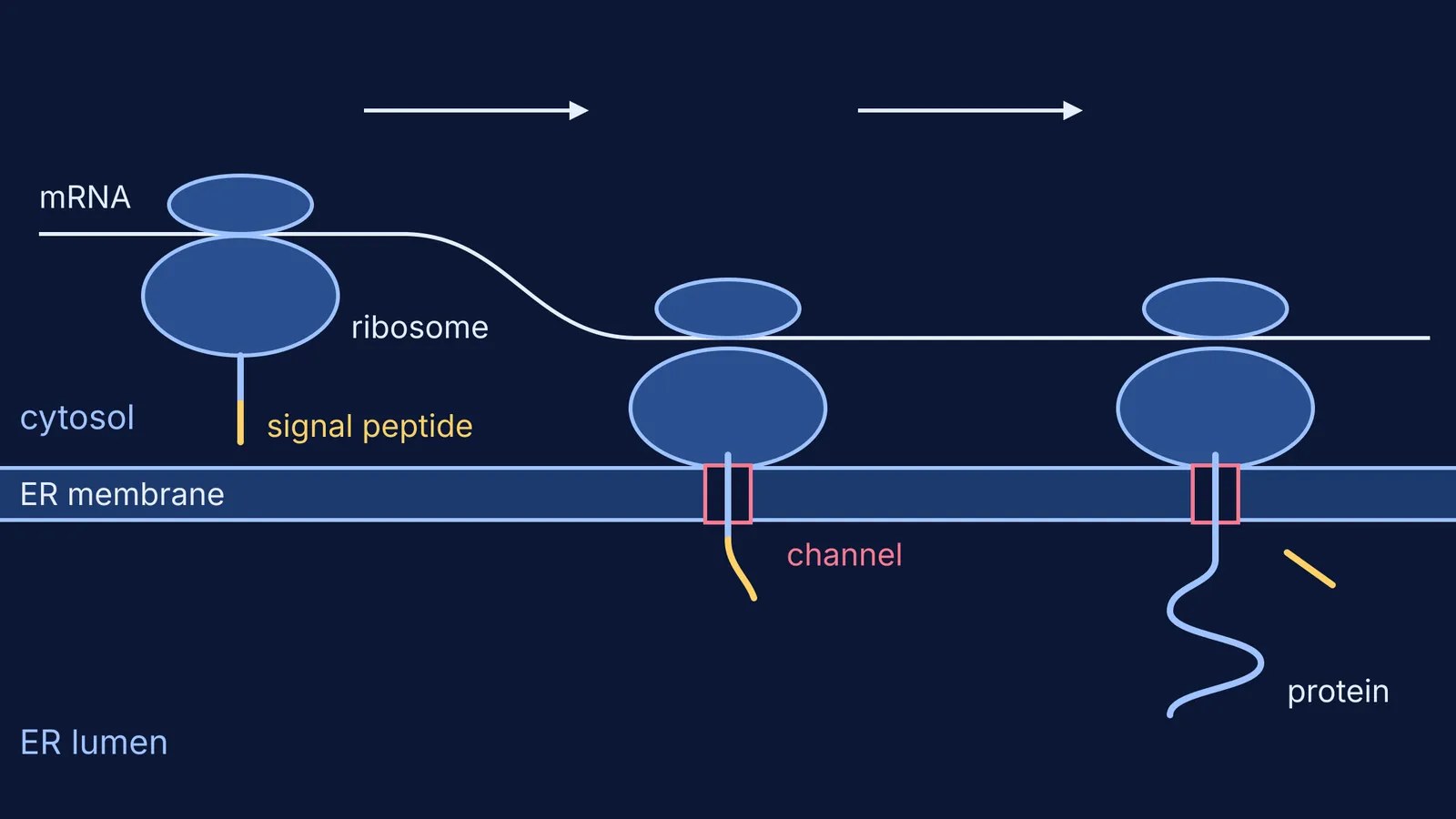
Blobel formulated a first version in 1971. The signal is a peptide, a sequence of amino acids built into the protein itself, and the growing protein crosses the ER membrane through a channel. The press release lists the steps:
The ribosome reads the messenger RNA and starts building the protein.
The first part made is the signal peptide.
With the help of binding proteins, the signal peptide guides the ribosome to a channel in the ER membrane.
The growing chain threads through the channel, and the signal peptide is cut off.
The finished protein is released into the ER lumen and later transported out of the cell.
If ribosomes still feel shaky, read our guide to the genetic code and translation first.
How did Blobel prove that proteins carry an address?
Blobel graduated in medicine from Tübingen in 1960, finished his graduate studies at the University of Wisconsin in 1966, and then joined George Palade's Laboratory of Cell Biology, as he recounts in his Nobel autobiography. Read about George Palade and the ribosomes in the cell's protein factory.
Key evidence came in a 1975 paper with Bernhard Dobberstein in the Journal of Cell Biology. They studied antibody light chains from mouse myeloma tumours, whose messenger RNA sat on membrane-bound ribosomes. Translated in a test tube, the RNA gave a product larger than the light chain the cells secrete. In the cells, the extra piece, the signal, was removed before the chain was even finished.
Do other organelles have their own postcodes?
Yes. In a 1980 paper, Intracellular protein topogenesis, Blobel proposed that the information for a protein's location is encoded in "topogenic" sequences in its chain. He named four kinds: signal sequences that start transfer across a membrane, stop-transfer sequences that leave a protein sitting in the membrane, sorting sequences, and insertion sequences.
The Nobel press release adds that these signals are a short tail at one end of the protein or sometimes inside it, and that the processes work the same way in yeast, plant and animal cells.
Why does protein targeting matter for health?
If a sorting signal is changed, the protein can end up in the wrong place. The press release gives examples: primary hyperoxaluria, which causes kidney stones early in life; some forms of familial hypercholesterolemia; and cystic fibrosis, where proteins fail to reach their proper destination.
The same knowledge helps make medicines. Drugs such as insulin and growth hormone are proteins, and genes for them can be given sequences coding for transport signals so that cells work as efficient "protein factories".
Blobel was born in 1936 in Waltersdorf, now in Poland, and died in New York in 2018 (Nobel facts page). His autobiography says he donated the entire prize sum to restoring Dresden, including rebuilding the Frauenkirche.
How can you trace a protein's route in an exam answer?
Use this four-question check:
Where is it made? On free ribosomes, or on ribosomes attached to the ER?
Does it start with a signal peptide? If yes, it is steered to the ER as it is made.
Is the signal cut off? A cleaved signal means the final protein is shorter than the first product.
Where does it end up? Secreted, held in a membrane, or sent to an organelle by its own tag.
Worked example: an antibody light chain. It is made on membrane-bound ribosomes (1) and starts with a signal peptide (2). The signal is cut off at the ER, which is why the test-tube version in the 1975 experiment was larger (3). The chain enters the ER lumen and is secreted (4).
For organelle comparisons, see Cell: the unit of life for NEET, with organelles compared. If a step is still unclear, the Fermi Concept Library has a lesson for each biology concept, and Fermi's AI tutor checks your understanding as it goes.