

On this page
In the late 1930s, television was still a black-and-white medium, and the equipment to broadcast it was fiercely expensive. In Mexico City, an engineering student named Guillermo González Camarena wanted to change both. In 1934, he built his first television camera from an RCA iconoscope kit and parts scavenged from local markets, setting out to create a system that could see the world in full colour.
His solution was as elegant as it was practical. Rather than inventing an entirely new broadcasting standard from scratch, he designed an adapter that could upgrade existing black-and-white sets.
How did Camarena's field-sequential colour television work?
Camarena's invention, the Sequential Field Tri-Chromatic System, relied on two core ideas from physics and biology: the primary colours of light and the persistence of vision.
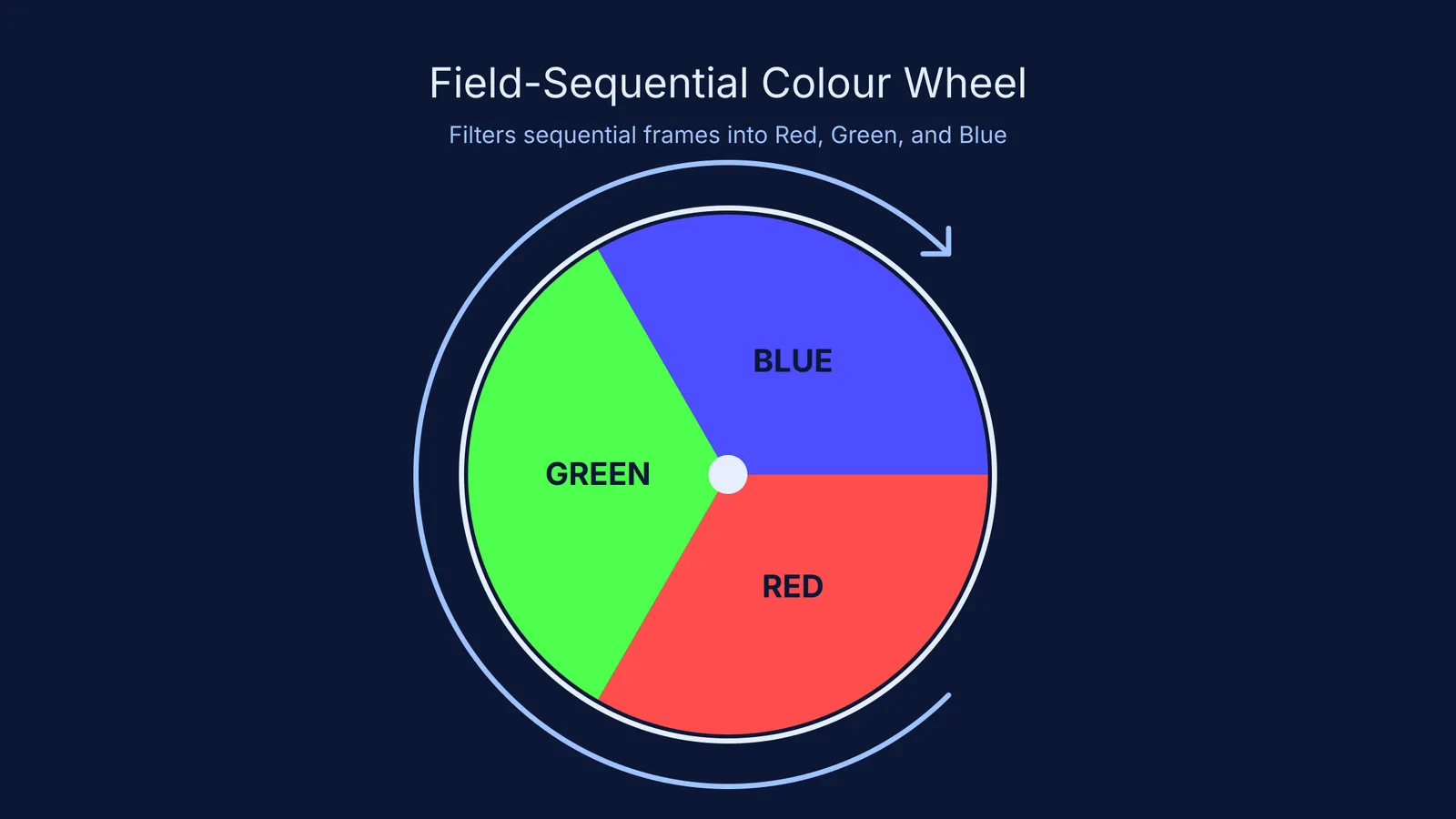
The system used a motor-driven spinning disc with three primary colour filters (red, green, and blue) placed in front of a standard black-and-white camera. As it turned, the camera captured a rapid sequence of monochromatic frames. First, it recorded only the intensity of the red light in the scene, then the green, and finally the blue.
At the viewer's end, a second, identical wheel spun in perfect synchronization in front of the television receiver. Because the human eye retains an image for a fraction of a second, the rapidly flashing red, green, and blue frames blended together in the brain. The viewer perceived a continuous, full-colour moving image.
Just as a prism separates white light into its component wavelengths — a phenomenon often studied alongside the dispersion of white light by a glass prism — Camarena's wheel separated the scene into three primary bands before putting them back together in the mind of the observer.
Why was his 1940 patent important?
In 1940, at the age of 23, Camarena patented his Sequential Field Tri-Chromatic System in Mexico and filed for a patent in the United States, which was granted in 1942.
This 1940 milestone is widely recognised as a pioneering breakthrough for colour television. Its brilliance lay in its simplicity. Because it was designed as an adapter, it offered an affordable path to colour broadcasting without forcing stations and families to discard their expensive black-and-white equipment.
His work built on the foundation of 19th-century physics and the primary colours of light. Camarena brought this three-colour principle to the moving image.
How did NASA use his technology?
Camarena continued to refine his designs, eventually creating a Simplified Bi-Color System in the 1960s to further reduce manufacturing costs by 50%. Tragically, he died in 1965, but his engineering legacy reached far beyond Earth.
When NASA needed a robust, reliable camera system for deep space exploration, commercial colour television standards were less compact and reliable. Instead, NASA used a field-sequential colour system — the very technology Camarena pioneered — for the Voyager mission in 1979 to transmit the first high-quality colour images of Jupiter back to Earth.
How to study optics and colour addition
If you are studying light and colour in physics, use this three-step framework to master the concepts:
Trace the path: Always start by drawing the ray diagram or wave. Whether light is passing through a lens or being filtered by a spinning disc, sketching the physical path makes abstract ideas visible.
Isolate the variables: In Camarena's system, time and colour are separated. Treat each variable independently (for example, trace what happens only to the red light first).
Connect to human perception: Optics often bridges physics and biology. Remember that "colour" and "continuous motion" are biological responses to physical wavelengths and frame rates.
Mastering optics and waves
Understanding how light can be manipulated, filtered, and recombined requires a solid grasp of waves and electromagnetism. If you are struggling to visualise how frequencies of light interact, Fermi's AI tutor can work out what you already know and build a plan for the session. Rather than just giving you the answer, it teaches through the concept — drawing the figures and checking your understanding as it goes, so you sit down to a clear next step.
Guillermo González Camarena proved that you do not always need to invent a complex new machine; sometimes, the best solution is a clever way to adapt the tools you already have.


