On this page
In the early 1900s no one had proved what caused scarlet fever. Gladys Henry Dick trained as a doctor at Johns Hopkins and caught the disease herself while working at Children's Memorial Hospital in Chicago. She then studied its cause at the University of Chicago with George Dick, who became her husband in 1914 (Wikipedia biography). In 1923 they settled the question, and within two years they had a test and a treatment as well.
Why was the cause of scarlet fever so hard to find?
You could grow bacteria from sick patients, but that alone does not prove the bacteria caused the illness. The Dicks' own patent lists what earlier researchers had tried to inoculate into people: skin scales, blood, filtered throat mucus and pure cultures from patients. The patent's summary of that work: "Experimental scarlet fever had not been produced in animals or in man by inoculation of a pure culture of any organism" (US patent 1,547,369).
And one attack of scarlet fever usually gave lasting immunity, which, the patent notes, "was not considered characteristic of streptococcus infections".
How did Gladys Dick discover the cause of scarlet fever?
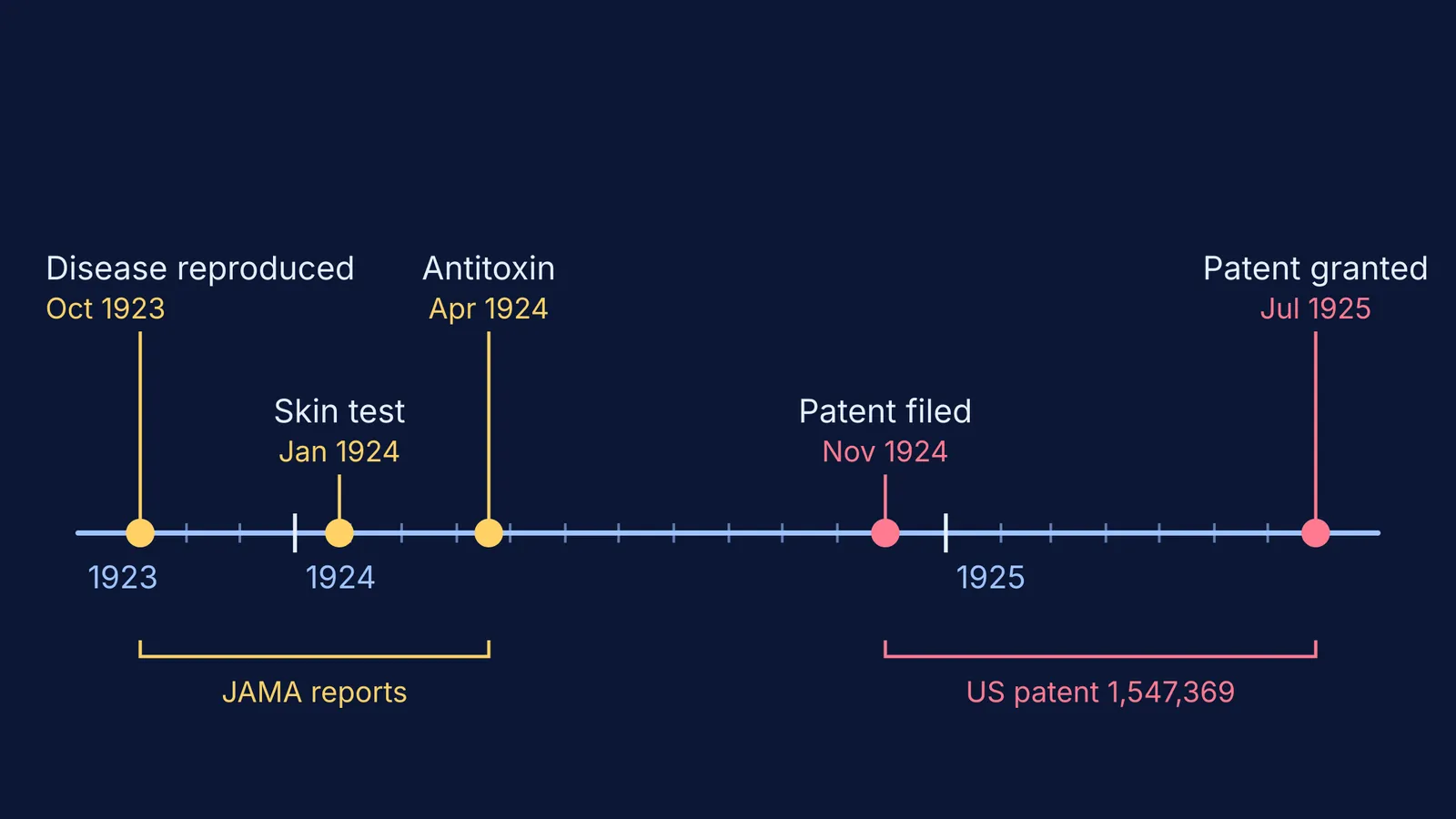
The Dicks isolated a haemolytic streptococcus from a lesion on the finger of a scarlet fever patient and grew it as a pure culture. When they inoculated a human volunteer with it, the volunteer developed scarlet fever (US patent 1,547,369). The report, "Experimental scarlet fever", appeared in JAMA on 6 October 1923 (JAMA, doi:10.1001/jama.1923.02650140010004).
Next they separated the germ from its poison: they grew the streptococcus for six days, filtered the broth through paper and a Berkefeld filter, and cultured the liquid to check it was sterile. The patent says the sterile toxin "is capable of producing the characteristic symptoms of scarlet fever, including the rash." An amount equal to one thousand skin-test doses could cause malaise, nausea, vomiting, a fever of 101 F and a scarlet rash in susceptible adults.
Today these toxins are called streptococcal pyrogenic exotoxins. They belong to a family of bacterial proteins known as superantigens (Hurst et al., PLOS Pathogens, 2021).
What is the Dick test and how does it work?
The Dick skin test injects 0.1 c.c. of standardised toxin into the forearm and reads the result after 24 hours (US patent 1,547,369). The other arm gets toxin that has been neutralised, as a control. Redness, tenderness and swelling at the toxin site mean the person is not immune (Encyclopedia.com). The test was described in JAMA on 26 January 1924 (doi:10.1001/jama.1924.02650300011003).
In the Dicks' 1924 report, the filtrate gave positive or strongly positive skin tests in 41.6% of people with no history of scarlet fever, while people recovering from the disease showed negative or only slightly positive reactions (LITFL). Other doctors soon took up the test. A 1924 JAMA study by Charles Branch and F. Gill Edwards at Boston City Hospital used the Dicks' "original W filtrate, diluted 1:1,000" (JAMA).
Worked example: read three Dick tests
Toxin arm red and swollen, control arm clear. Susceptible: nothing in the blood neutralised the toxin.
Both arms clear. Immune: the person's own antitoxin neutralised the toxin.
Both arms red. The neutralised control reacted too, so the redness cannot be blamed on the toxin alone. This is why the control exists.
The Dicks used the same logic to identify scarlet fever strains: a strain counted if its filtrate gave a positive reaction mixed with salt solution but not mixed with serum from a recovered patient.
How did the Dicks make a scarlet fever antitoxin?
They injected horses under the skin with increasing doses of toxin, "beginning with 20 c. c. and increasing to one liter", and collected the antitoxin from their blood (US patent 1,547,369). JAMA published "A scarlet fever antitoxin" on 19 April 1924 (doi:10.1001/jama.1924.02650420010005). Larger doses of the toxin itself were used to build active immunity (Wikipedia).
Their 1924 and 1926 patents drew criticism from the medical field; they argued the patents maintained quality control. Penicillin replaced their antitoxin in the 1940s (Wikipedia). They were nominated for the Nobel Prize in 1925 (University of Nebraska-Lincoln).
For a biology exam: horse antitoxin gives passive immunity (ready-made antibodies), while graded toxin doses give active immunity (the body makes its own). The horse-serum idea follows Emil von Behring's diphtheria antitoxin, which built on Shibasaburo Kitasato's pure tetanus culture. Our chapter guide to pathogens, immunity and vaccines for NEET puts these ideas side by side.
If active and passive immunity still blur together for you, the Fermi Concept Library gives every concept in biology its own lesson and shows where it fits on the map.
Is scarlet fever still around?
Yes. Group A streptococcus causes scarlet fever, it is contagious, and it is most common in children aged 5 to 15 (CDC). Cases have risen in parts of East and South-East Asia since around 2011, and in the UK and other European countries since around 2014 (Hurst et al., 2021). Today it is treated with antibiotics.
Next time you read about a pathogen, try asking the Dicks' three questions: can it cause the disease, what does it release, and can the body neutralise that?