

On this page
Long before microscopes could reveal bacteria and viruses, the medical world blamed epidemics on "miasma"—invisible clouds of poisonous or bad air that rose from swamps and decaying matter. Alternatively, doctors blamed internal imbalances of the body's four humours. But in 1546, the Italian physician Girolamo Fracastoro offered a radically different and highly accurate idea.
In his landmark book *De Contagione et Contagiosis Morbis* (On Contagion and Contagious Diseases), Fracastoro proposed that diseases spread by invisible "seeds of contagion" (10.1086/368701). While he still believed celestial alignments and foul air could trigger outbreaks, he argued that contagious diseases themselves were transmitted by tiny particles that passed from person to person. This concept anticipated the modern germ theory of disease by over 300 years.
What were the seeds of contagion?
Fracastoro called these theoretical particles *seminaria contagionis*, or "seeds of contagion" (Wikipedia). He reasoned that these invisible seeds were specific to each disease, much like the seeds of a particular plant grow only into a specific tree.
He suggested that these seeds were physical particles capable of multiplying within a host and surviving for extended periods outside of it. While he could not see them, his logical deduction perfectly described what we now know to be pathogens such as bacteria and viruses, viroids and lichens. It would take centuries and the meticulous work of scientists like Dmitri Ivanovsky on how viruses were discovered to finally isolate and observe the particles Fracastoro had imagined.
What are Fracastoro's three modes of transmission?
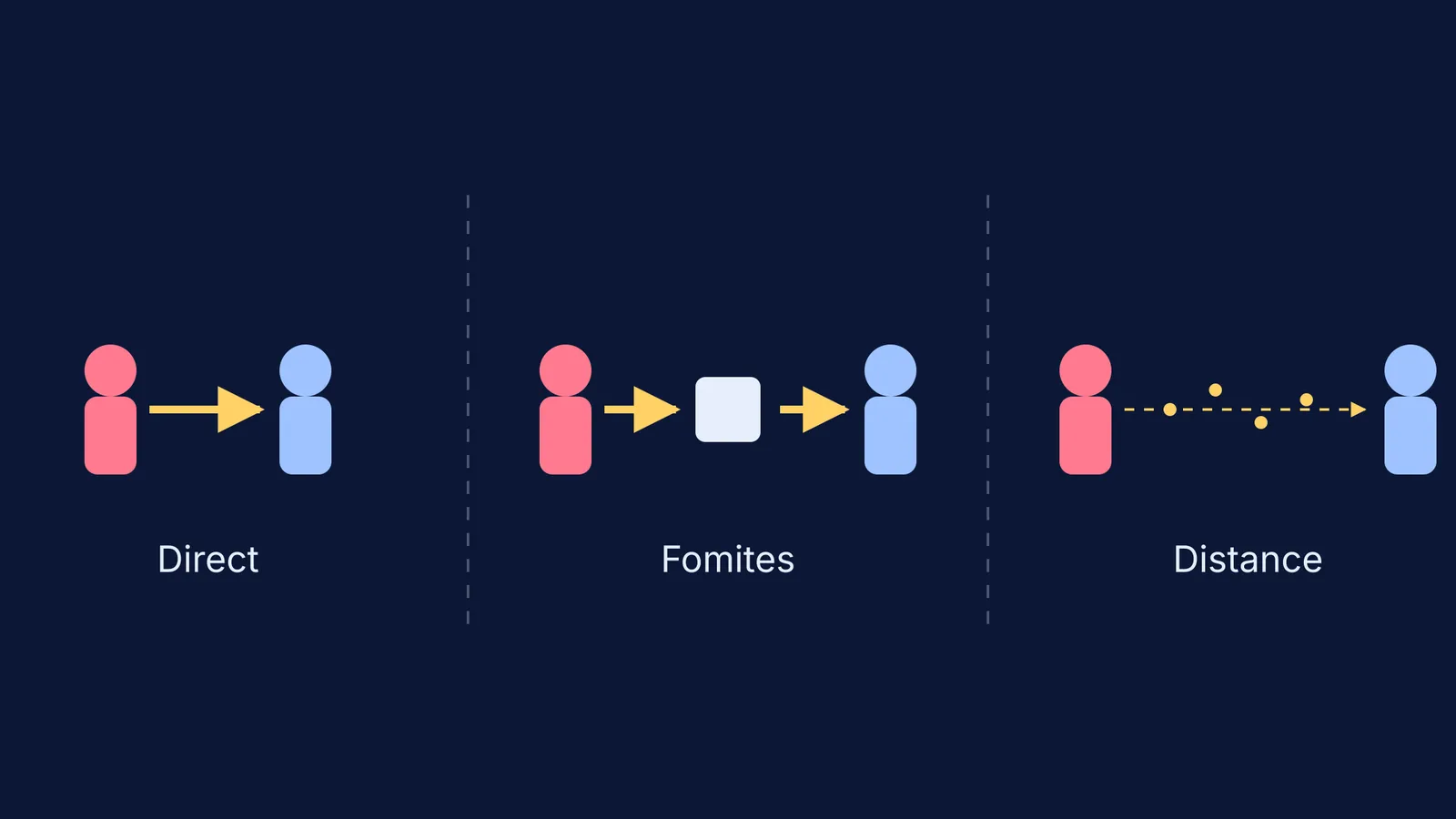
Perhaps Fracastoro's most lasting contribution was categorising how these seeds travel from one person to another. His 1546 classification is remarkably accurate and remains the foundation of epidemiology today:
Direct Contact: The seeds spread through immediate physical touch between an infected person and a healthy one. This includes skin-to-skin contact or the transfer of bodily fluids.
Indirect Contact (Fomites): The seeds are left on inanimate objects, which then infect the next person who touches them. Fracastoro coined the Latin term *fomes* (meaning "tinder") to describe how everyday items like clothing, bedding, and wooden tools could catch and carry the "fire" of infection.
Distance Transmission: The seeds travel through the air without any physical contact or shared objects. Fracastoro likened this to the way an odor can travel across a room.
How did the medical world react to his theory?
Despite its brilliant logic, Fracastoro's specific mechanical explanation of "seeds" was largely ignored or misunderstood by his peers. Sixteenth-century medicine was heavily reliant on the ancient texts of Galen and Hippocrates, and most physicians integrated his ideas into existing frameworks rather than abandoning the miasma theory.
The biggest hurdle was the lack of empirical evidence. Because the microscope had not yet been invented, Fracastoro could not show anyone his "seeds". It was not until the late 19th century, with the groundbreaking experiments of Louis Pasteur and Robert Koch, that the scientific community finally proved that microscopic germs were the true agents of disease.
How can this framework help your biology revision?
For students preparing for biology exams like NEET, Fracastoro's 1546 framework is a highly effective way to group and memorise human diseases. Instead of trying to rote-learn a long, random list of pathogens, you can actively organise them by his three classic modes of transmission:
Direct Contact: Fungal infections like ringworm spread when infected skin touches healthy skin, while diseases like syphilis require direct fluid transfer.
Fomites: Typhoid (bacteria) and common colds (viruses) frequently spread through contaminated utensils, shared towels, or doorknobs.
Distance (Airborne): Respiratory diseases like pneumonia (bacteria) and tuberculosis spread via tiny droplets or aerosols suspended in the air.
By connecting each pathogen to its specific mode of travel, you create a mental map that is much easier to recall during an exam. If you struggle to remember which pathogen takes which route during your revision, Fermi's AI tutor can work out what you already know and build a plan for the session, so you sit down to a clear next step. You can also look up the complex life cycles of specific pathogens in the Fermi Concept Library to see exactly how they enter the human body and evade the immune system.
Fracastoro lacked the optical tools to prove his theory, but his deduction that diseases spread through specific, physical seeds remains one of the greatest intellectual leaps in the history of science.


