

On this page
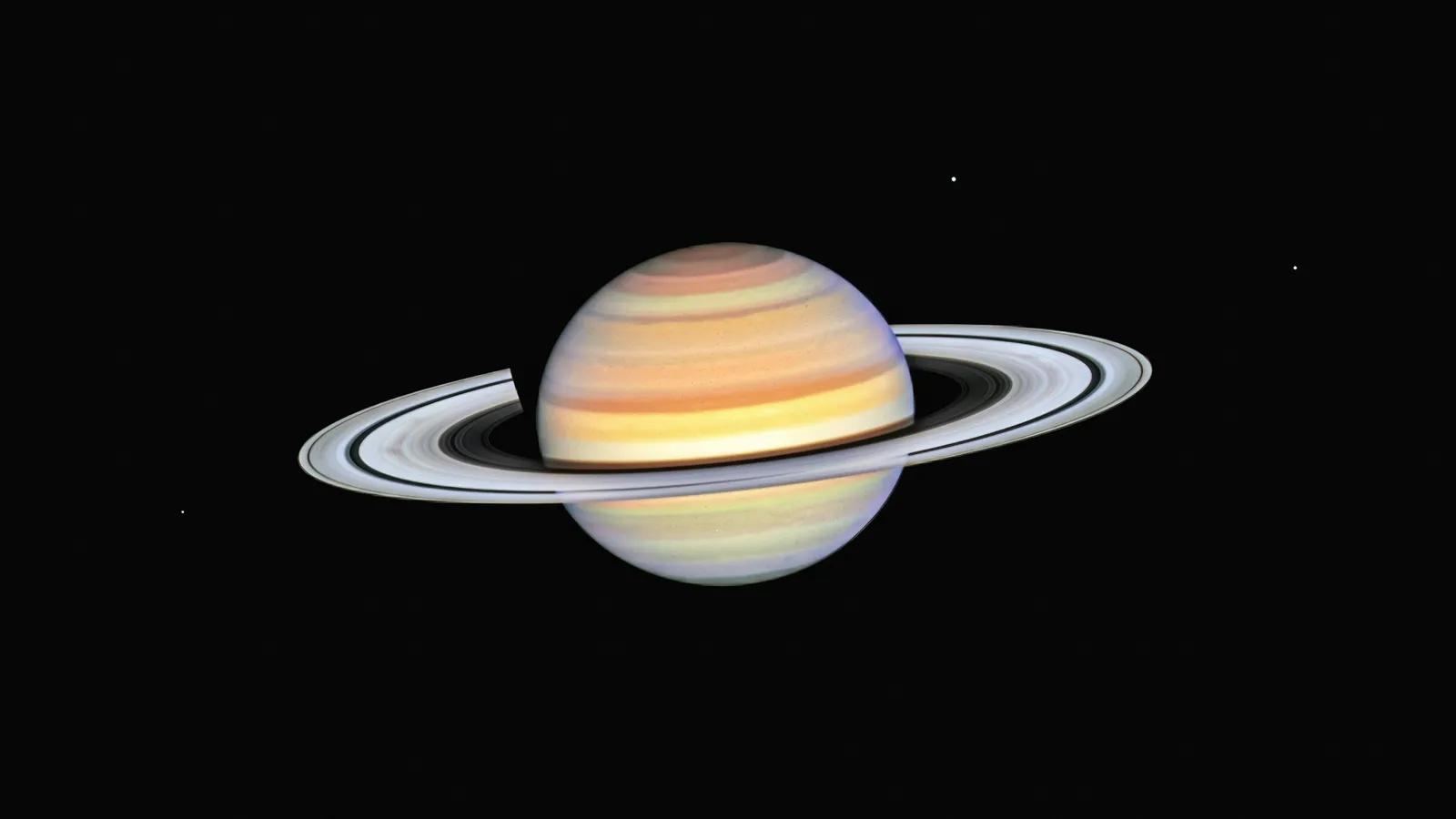
Look at Saturn through a decent telescope and the rings appear split by a thin dark line. Giovanni Domenico Cassini saw that line in 1675, and he found four of Saturn's moons as well. This post covers what he discovered, how he reasoned about it, and how Kepler's third law from Class 11 explains why the gap sits where it does.
Who was Giovanni Cassini?
The European Space Agency's profile says Cassini was born on 8 June 1625 in Perinaldo in Italy. He came to astronomy through an early interest in astrology, worked in Bologna with a wealthy amateur astronomer's instruments, and held a chair at the University of Bologna. In 1666 he used observations of Mars to estimate that it rotates once every 24 hours 40 minutes, close to the modern 24 hours 37 minutes. The tables of Jupiter's moons he compiled in 1668 were later used by Ole Rømer to show that light travels at a finite speed.
In 1669 King Louis XIV invited him to Paris to join the new Académie Royale des Sciences, and by 1671 he was director of the Paris Observatory. Known in France as Jean-Dominique Cassini, he died in Paris in 1712.
Which moons did Cassini discover?
NASA's moon pages give the dates:
Cassini called the four the Sidera Lodoicea, the Stars of Louis, after the king. Iapetus puzzled him: it looked bright on one side of Saturn and faint on the other. NASA notes that Cassini observed this dark-light difference when he discovered the moon, and that the Voyager flybys of 1980 and 1981 confirmed his explanation, that one hemisphere of Iapetus is far darker than the other. Its leading side is as dark as coal.
What is the Cassini Division?
ESA records that in 1675 Cassini found a narrow gap separating Saturn's rings into two parts. He also suggested that the rings were swarms of tiny moonlets too small to see one by one, which matches the modern picture of ice particles, pebbles and dust.
The NASA Saturn ring fact sheet puts the outer edge of the B ring at 117,507 km from Saturn's centre and the inner edge of the A ring at 122,340 km. The gap between them is 122,340 - 117,507 = 4,833 km. It is not empty, just much thinner in material than the rings on either side.
Why is the gap where it is?
A 2010 study of Cassini spacecraft images in The Astronomical Journal describes the outer edge of the B ring as controlled in part by the 2:1 resonance with the moon Mimas, discovered much later by William Herschel. Ring particles there circle Saturn exactly twice for every one orbit of Mimas, so they get the same gravitational tug at the same point again and again.
Worked example: find the 2:1 resonance with Kepler's third law
Kepler's third law, from the NCERT Class 11 Gravitation chapter, says T² is proportional to a³ for bodies orbiting the same mass. So a ∝ T^(2/3).
Mimas's orbit. The Saturnian satellite fact sheet gives a = 185,520 km and T = 0.9424 days.
Half the period. A particle in 2:1 resonance has T = 0.9424 / 2 = 0.4712 days.
Scale the radius. a = 185,520 x (1/2)^(2/3). Since (1/2)^(2/3) = 0.630, a = 185,520 x 0.630 = about 116,900 km.
Compare. The B ring ends at 117,507 km, so our simple estimate, which treats Saturn as a perfect sphere, lands within about 1 per cent of the edge of the Cassini Division.
You can check step 3 another way. Using T = 2π √(a³/GM) with Saturn's GM = 3.793 x 10^16 m³/s² from the Saturn fact sheet and a = 1.169 x 10^8 m gives T = 40,760 s, or 0.472 days. It matches.
Common mistakes:
Squaring and cubing the wrong side. It is T² ∝ a³, so a scales as the 2/3 power of T, not the 3/2 power.
Mixing units in the full formula. Use metres and seconds with GM in m³/s², then convert the answer to days.
For more on the law itself, read our post on Kepler's laws of planetary motion, or William Herschel, who found Mimas a century after Cassini. When a ratio problem like this goes wrong at the exponent, the Fermi Problem Library has worked problems with a step-by-step solver that explains the reasoning rather than printing an answer.
Was Cassini always right?
No. ESA notes that he concluded Earth was stretched at the poles like a rugby ball, when it actually bulges at the equator. Good observers can still draw the wrong conclusion from limited data, and later measurements settled the question.
What can a student take from Cassini's way of working?
Follow up on a puzzle. Iapetus brightening and fading was an odd detail, and he found its cause.
Better instruments open new questions. He turned to the planets as his telescopes improved.
Write down what you see. His careful tables of Jupiter's moons were useful to someone else for a discovery he did not make himself.
Try it now: use the same method to find where a 3:1 resonance with Mimas would sit, then look it up on the ring fact sheet.


