On this page
A Pap test takes a few cells from the cervix, the narrow lower end of the womb, and checks them under a microscope. It carries the name of the man who showed that these cells can give away cancer before a woman feels anything wrong, and who waited more than a decade to be believed.
Who invented the Pap smear test?
Georgios Papanikolaou, spelt George Papanicolaou in the US, invented the Pap smear. He was born on 13 May 1883 in Kymi, on the Greek island of Euboea, finished medical school in 1904 and earned a PhD in zoology from the University of Munich in 1910, according to the Embryo Project Encyclopedia at Arizona State University.
He and his wife, Mary, moved to New York in 1913. Weill Cornell Medicine's archives record that both found work at Gimbels department store before he became an assistant in the Department of Pathology at New York Hospital. He then spent 47 years at Cornell, where he set up the Papanicolaou Cytology Laboratory.
How did guinea pigs lead to a cancer test?
In 1917 he began studying the vaginal discharge of guinea pigs under the microscope, as the Embryo Project describes.
He then tried the same method on people. The same source says he performed the first of what was later called the Pap test on his wife in 1923, began a larger study with women who worked at the New York Women's Hospital two years later, and presented the technique as a new way to diagnose cancer at the Third Race Betterment Conference in Battle Creek, Michigan, in January 1928. Few doctors adopted it, and many called it superfluous.
In 1939 he partnered with Herbert Traut. Their 1941 paper, The Diagnostic Value of Vaginal Smears in Carcinoma of the Uterus40621-6), appeared in the American Journal of Obstetrics and Gynecology. After it, the Embryo Project notes, physicians began using his technique and the test became popular in the US.
What does a Pap test actually look for?
The US National Cancer Institute puts it in one line: "The Pap test (also called a Pap smear or cervical cytology) collects cervical cells so they can be checked for changes caused by HPV that may—if left untreated—turn into cervical cancer."
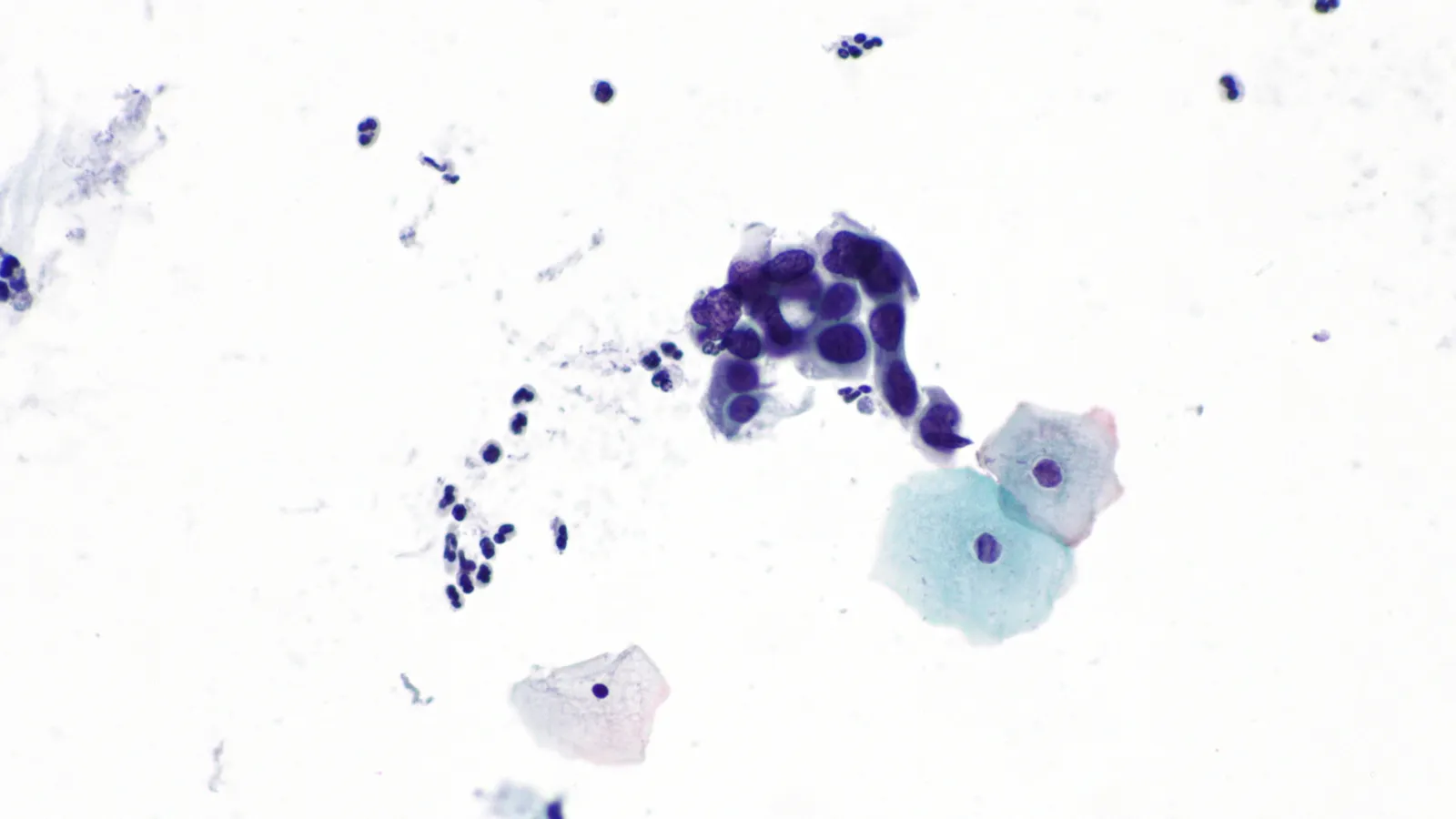
A teaching guide from the Wisconsin State Laboratory of Hygiene lists what marks a cell as abnormal. Use its clues as a checklist on the photo at the top of this page:
Nucleus size: low-grade abnormal cells have an abnormally large, dark nucleus.
Nucleus-to-cell ratio: high-grade cells show significant changes in how much of the cell the nucleus fills.
Stain and shape: high-grade nuclei are hyperchromatic, meaning they stain darker, and can vary a lot in size.
Maturity and grouping: high-grade cells are less mature and may sit singly, in sheets or in clusters.
Worked example: in the photo, the pale cells below and to the right of the centre are broad and flat, each with one small dot of a nucleus. Above them sits a crowded clump where dark, uneven nuclei almost fill each cell. All four clues point at the clump, and the photo's source labels it a high-grade lesion found on a Pap test.
Why does the Pap test still matter today?
The cervical cancer death rate in the US has dropped by more than half since the mid-1970s because of prevention and screening, says the American Cancer Society, although rates have stabilised in recent years.
Screening works because of time: the World Health Organization says abnormal cells usually take 15 to 20 years to become cancer.
The disease is far from beaten. WHO estimates around 604,000 new cases and around 280,000 deaths worldwide in 2024. India recorded 123,907 new cases in 2020, according to the figures in a review of Government of India screening guidelines, which notes that visual inspection with acetic acid every five years is the most cost-effective method in the Indian context.
The science also moved on. We now know the cause is persistent HPV infection, the discovery told in our story of Harald zur Hausen and HPV. WHO now recommends screening with a high-performance test every 5 to 10 years from age 30, and calls HPV vaccination a priority for girls aged 9 to 14, made possible by work like Ian Frazer's HPV vaccine.
What can students and families take from this?
For a biology student, Papanikolaou's work rests on the idea that disease shows up in cells, which goes back to Rudolf Virchow's cell theory. If the nucleus, the cell cycle or why cancer cells divide out of control still feels hazy, the Fermi Concept Library has a lesson for each concept and shows where it sits in the map of biology.
For families, the hard part is starting the conversation. A script a teenager could use with a mother or aunt:
"WHO says women should be screened for cervical cancer from age 30. Have you had a test?"
"Would you ask your doctor or the nearest government health centre about it? I can come with you."
This is not medical advice: screening choices, results and any symptoms belong with a doctor.
Next time you see a slide under a school microscope, look at the nuclei first. That is where Papanikolaou looked.