

On this page
In 1914 Cleveland inventor Garrett Morgan was granted a patent for a hood that let a firefighter breathe in a smoke-filled room. Its trick was a tube that hung down to just above the floor, where the air is cleaner. Two years later, Morgan wore it into a gas-filled tunnel under Lake Erie.
What was Garrett Morgan's safety hood?
Morgan's US patent 1,113,675, titled "Breathing device", was filed on 19 August 1912 and granted on 13 October 1914 (US1113675A on Google Patents). Its stated aim was to "enable a fireman to enter a house filled with thick suffocating gases and smoke and to breathe freely for some time therein".
The design had four parts:
A hood of rubber cloth, or asbestos cloth for fire work, pulled over the head.
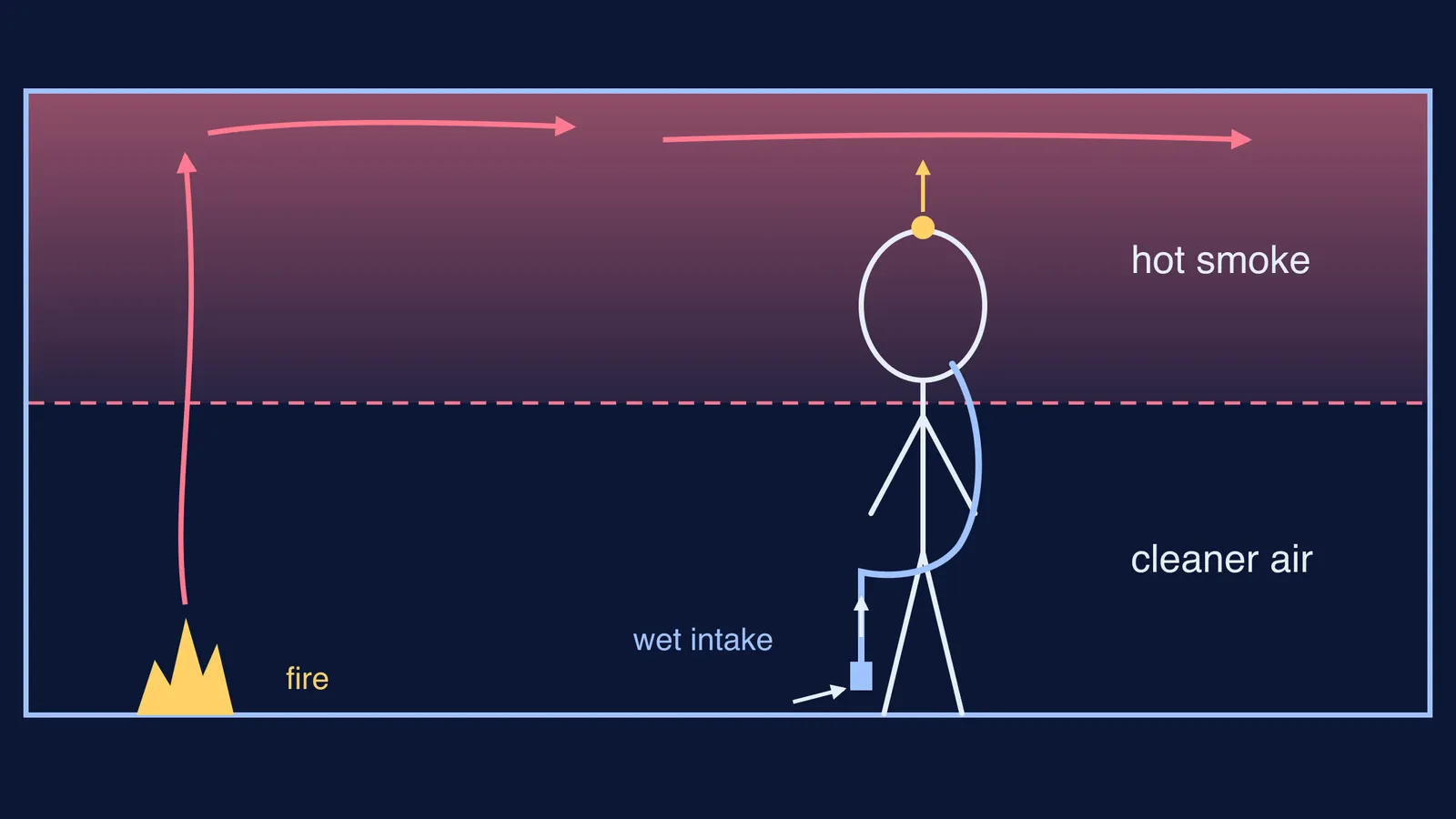
Two tubes running from the front of the hood down around the waist, resting on the hips and joining behind the body into one tube.
An absorbent lining at the lower end of that tube, kept wet, to hold back smoke and dust and cool the incoming air (Wikipedia describes it as a moist sponge).
A separate mouthpiece tube for breathing out: the exhaled breath lifts a light ball sitting in an opening at the top of the hood and escapes.
On the tube's length, the patent says that "for ordinary use the length shown just avoiding the floor will be sufficient".
Why does smoke rise and leave cleaner air near the floor?
Hot gas is less dense than cool gas at the same pressure. From the ideal gas law, density equals PM/RT, so at fixed pressure a gas's density is inversely proportional to its absolute temperature (see Jacques Charles and the gas law).
A worked example:
Room air at 27 °C is at 300 K.
Suppose gas leaving a fire is at 327 °C, which is 600 K.
Density ratio = 300 / 600 = 0.5, so the hot gas is about half as dense as the air around it.
The lighter gas rises, spreads under the ceiling and builds a hot layer that thickens downward.
Below that layer, for a while, sits cooler air that has not yet mixed with the smoke. This is why fire-safety advice says: "Crawl low in smoke, moving on hands and knees. Cleaner air is nearer the floor." That line comes from a fire-safety sheet adapted from a 1984 National Fire Protection Association leaflet (10 Tips for Fire Safety, City of Chico). Morgan's hood did the crawling for you: its tube reached the low air.
The limit: the wet lining could not make oxygen, so the hood only worked while breathable air remained near the floor.
What happened in the 1916 Lake Erie tunnel rescue?
Cleveland was building a water-intake tunnel under Lake Erie. Around 9:30 p.m. on 24 July 1916, the crew hit a pocket of natural gas, which exploded, according to Biography.com's account of the Cleveland tunnel disaster. The blast killed the nine-man crew in the tunnel and two others, and by the end the disaster had caused 21 deaths.
Morgan was called in and arrived with his brother Frank and four of his hoods (Garrett Morgan on Wikipedia). Biography.com reports that he made four trips into the tunnel, helping save two men, one of them named Van Duzen, and bringing out the bodies of four others. Other retellings give different counts.
Biography.com says Cleveland's daily papers barely mentioned him, and the Carnegie Hero Fund Commission turned him down, saying his rescue did not appear to carry "any extraordinary risk to his own life" because the hood protected him. On 4 February 1917, citizens presented him with a diamond-studded gold medal. Morgan kept inventing; read how he patented a traffic signal with a caution position.
How can you use Morgan's idea today?
Ask five questions of any safety device, from a pressure cooker's whistle to a seatbelt:
Where is the danger? For the hood: hot smoke, high up.
Where is the safe resource? Cooler air, low down.
How does the design reach it? A tube ending just above the floor.
What does it clean or block? A wet lining that holds back smoke and dust.
What does it get rid of? Breathed-out air, through the valve at the top.
For a family fire drill, the same leaflet gives the steps:
Agree on two ways out of every room in case flames or smoke block one.
Pick a meeting place outside.
Practise the plan as a drill.
In a flat, plan to use only the stairs, never the lift.
Never go back into a burning building.
To watch buoyancy at work, the Fermi Simulation Lab has interactive simulations for ideas that are easier to see than to read. For the gas law itself, the Fermi Concept Library gives each physics and chemistry concept its own lesson.
Next time you see smoke pooling under a ceiling, look at the gap beneath it. That gap is what Morgan designed for.


