

On this page
You sit down in an exam hall and stare at a question about cell division. You studied the textbook yesterday, but when you write down the answer, you somehow merge mitosis with meiosis, using phrases that sound scientific but mean nothing.
This is not just forgetting. Your brain is actively rewriting the facts to fit what it already assumes.
This phenomenon was first mapped in a famous 1932 psychological study, and it explains why rote learning often betrays students when they need it most.
What was the War of the Ghosts experiment?
In his 1932 book *Remembering*, British psychologist Frederic Bartlett asked participants to read a Native American folk tale called "The War of the Ghosts". He chose this story specifically because its narrative structure and cultural elements were entirely unfamiliar to his British readers.
Bartlett asked his subjects to reproduce the story from memory over varying intervals. He found that participants rarely recalled the story perfectly. Instead, they unknowingly altered the details to make the tale more logical to themselves. For example, culturally unfamiliar concepts were replaced with familiar ones as the story was retold.
What are memory schemas?
To explain these distortions, Bartlett introduced the concept of memory schemas. A schema is a mental framework or filing system built from your past experiences and expectations.
When you encounter new information, your brain tries to fit it into an existing schema. If the new facts do not quite fit, your brain simply files off the rough edges, transforming the unfamiliar details into something familiar.
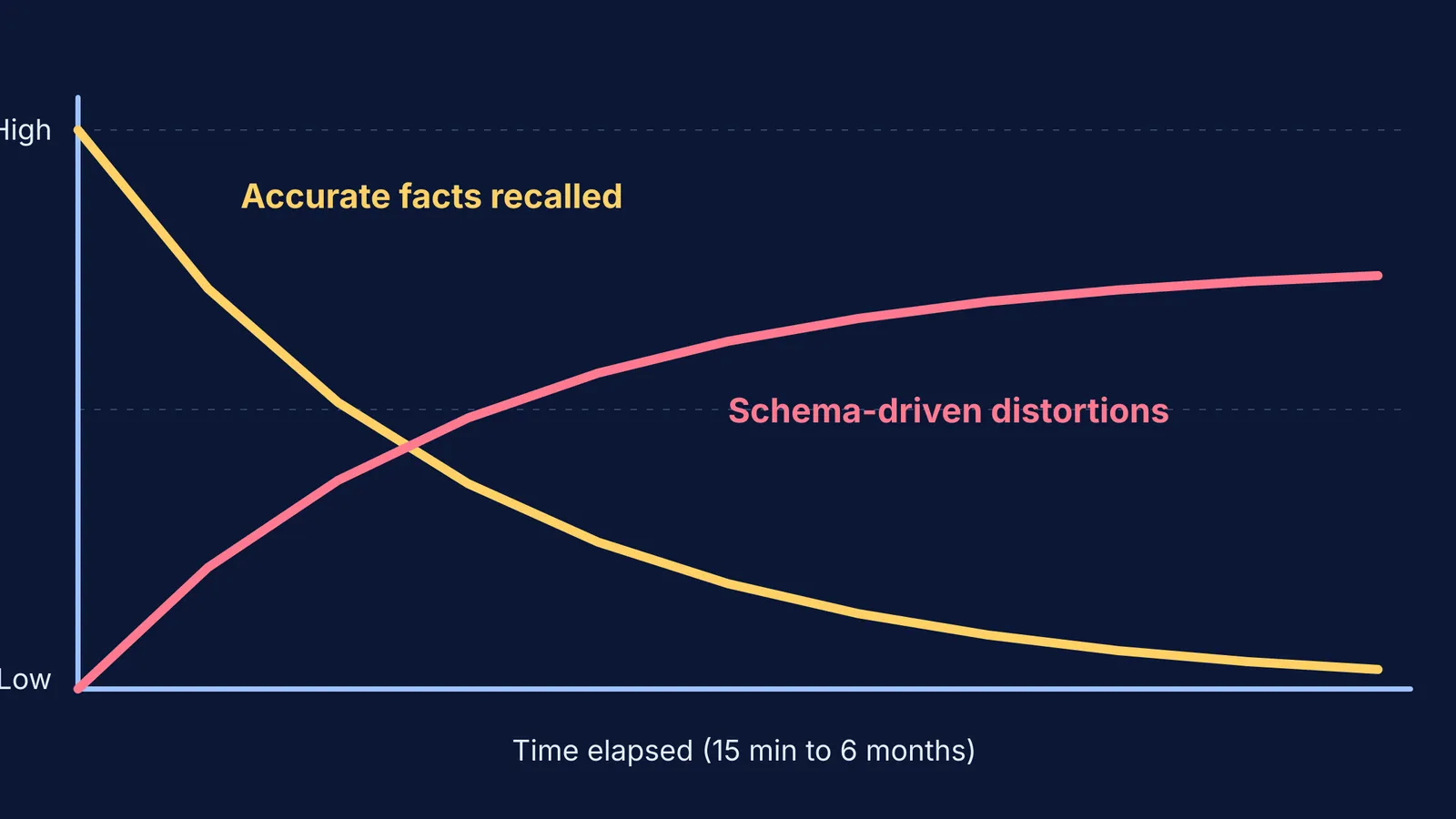
This effect worsens over time. In a rigorous 1999 replication of Bartlett's experiment published in *Memory & Cognition*, researchers Erik Bergman and Henry Roediger found that as the delay between reading and recalling grew from 15 minutes to six months, subjects forgot more of the original story and introduced a higher proportion of completely new, distorted facts (PMID: 10586570). Your brain fills in the gaps of what you forgot with what it assumes should be there.
How do schemas affect exam prep?
When you study complex subjects like physics or biology, you are constantly encountering ideas that defy your everyday schemas. For instance, your daily experience tells you that heavy objects fall faster than light ones, or that a constant pushing force is needed to keep an object moving.
When you try to memorise Newton's laws without truly understanding them, your brain's schema filter takes over. Over a few weeks, your memory will quietly rewrite the strict mathematical rules of physics to match your everyday intuition. By the time you sit for the test, you will write down an answer that feels completely right to you, but is physically wrong.
If you find your memory rewriting strict scientific rules into vague everyday ideas, it helps to practice applying them. The Fermi Problem Library has worked problems with a step-by-step solver that explains the reasoning rather than printing an answer.
How can you beat the schema filter?
You cannot turn off your brain's schemas, but you can study in a way that prevents them from rewriting your notes.
Spot the friction: When learning a new concept, explicitly write down how it contradicts your common sense. If you highlight exactly why a rule feels strange, your brain is less likely to overwrite it later.
Do not accept "close enough": When you test yourself, check your wording strictly against the source. If you swapped a specific term for a generic one, correct it immediately. That small swap is your schema taking control.
Space out your testing: Because schema distortions increase over time, testing yourself a week or a month after learning is crucial. This forces your brain to retrieve the actual facts before the schema quietly fills in the blanks.
Read more about memory and the brain:


