

On this page
In the history of flight, the parachute arrived long before the aeroplane. Before any human had powered an aircraft, inventors were already thinking about how to survive a steep fall. In his 1615 masterwork *Machinae Novae*, Croatian polymath Faust Vrančić (also known as Fausto Veranzio) published a design for a parachute dubbed "Homo Volans" (The Flying Man). Unlike Leonardo da Vinci's earlier pyramidal sketch, Vrančić designed a rectangular frame with a sail-like piece of cloth stretched tightly across it.
Legend says that in 1617, Vrančić successfully tested the parachute by jumping from St Mark's Campanile in Venice. Whether the legendary jump happened or not, his mechanical insight was incredibly sound. Here is the physics of why a simple rectangular piece of fabric can safely arrest a human's fall to the earth.
What was the "Homo Volans" parachute?
Vrančić published *Machinae Novae* (New Machines) as a collection of 56 different technical concepts, with "Homo Volans" appearing prominently as Plate 38. He observed that by stretching a large canvas over a rigid wooden frame, a falling person could trap a significant column of air to slow their descent.
The specific shape and construction of the device mattered immensely. A flat, rigid rectangle behaves fundamentally differently from a trailing piece of loose cloth. It presents a guaranteed, uncollapsible surface area to the air below, ensuring that aerodynamic drag acts heavily on the falling body from the very first second of the descent.
How does a parachute balance gravity?
A skydiver in free fall is subject to two main competing forces: the downward pull of gravity and the upward push of air resistance, which physicists call drag.
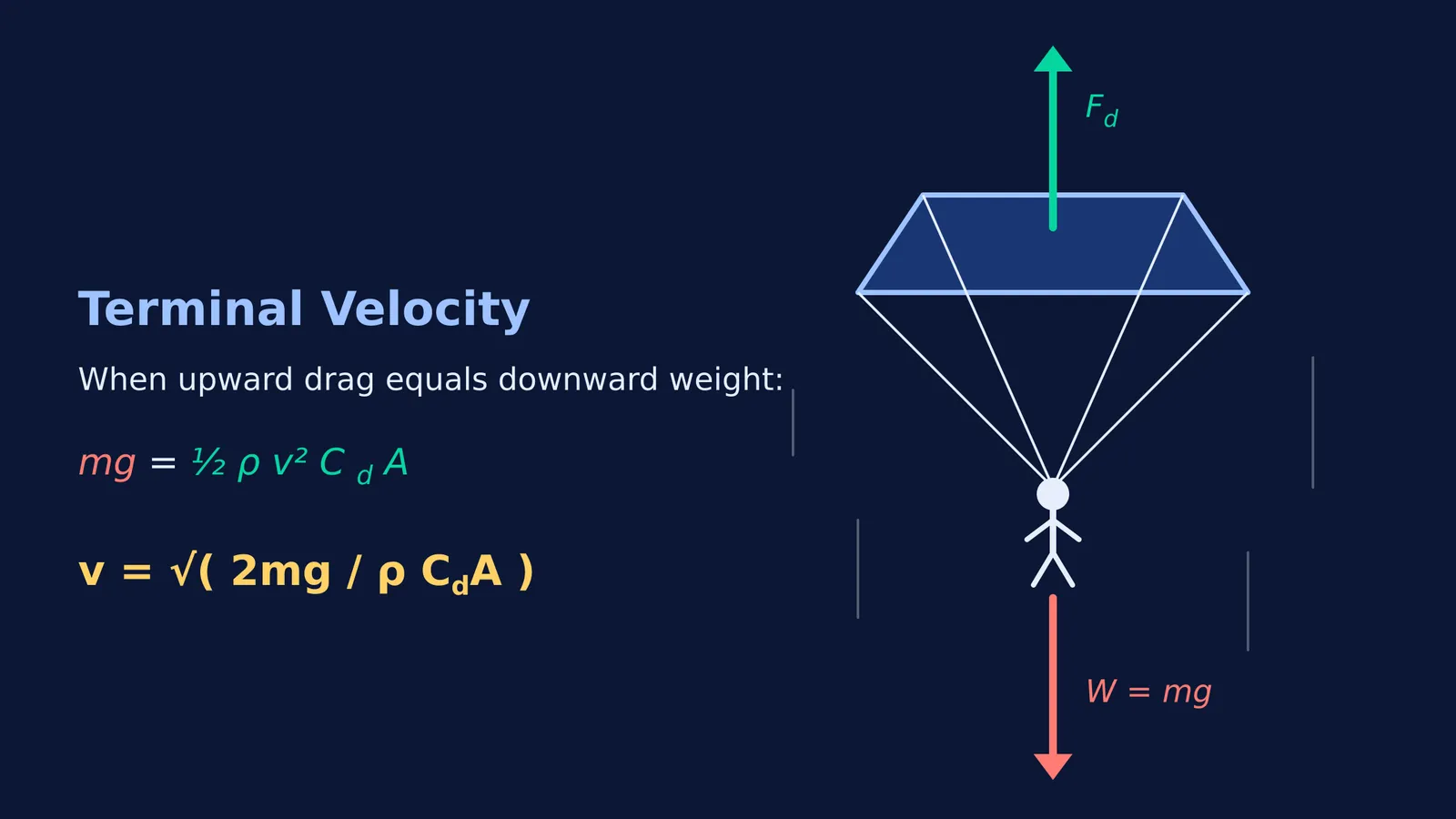
Gravity pulls the mass of the jumper downward with a constant force (W = mg). As the jumper accelerates downwards, the upward drag force grows proportionally to the square of their velocity. The drag force (F_d) opposing the fall is calculated using the standard aerodynamic equation:
F_d = ½ ρ v² C_d A
Where ρ is the density of the air, v is the instantaneous velocity, C_d is the drag coefficient of the parachute's shape, and A is the projected surface area facing the wind.
If you are trying to picture how variables like density and surface area shift the force balance in real time, the Fermi Concept Library breaks down the mechanics of drag with interactive lessons for each parameter.
Why did the 1615 parachute use a rigid frame?
Look closely at the denominator of the drag equation: the surface area (A) is critical to maintaining resistance. If a parachute folds, tangles, or collapses during a fall, the area drops, the drag vanishes, and the jumper accelerates dangerously.
Modern parachutes use complex rigging, tension, and internal airflow to keep the fabric canopy inflated. Vrančić sidestepped this fluid dynamics problem entirely by using a solid rectangular wooden frame. His rigid structure guaranteed a constant, maximum surface area. This meant the drag coefficient (C_d) remained stable throughout the fall, acting much like a modern flat circular parachute which serves as a pure drag device.
How do you calculate terminal velocity?
As the jumper falls and speeds up, the drag force (F_d) eventually perfectly matches the gravitational force (mg). When these two forces become equal, the net force acting on the jumper reaches zero. The jumper stops accelerating and falls at a constant, steady speed known as terminal velocity.
By setting the two forces equal (mg = ½ ρ v² C_d A) and solving for velocity, we find the terminal velocity (v_t):
v_t = √( 2mg / ρ C_d A )
Because area (A) sits in the denominator, a larger parachute drastically reduces the terminal velocity. Modern variations, such as cruciform parachutes, manipulate this area and shape to reduce the rate of descent by approximately 30% compared to older parachute designs, further lowering the impact energy on landing.
Worked example: How surface area changes velocity
If you double the surface area (A) of a parachute while keeping the jumper's mass and the air density the same, the term A in the denominator doubles. Because the final velocity depends on the square root of the denominator (1/√2), your terminal velocity drops to roughly 70% of what it originally was. A surprisingly small change in the canvas size makes a massive difference in how hard you hit the ground.
Setting up the equilibrium equation and isolating variables is a core skill in mechanics. If you get stuck rearranging equations with roots and fractions, the Fermi Problem Library provides worked physics problems with a step-by-step solver that explains the reasoning rather than printing an answer.
Read next:


