

On this page
In the 1880s, the idea that humans had evolved from ape-like ancestors was being argued over, but there were few fossils to test it. A young Dutch doctor named Eugène Dubois decided to go and look for them, and he chose where to search before he had found anything at all. That bet paid off on the banks of a river in Java.
Who was Eugène Dubois, and why did he go to Java?
Dubois was a Dutch physician and anatomist who grew up on the books of Charles Darwin, Thomas Huxley and Ernst Haeckel, according to the Linda Hall Library. Haeckel had proposed that humans and the great apes shared a common ancestor, and he suggested that Java and Borneo, home of the gibbon and the orangutan, were the logical places to look for the "missing links" (Linda Hall Library).
To get there, Dubois enlisted in the Dutch army, which had a presence in the Dutch East Indies, and in 1887 he was sent to Sumatra (Linda Hall Library).
What did Dubois find at Trinil in 1891?
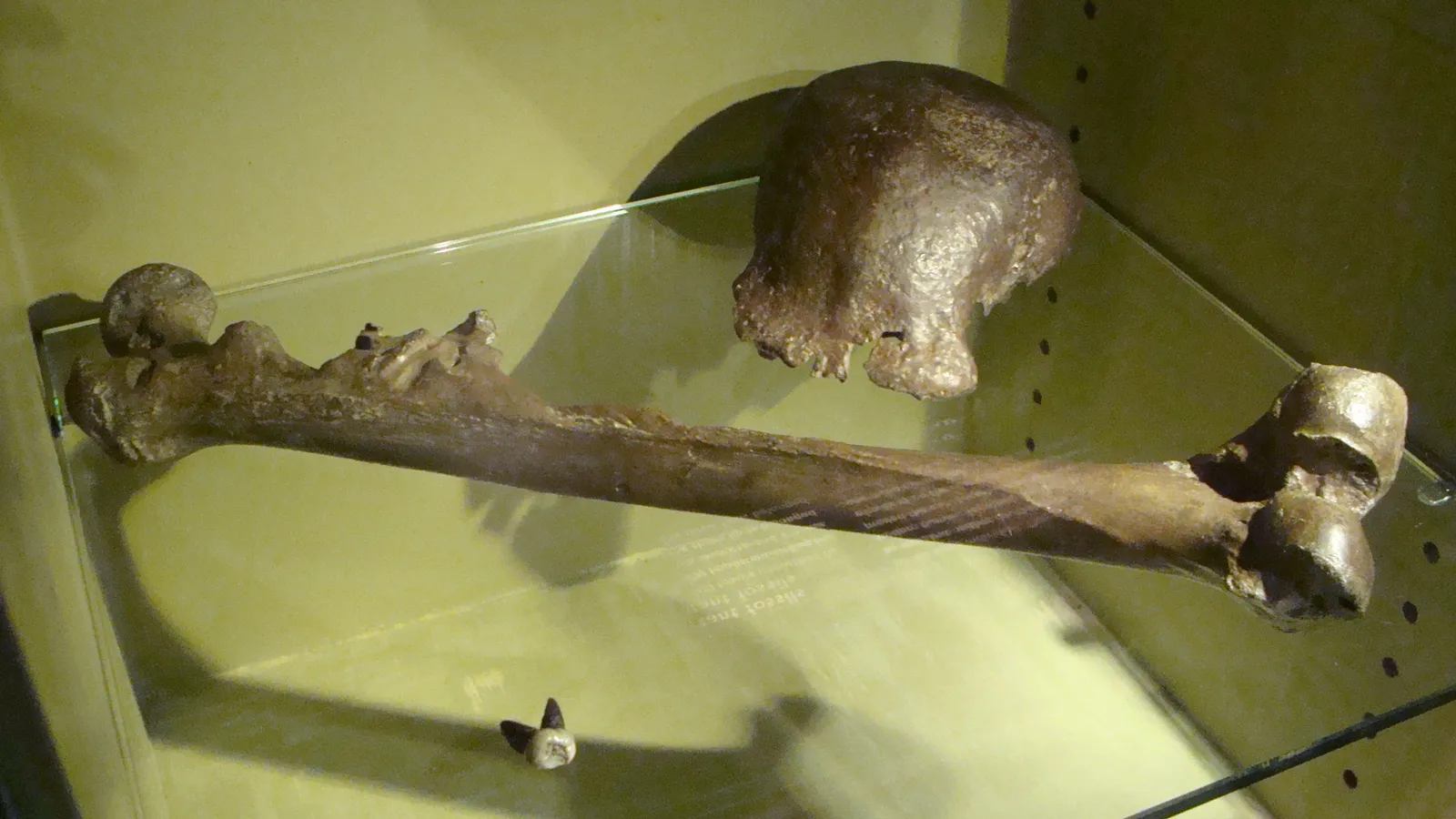
At Trinil, in central Java, Dubois found a human-like skullcap, a human-like thigh bone (femur) and a tooth (Linda Hall Library). The Smithsonian dates the skullcap find to 1891 (Smithsonian Human Origins).
A 2022 study of the excavation records says the skullcap came from a pit dug in 1891 and the femur from an excavation in 1892, both on the left bank of the Solo River (Huffman and colleagues, PaleoAnthropology). The same study traced the bone-bearing layer for about 12 metres between the two digs, which matters because questions about where the fossils came from had hung over them for more than a century.
The skullcap is long, with a flat forehead and distinct brow ridges (Smithsonian Human Origins).
Why is Java man important in human evolution?
That mix was the point. The skullcap was much smaller and flatter than a modern human's, while the femur was human-like (Linda Hall Library). Together they pointed to a creature that walked upright on human-like legs but had a smaller, flatter skull than ours.
In 1894 Dubois named the species *Pithecanthropus erectus*, meaning "erect ape-man" (Smithsonian). The popular press called it "Java man" (Linda Hall Library). In the 1950s the biologist Ernst Mayr reassigned the skullcap, known as Trinil 2, to *Homo erectus* (Smithsonian).
Java man is the first *Homo erectus* individual ever found, according to the Smithsonian. The same page says *Homo erectus* lived between about 1.89 million and 110,000 years ago, in Africa, western Asia and east Asia, with relatively long legs and shorter arms compared with the size of the torso.
How old is Java man?
This answer has changed, and that is a useful lesson. The Smithsonian gives the skullcap an age of between 1 million and 700,000 years (Smithsonian Human Origins).
A 2014 study in Nature went back to the shells in the Dubois collection, now at the Naturalis museum in Leiden, and dated the sediment inside them (Joordens and colleagues, Nature). It found a maximum age of 0.54 ± 0.10 million years and a minimum of 0.43 ± 0.05 million years for the main bone layer, younger than earlier estimates. The team also found a shell with a geometric engraving, which they argue was made by *Homo erectus*.
So shells collected in the 1890s gave a new answer more than a century later.
How do you read a fossil find like a scientist?
When you meet a famous fossil in a chapter or a quiz, run it through four questions. Here is the checklist, worked through for Java man.
What exactly was found? A skullcap, a femur and a tooth, not a whole skeleton.
What does each piece show? The skullcap is long and flat with distinct brows; the human-like femur points to upright walking.
How do we know they belong together? The 2022 study traced one layer about 12 metres from the skull pit to the femur dig.
How old is it, and how was that measured? Estimates range from about 1 million to under half a million years; the 2014 figures came from argon and luminescence dating of sediment inside shells from the main bone layer.
If you cannot answer question 3 or 4 for a fossil, that is where the real scientific argument usually sits. Write it down as an open question rather than a fact.
Where to go next
To place Java man in the full sequence, read our guide to human evolution for NEET, from Dryopithecus to Homo sapiens. For the African side of the story, see Raymond Dart and the Taung child skull, and for the case for human evolution that Dubois grew up reading, see how Thomas Henry Huxley argued for evolution in public.
If terms like "genus", "fossil dating" or "natural selection" still feel shaky, the Fermi Concept Library has a lesson for every concept in biology, each with its place in the map. And if you are not sure where to start, Fermi's AI tutor can work out what you already know and build a plan for the session.


