

On this page
A new scientific idea does not win by being right. It wins when someone lays out the evidence clearly enough that other people can check it. For Charles Darwin's theory of evolution, that person was often Thomas Henry Huxley. This post covers what Huxley argued, the evidence he used, and the habits that made him persuasive.
Who was Thomas Henry Huxley?
The Huxley File, a scholarly archive of his writing at Clark University, gives his dates as 4 May 1825 to 29 June 1895. He was a comparative anatomist, later President of the Royal Society, and is credited there with inventing the word "agnostic". The archive notes that he called himself "Darwin's bulldog", a nickname for his defence of evolution.
His family stayed in science. His grandson Andrew Huxley shared the 1963 Nobel Prize for work on nerve impulses; Andrew's Nobel biography says his father Leonard was a son of Thomas Huxley. Our post on Hodgkin, Huxley and the action potential tells that story.
What did Huxley say about Darwin's book?
On 23 November 1859, the day after he finished On the Origin of Species, Huxley wrote to Darwin. The letter is published by the Darwin Correspondence Project. He warned Darwin of the "abuse & misrepresentation" he expected, and added: "I am sharpening up my claws & beak in readiness".
That line is often quoted. What matters more is what he did next: he spent years assembling evidence that people could see for themselves.
How did he argue that humans are related to apes?
In the preface to Man's Place in Nature, Huxley explains that a paper read in 1857 claimed certain brain features were peculiar to humans. He studied the question and concluded those features were shared with all the higher and many of the lower apes. His first three essays on the structural relations of humans and apes were published in January 1863.
The method was comparative anatomy: put structures side by side and list what is shared. Today the NCERT Class 12 chapter on evolution uses the same kind of reasoning when it presents comparative anatomy and morphology as evidence for evolution.
Why did he link dinosaurs and birds?
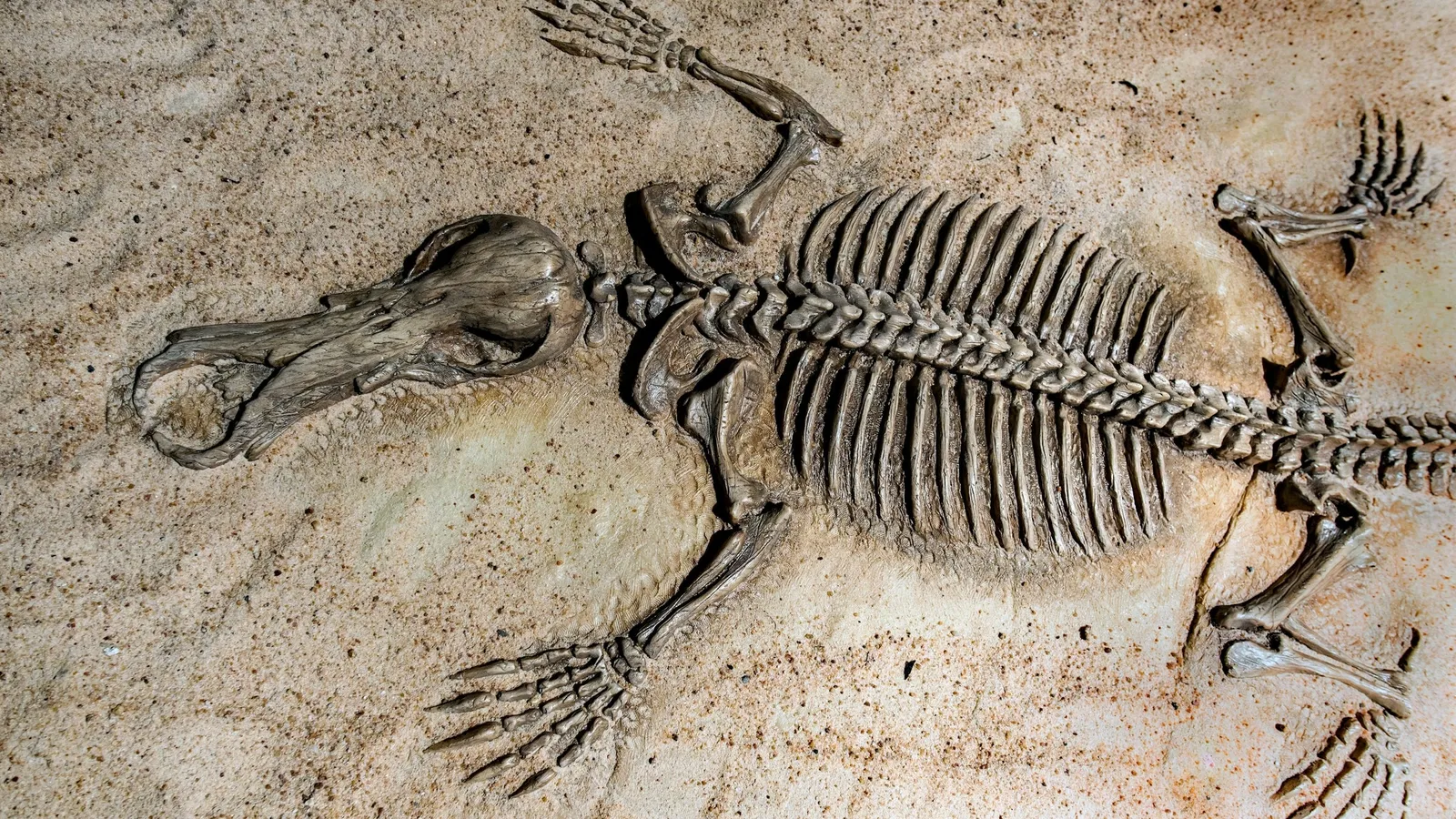
Huxley also worked on fossils. In 1870 the Quarterly Journal of the Geological Society published his paper Further Evidence of the Affinity between the Dinosaurian Reptiles and Birds. The title states the argument: features of the skeleton suggested that birds and certain reptiles were closely related. It is an early example of using fossils to connect living groups, a line of evidence the NCERT evolution chapter also discusses.
How did he explain deep time to ordinary people?
Huxley gave many public talks. One, published in 1868 in Macmillan's Magazine as On a Piece of Chalk, opens by imagining a well dug beneath the city of Norwich. He then shows that chalk is made largely of tiny shells such as Globigerina, compares them with shells in mud dredged from the Atlantic floor, and concludes that the chalk is the dried mud of an ancient deep sea.
Look at the structure of that argument:
Start with an object everyone has handled.
Look at it under a microscope and describe what you see.
Compare it with something whose origin is known, the living deep-sea mud.
Draw the conclusion only after the comparison.
It is a model for answering any "give evidence for" question.
Common mistakes when writing about Huxley
Treating him as the author of evolution by natural selection. That was Darwin and Wallace; see our post on Darwin, Wallace and the 1858 papers. Huxley defended and extended the case.
Quoting famous debate lines as fact. Many dramatic lines attributed to Huxley come from later recollections and cannot be checked word for word. Stick to his letters and published essays.
Confusing him with Andrew Huxley. Different century, different field.
What can a student take from Huxley?
Huxley had two skills that rarely sit in one person: careful anatomy and clear public explanation. You can practise both. After studying a topic, try explaining it to a younger sibling using one object they can hold, the way Huxley used chalk. If the explanation breaks down, that is the part you do not yet understand. Fermi's AI tutor holds a line of reasoning across a session and checks understanding as it goes, which is a useful partner for that kind of practice.
Next step: pick one piece of evidence for evolution from your NCERT chapter and explain it in four steps, the way Huxley explained chalk.


