On this page
In the 1850s Chicago sat only a little higher than the shoreline of Lake Michigan, so rainwater and waste had nowhere to run. In 1854 cholera killed 1,424 people in the city, according to a history of Chicago's water published on MIT OpenCourseWare. The engineer hired to fix it, Ellis Sylvester Chesbrough, chose an answer that sounds backwards: instead of digging the sewers deeper, lift the city.
Why did Chicago have to raise its streets?
A sewer works by gravity: every pipe must slope down to an outlet that sits above the water it empties into. Illinois created a Board of Sewerage Commissioners on 14 February 1855 and appointed Chesbrough, who had been Boston's first city engineer, as its engineer, according to his biography.
In a flat city he could dig deep and pump, or keep the pipes shallow and build the ground up over them. In his Report and Plan of Sewerage he rejected pumping, warning that in war or a time of disease "the dependence of a large city upon engines for pumping up its sewage, might prove a terrible calamity."
What did Chesbrough's 1855 sewer plan say?
The Board of Sewerage Commissioners adopted the plan on 31 December 1855, as the title page of the original report, digitised from the US National Library of Medicine's copy, records. Its key numbers, all from that report:
Main sewers: circular brick, 5 feet across (6 feet on Clark Street), with walls 8 inches thick.
Slope: a 5-foot main "could have a declivity of two feet per mile"; the small 12- and 15-inch pipes needed at least 10 feet per mile.
Outlets: the floor of each main 6 inches below the lake's surface at the time, emptying into the Chicago River.
Cover: at least 2 feet of earth over every sewer.
The report calls a fall of 1 in 2,500 "the greatest declivity it would be practicable to give" the mains while still draining without machines. Streets, it says, must rise by an average of 18 inches over large areas, and about 3 feet on Franklin Street.
How high did the streets need to be?
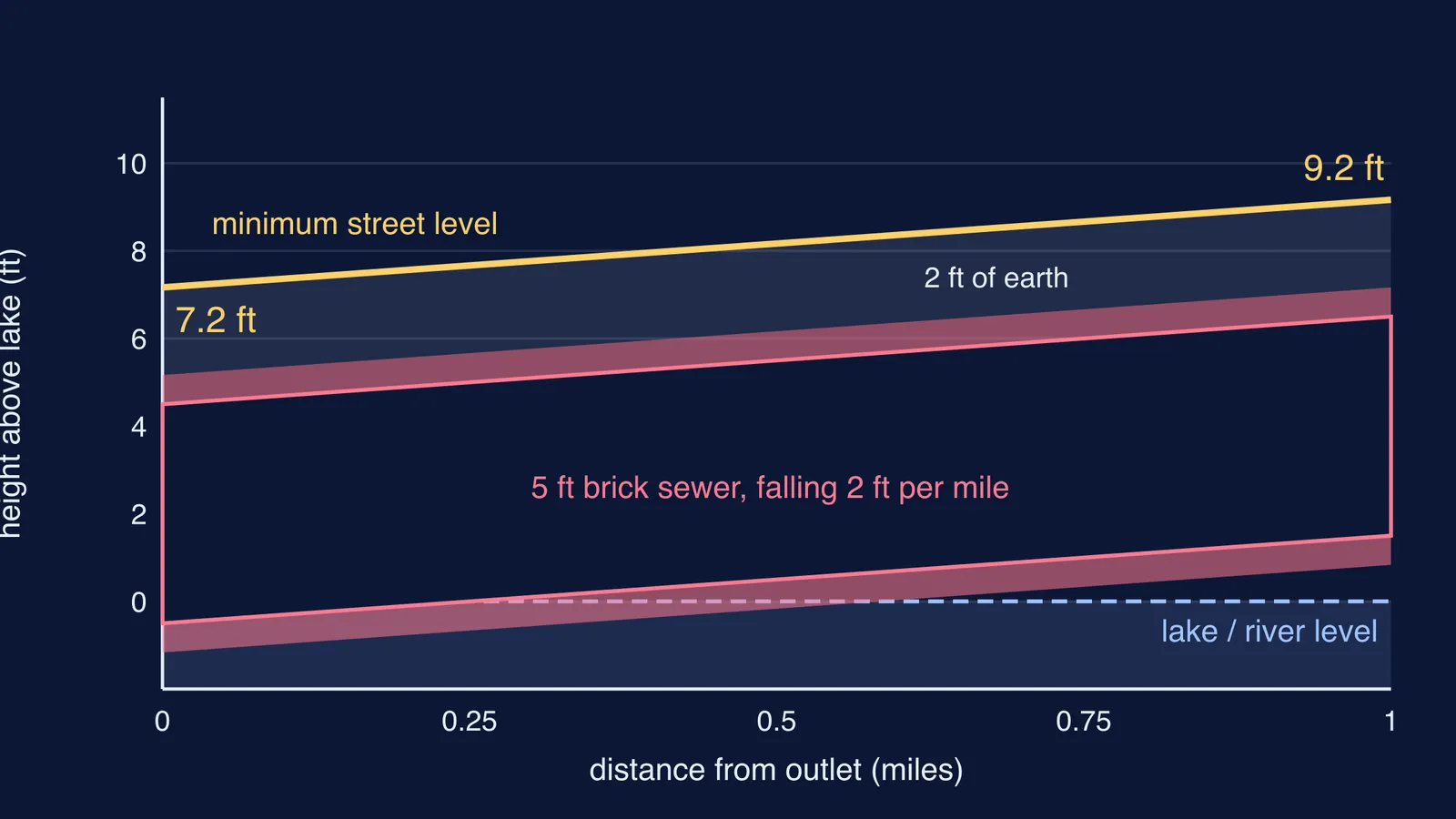
You can rebuild Chesbrough's sum from the report's figures, measuring every height from the lake surface.
Sewer floor at the outlet: 0.5 ft below the lake, so -0.5 ft.
Slope: the floor rises 2 ft per mile back from the river, so at d miles it sits at -0.5 + 2d ft.
Pipe: add 5 ft of opening and 8 inches (0.67 ft) of brick on top.
Cover: add 2 ft of earth.
Minimum street height = -0.5 + 2d + 5 + 0.67 + 2 = 7.17 + 2d feet above the lake.
At the river, the street had to be about 7.2 ft (2.2 m) above the lake; a mile inland, about 9.2 ft (2.8 m). The slope checks out too: 5,280 ft in a mile / 2,500 is about 2.1 ft.
Wherever the old ground was lower than this line, it was filled, and buildings beside it had to come up too or their ground floors would become basements.
How do you lift a whole building?
With many screw jacks turned together. In January 1858 a four-storey brick building at Randolph and Dearborn streets was lifted on 200 jackscrews to a level 6 ft 2 in higher, the first masonry building in Chicago raised this way, according to the history of the Raising of Chicago.
The biggest job came in 1860, when a 320-foot row of shops on Lake Street went up. The Chicago Press and Tribune reported on 26 March 1860: "There will be some 600 men employed, and about 6,000 screws" (transcribed Tribune reports). That is 10 jacks per worker, turned a little at a time so the walls rose evenly. The shops stayed open, and in 1861 the six-storey Tremont House hotel was raised 6 feet by 500 men on 1,000 jackscrews while guests stayed inside (Raising of Chicago).
What can a student learn from Chesbrough?
Three habits carry into your own problem-solving:
Turn the constraint into a number. "The city is flat" became a fall of 1 in 2,500, the steepest the report judged practicable without pumps.
Write down every option. Chesbrough weighed draining into the river, the lake, reservoirs and a canal before choosing.
Stack your quantities. The worked example is the method of any physics numerical: list each length, add, check units.
The plan was not perfect: the river carried sewage into the lake that supplied drinking water, and the MIT OpenCourseWare paper describes the canal, begun in 1892, that later sent it away from the lake. London faced the same problem; read how Joseph Bazalgette built London's sewers. If this kind of work appeals, see career options after civil engineering in India.
If slopes, ratios and unit conversions still feel shaky, the Fermi Concept Library has a lesson on every concept in physics and mathematics, and the Fermi Problem Library has worked problems with a step-by-step solver that explains the reasoning rather than printing an answer.