

On this page
In 1847 a medical college in Geneva, New York, let its students vote on whether a woman could join their class. They said yes. Two years later Elizabeth Blackwell graduated at the head of that class, and she spent the rest of her life making sure she would not be the only one.
Who was the first woman to earn a medical degree in the USA?
Elizabeth Blackwell was the first woman to receive an MD degree from an American medical school, in 1849, according to the US National Library of Medicine. She was born in Bristol, England, in 1821, and her family moved to America when she was 11, as the University of Bristol records.
After graduating she studied midwifery in Paris, then returned to New York City in 1851 and set up a practice there. The National Library of Medicine lists her field as obstetrics and gynaecology.
How did Elizabeth Blackwell get into medical school?
Slowly. She was rejected by 29 medical schools before Geneva Medical College admitted her in 1847, according to Hobart and William Smith Colleges, which keep her biography in Geneva today.
The faculty there were largely against her application, so they handed the decision to the student body and promised to accept the result. The students voted her in, possibly as a joke. She graduated on 23 January 1849, at the head of her class, the colleges' biography says.
What was the New York Infirmary for Indigent Women and Children?
It was a hospital run by women, for women and children who could not pay. Blackwell first opened a dispensary in a single rented room in New York in 1853, seeing patients three afternoons a week, according to the National Library of Medicine. The Social Welfare History Project at Virginia Commonwealth University describes it as a free dispensary for poor women and children that was open only a few hours a week.
In 1857 she closed it and opened the New York Infirmary for Indigent Women and Children, a full hospital with beds for medical and surgical patients, staffed at first by Blackwell, her sister Dr Emily Blackwell and Dr Marie Zakrzewska (VCU). "Indigent" means poor.
The infirmary did two jobs at once. It gave medical care to the poor, and it gave women doctors, who were turned away from internships elsewhere, the training and experience they needed, the National Library of Medicine explains. The infirmary later added its own medical college for women, with Elizabeth teaching hygiene and Emily teaching obstetrics (VCU).
What did she do in Britain?
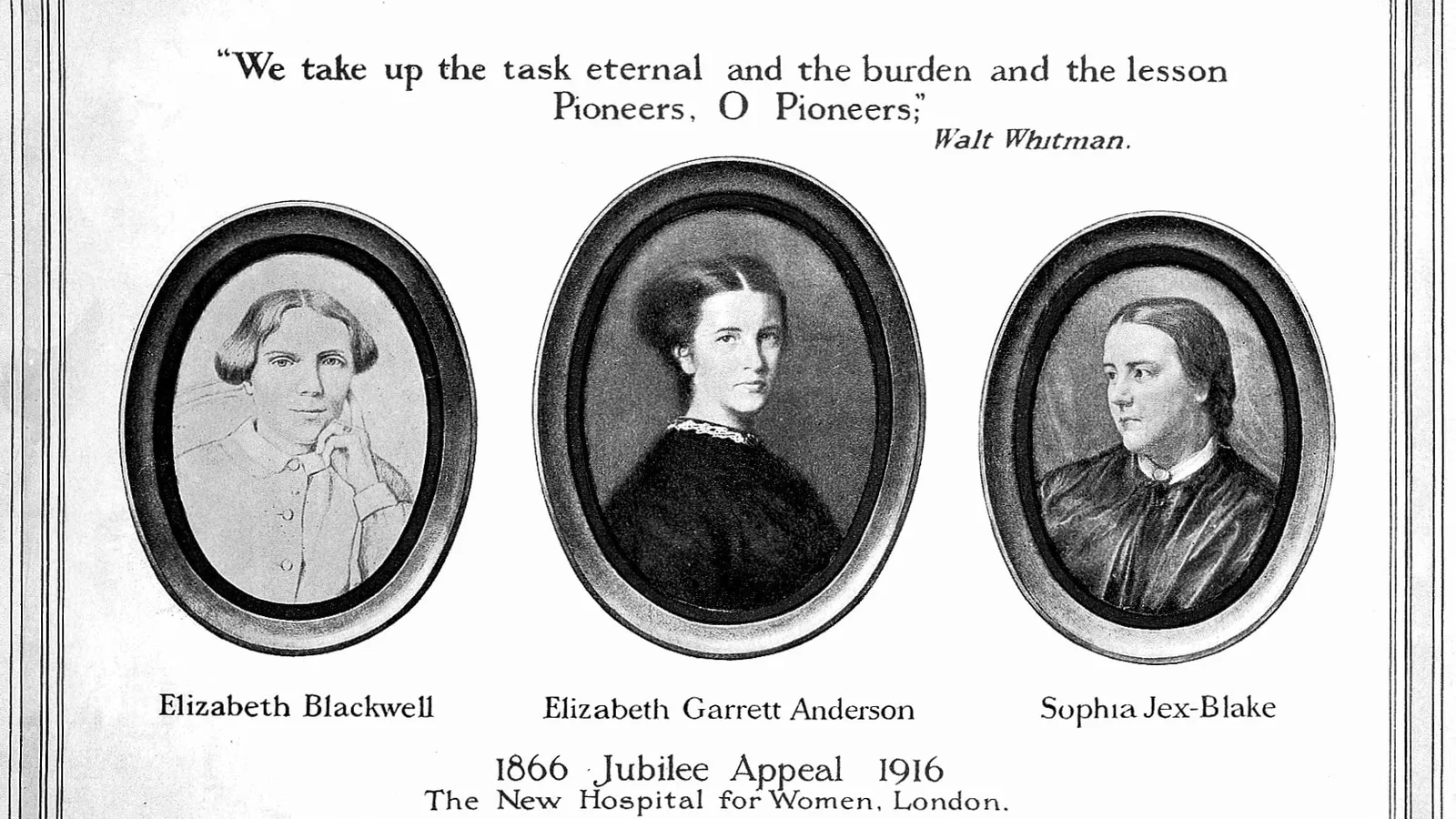
On a visit to England in 1859, Blackwell became the first woman entered in the British General Medical Council's medical register, according to the University of Bristol. In 1874 she, Sophia Jex-Blake and Elizabeth Garrett Anderson set up the London School of Medicine for Women (University of Bristol). You can read how Elizabeth Garrett Anderson became Britain's first woman doctor in our earlier profile.
She published *Medicine as a Profession for Women* in 1860 and died in 1910 (National Library of Medicine).
India had its own pioneers within a few decades: read about Anandibai Joshi, who crossed an ocean to study medicine, and Kadambini Ganguly, one of India's first women physicians.
What can a medicine aspirant learn from her today?
Her story is usually told as grit. Look closer and there is a method you can copy for a medical entrance exam or any long, uncertain goal.
Count your attempts, not just your results. She kept going through 29 rejections, by the Hobart and William Smith Colleges count. Keep a simple log of every mock test, application or interview, with one line on what you will change next time.
Find the one door that is open. Geneva said yes through an unusual route, a student vote. Write down three routes to your goal, not one.
Be top of the class you are in. Once admitted, she graduated at the head of her class. Put your energy into the chapter in front of you rather than the rank you fear.
Build what is missing. When women doctors were shut out of hospital training, she opened a hospital. If your school has no study group, start a two-person one.
Pass it on. Her hospital trained other women. Teach a friend one topic a week; explaining shows you your own gaps.
If a chapter of biology keeps stopping you, the Fermi Concept Library gives every concept in biology its own lesson and its place in the map, so you can find the gap underneath.
Next step: pick one item from the list above and do it this week.


