

On this page
In 1883 a Belgian zoologist was studying the eggs of a parasitic roundworm of horses. In them he saw something NEET and board biology students now write in exam answers: egg and sperm each carry half the chromosomes, and fertilisation puts the full set back together.
The zoologist was Edouard van Beneden. He was born in Louvain on 5 March 1846, died in Liège on 28 April 1910, and held the Chair of Zoology at the University of Liège, according to the University of Liège's biography of Van Beneden.
What did van Beneden see in the Ascaris egg in 1883?
A detailed modern account is a 1992 paper by Gabriel Hamoir in the *International Journal of Developmental Biology*, which reproduces van Beneden's original drawings (Hamoir, Int. J. Dev. Biol. 36: 9-15).
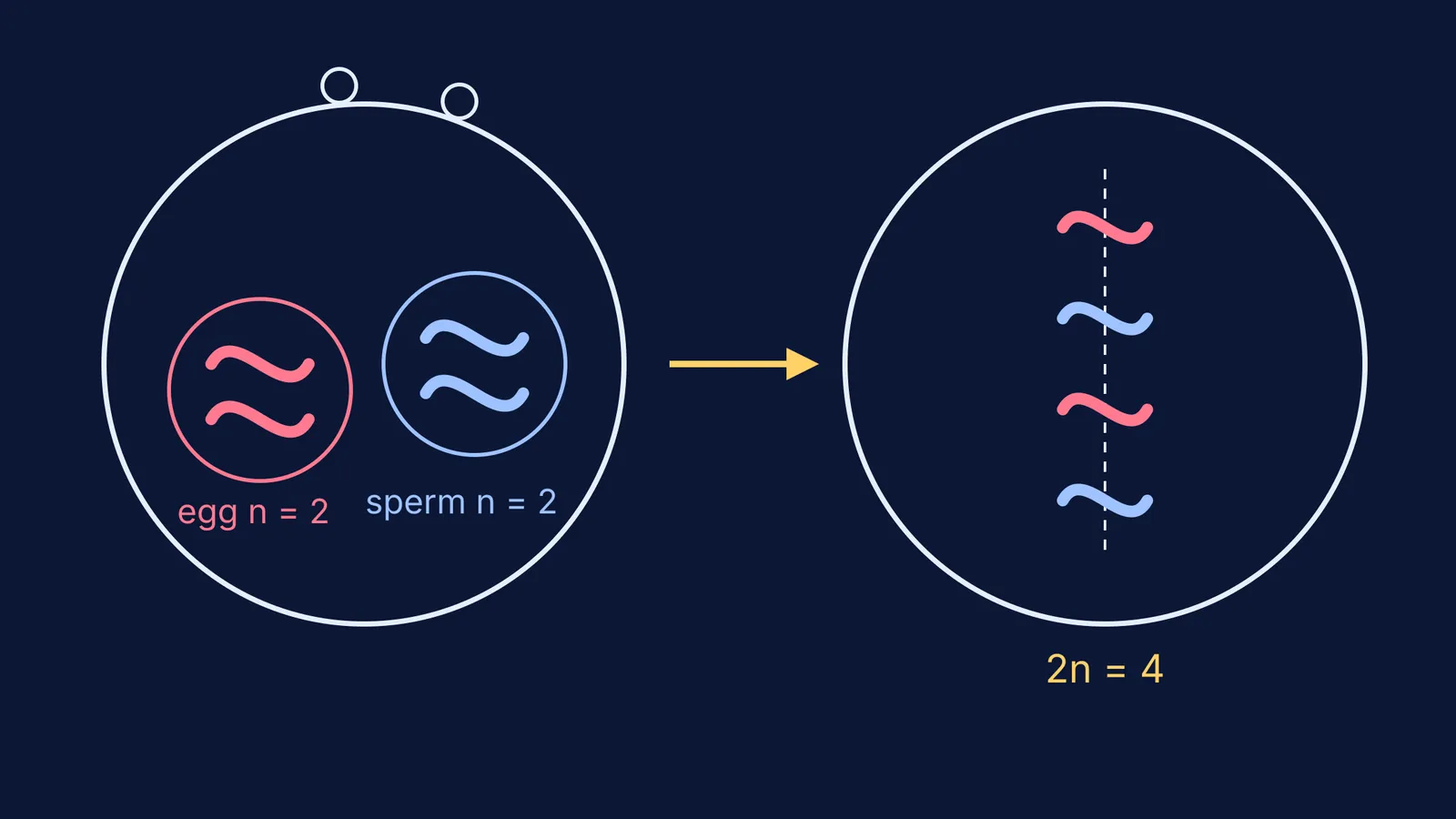
After a sperm enters the egg of the horse roundworm *Ascaris megalocephala*, the egg throws out two small polar bodies. What is left of the egg nucleus becomes the female pronucleus, and the sperm nucleus becomes the male pronucleus. Van Beneden watched the chromatin in each one condense into just two curved threads, which he called chromatic loops. Hamoir notes that Waldeyer named these elements chromosomes in 1888.
So the egg brought two chromosomes and the sperm brought two. When the fertilised egg divided, each of the first two embryonic cells had two female and two male chromosomes, four in all (Hamoir 1992). In the English quoted by Hamoir, van Beneden wrote that each pronucleus is "equivalent to a half-nucleus endowed, owing to its origin, with a unisexual character".
Why was a roundworm the right choice?
Oscar Hertwig had already shown in sea urchin eggs that fertilisation is the union of two cells; read that story in our post on how Oscar Hertwig watched fertilisation happen. But van Beneden suspected that the small size of the sperm and pronuclei in such material was behind the disagreements of the time.
Hamoir explains why *Ascaris* worked better (Hamoir 1992):
Its sperm is about ten times larger than a sea urchin's.
Its eggs can be made transparent with the right treatment.
Half a centimetre of the worm's genital tract holds thousands of eggs at the same stage.
Its chromosome number turned out to be unexpectedly low, so the halving was unquestionable.
Luck helped too. Hamoir describes how van Beneden sent the first part of his paper to the printer in October 1883 while his fresh samples had hit a dead end. He then stained old preparations: live female worms that had been put into dilute alcohol and kept for several months. In those eggs development had crept on, and the later stages showed the pronuclei and their chromosomes clearly. The paper appeared in volume 4 of the *Archives de Biologie*, printed in March 1884.
Did van Beneden discover meiosis?
He found the halving, which is the heart of meiosis, but not every detail. The University of Liège credits him with discovering in 1883 what would later be called meiosis, a name given in 1905. Hamoir is careful: van Beneden misread how the polar bodies form, a view Theodor Boveri challenged in 1887. Only later did it become clear that the first meiotic division is usually the reductional one and the second is equational (Hamoir 1992).
Hamoir argues that van Beneden's main legacy was focus: equal shares from each parent pointed the study of heredity at the chromosomes. To follow that thread, read about Walter Sutton linking chromosomes to Mendel's factors.
How do you use this in an exam answer?
Humans have 23 pairs of chromosomes, 46 in all, and each egg or sperm carries one copy of each chromosome, so 23 (NHGRI chromosomes fact sheet). The worm in van Beneden's study had four chromosomes in its embryonic cells (Hamoir 1992). The same logic works for both species:
Write the body-cell number as 2n: 2n = 4 for the worm, 2n = 46 for humans.
Meiosis halves it in the gametes: n = 2 for the worm, n = 23 for humans.
Fertilisation adds egg and sperm: 2 + 2 = 4, and 23 + 23 = 46.
Check the trap: if gametes were made by mitosis, they would carry 2n, and the zygote would have 4n. The count would double every generation.
Step 4 is why meiosis has to exist, and it makes a strong one-line answer to "why is meiosis necessary?"
If chromosome movement is hard to picture from a textbook figure, the Fermi Simulation Lab has interactive simulations for ideas that are easier to see than to read. To revise the stages in order, see our guide to the cell cycle, mitosis and meiosis, and the Fermi Concept Library, which gives each biology concept its own lesson.
Next time you write "gametes are haploid", remember it started with a zoologist counting chromosome threads in a worm egg.


