

On this page
Every student in Class 9 and Class 11 learns the distinction early: cells are either prokaryotic or eukaryotic. The division feels as ancient as the split between plants and animals. Yet the terms themselves were coined only a century ago by a French protistologist named Édouard Chatton.
Who coined the terms prokaryote and eukaryote?
French biologist Édouard Chatton (1883–1947) introduced *procaryote* and *eucaryote* in print in 1925. He formed the words from the Greek *karyon*, meaning nut, kernel, or nucleus. Organisms lacking a membrane-enclosed nucleus became prokaryotes (*pro-*, meaning before), denoting cells that predated the evolutionary appearance of a nuclear envelope. Organisms possessing a true, membrane-bound nucleus became eukaryotes (*eu-*, meaning good or true).
Chatton first published these words in his 1925 study of the parasite *Pansporella perplexa* in *Annales des Sciences Naturelles, Zoologie*. As historian Jan Sapp documented in Microbiology and Molecular Biology Reviews, Chatton did not offer an elaborate manifesto. Instead, he placed the labels onto two phylogenetic schemes at the end of his paper, grouping bacteria and blue-green algae as prokaryotes, and placing amoebae, ciliates, plants, and animals within eukaryotes.
How did Édouard Chatton discover the cellular split?
Chatton did not arrive at his dichotomy from abstract theory. Working at marine stations in Banyuls-sur-Mer and Sète, he spent decades examining parasitic single-celled organisms under light microscopes. While studying *Pansporella perplexa* in the gut of water fleas (*Daphnia*), he observed that standard protozoa possessed a distinct, membrane-limited nucleus and mitotic apparatus, whereas bacteria completely lacked internal nuclear boundaries.
In his 1938 compendium *Titres et Travaux Scientifiques (1907–1937)*, published in Sète by Sottano, Chatton used the terms again on page 50, contrasting autotrophic bacteria and blue-green algae as *Procaryotes* alongside organisms possessing a true nucleus as *Eucaryotes*. As analyzed in Microbiology and Molecular Biology Reviews, Chatton treated the distinction not as an ideological breakthrough, but as an empirical cytological fact. Later research, including George Palade's discovery of ribosomes, proved that this visible boundary reflected a deeper divergence in internal organelles and protein factories.
Why did the prokaryote-eukaryote dichotomy take 37 years to become mainstream?
Despite its clarity, Chatton's distinction lay ignored for over three decades. Outside a small French circle, microbiologists continued attempting to classify bacteria into the plant kingdom as fungi or into the animal kingdom as primitive infusoria.
The turning point came when Chatton's student André Lwoff, who later shared the 1965 Nobel Prize in Physiology or Medicine, introduced American microbiologist Roger Stanier to Chatton's papers in Paris in 1961. In 1962, Roger Y. Stanier and Cornelius B. van Niel published 'The concept of a bacterium' in Archiv für Mikrobiologie. Citing Chatton's compendium (which they dated 1937, though printed in 1938), they codified the prokaryote-eukaryote divide as biology's fundamental organizational dichotomy.
When learning cell biology, tracing how organelles emerged can feel like memorising disconnected lists. The Fermi Concept Library places every concept in biology into an interconnected map, showing how membrane structure links to energy production and genetics.
What is the difference between prokaryotes and eukaryotes in NCERT Class 9 and 11?
In the Indian curriculum, Chatton's divide forms the core of Class 9 Science (Chapter 5) and Class 11 Biology (Chapter 8), available on the NCERT textbook portal.
NCERT highlights several decisive structural contrasts:
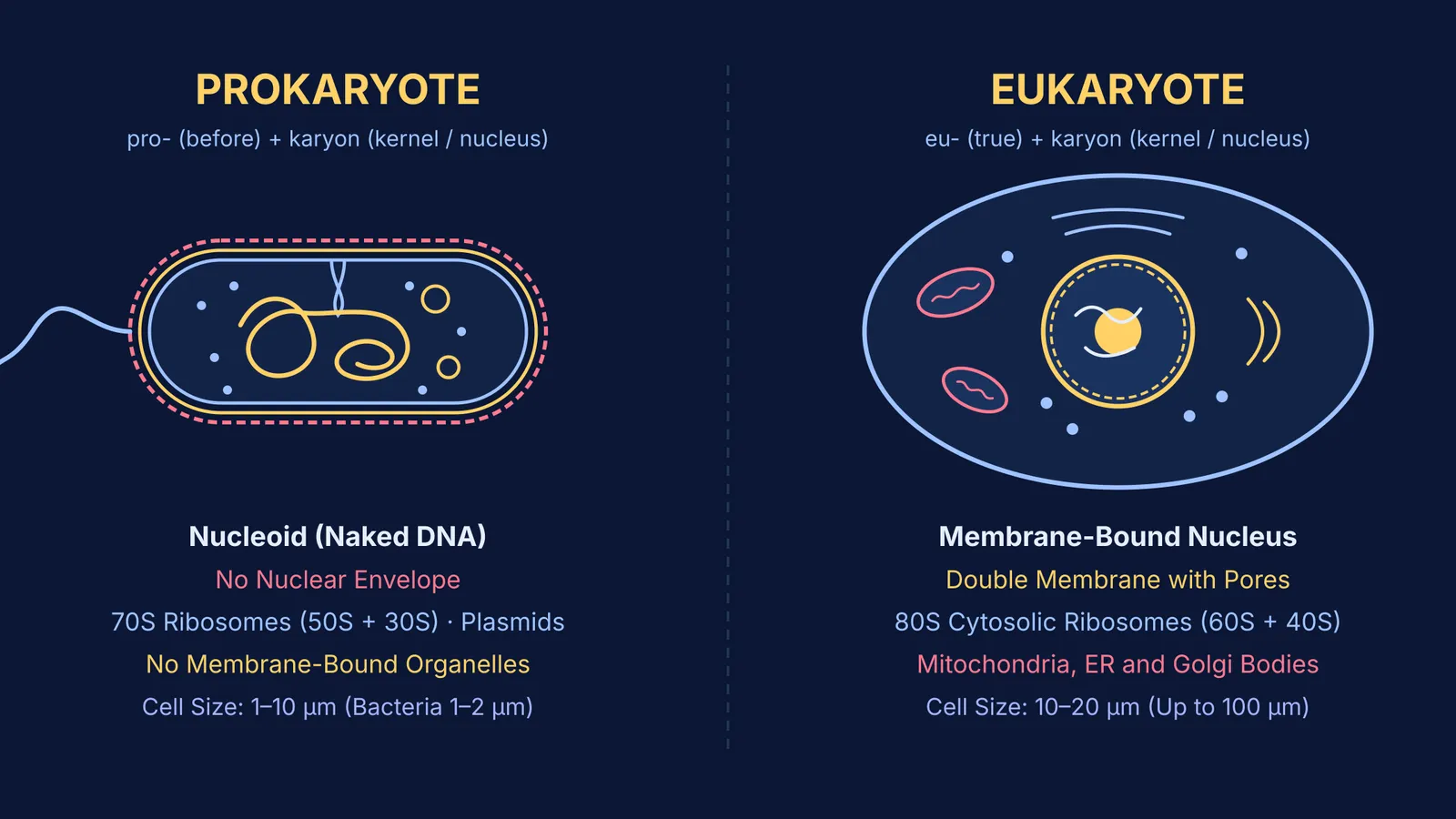
Nuclear region: Prokaryotes lack a nuclear envelope; naked DNA sits in an undefined region called the nucleoid. Eukaryotes have a double-layered membrane enclosing chromatin and nucleoli.
Cell size: Typical prokaryotes measure 1 to 10 µm, with typical bacteria spanning 1 to 2 µm and mycoplasmas measuring around 0.3 µm. Eukaryotic cells are larger, typically ranging from 10 to 20 µm.
Organelles and ribosomes: Membrane-bound organelles (mitochondria, chloroplasts, Golgi bodies) are absent in prokaryotes, which rely on mesosomes. Prokaryotes have 70S ribosomes (50S and 30S subunits), whereas eukaryotic cytoplasm contains 80S ribosomes (60S and 40S subunits).
In R. H. Whittaker's 1969 Five Kingdom system, Monera is the sole prokaryotic kingdom, while Protista, Fungi, Plantae, and Animalia are eukaryotic. Non-cellular entities lie outside this scheme; see our guide on five-kingdom classification and non-cellular biological entities.
For exams like NEET-UG, use this 4-step diagnostic checklist to identify cell types:
Check the nucleus: Look for naked circular DNA in a nucleoid (prokaryote) versus membrane-enclosed chromatin (eukaryote).
Inspect organelles: Mitochondria or chloroplasts confirm a eukaryotic cell.
Verify ribosomes: Identify whether cytosolic particles sediment at 70S or 80S.
Identify division: Binary fission without spindles indicates a prokaryote; mitosis with spindle fibers confirms a eukaryote.
To master these structures before exams, see our guide on mastering NCERT cell diagrams for NEET.
How does modern phylogenetics view Chatton's two-way division?
In 1977, Carl Woese and George E. Fox demonstrated in Proceedings of the National Academy of Sciences that prokaryotes do not form a single evolutionary lineage. By comparing 16S ribosomal RNA sequences, they showed that methanogenic bacteria (archaebacteria) represent a separate primary line of descent from typical bacteria (eubacteria). This work overturned the assumption that all non-nucleated cells share a single ancestor and led to the modern Three-Domain system (Bacteria, Archaea, and Eucarya).
Yet Chatton's cellular architecture distinction remains the most practical boundary in science. The structural gap between an uncompartmentalised bacterial cell and a compartmentalised eukaryotic cell remains biology's greatest architectural leap.
If you struggle to recall organelle structures during revision, Fermi's AI tutor works out what you already know and builds a plan for the session, noticing where you get stuck and checking understanding as you go.


