

On this page
For decades, popular culture depicted gorillas as savage monsters that would attack humans on sight. It took one researcher with immense patience and a completely different approach to prove otherwise. Dian Fossey spent 18 years in the mountains of Rwanda studying mountain gorillas, and her meticulous fieldwork forever changed how we understand primate behaviour 1.
Who was Dian Fossey?
Dian Fossey was an American primatologist who gave up her early career in occupational therapy to move to Africa and study great apes. She was initially encouraged and recruited by paleoanthropologist Louis Leakey, who believed that studying our closest primate relatives could offer vital insights into human evolution (see Louis and Mary Leakey and fossils of early humans in Africa).
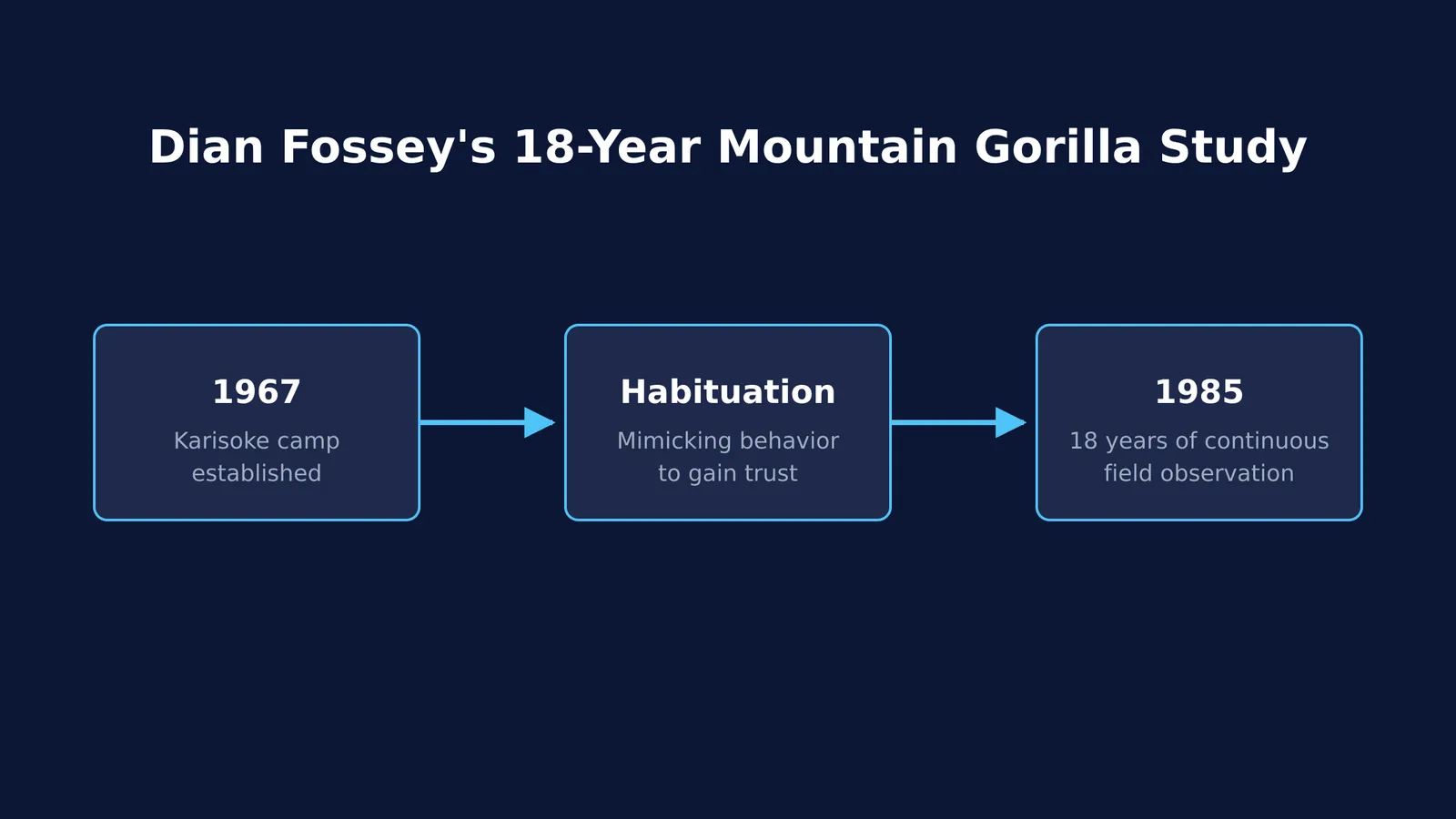
In 1967, Fossey founded the Karisoke Research Center, located between Mount Karisimbi and Mount Visoke in the Virunga Mountains of Rwanda. Over the next 18 years, she lived among the gorillas and conducted one of the longest and most detailed continuous field studies of any animal 1. Living in high-altitude, cold, and often muddy conditions, she dedicated her life to understanding a species that the rest of the world feared.
How do you study mountain gorillas?
When Fossey first arrived, the gorillas would flee into the dense vegetation as soon as they spotted her. She quickly realised that the traditional scientific method of "sit and stare" made the gorillas nervous and suspicious. The animals were not used to humans sitting silently for long periods, which made them agitated and defensive. If she wanted to study them, she had to play by their rules.
Instead of forcing her presence, she developed a technique known as habituation. She stayed low to the ground, crawled on her knuckles, and avoided standing tall, which gorillas interpret as a dominant or threatening posture. By presenting herself as submissive, she removed the immediate tension. To elicit their curiosity, she mimicked their natural behaviours, such as scratching herself and munching on local celery plants 1.
She even learned to copy their vocal sounds. By making grunting sounds to reassure them, she signalled that she meant no harm. By acting like them and never appearing as a threat, she slowly gained their trust. This slow, careful immersion allowed her to observe their true, unbothered behaviour up close.
Do mountain gorillas live in calm family groups?
Yes. Fossey's 18 years of observation completely debunked the aggressive myth 1. She discovered that mountain gorillas are actually gentle, social herbivores who rarely display unprovoked anger. They live in stable, calm family groups, which are usually led by a mature male known as a silverback.
These families form strong social bonds. They spend their days playing, grooming each other, and foraging peacefully. Fossey documented that they rely on social cohesion rather than aggression to maintain order within the group. The silverback acts as a protector, guiding the family through the forest and resolving internal disputes. She was one of the first researchers to give her subjects names instead of numbers—such as her favourite gorilla, Digit, and the silverback Uncle Bert—recognising their unique personalities. Much like how other scientists systematically unpacked complex natural systems (read about Niko Tinbergen and the four questions of animal behaviour), Fossey used extreme patience to uncover the truth about gorilla society.
What can a student learn from Fossey's 18 years?
Fossey's dedication offers a masterclass in how to approach difficult, long-term learning goals. When you are trying to master a challenging subject, you can apply her observational strategies to your own study habits.
Be patient with the material: Fossey did not get results immediately. She spent months just getting the gorillas to tolerate her presence at a distance. Deep understanding of complex subjects, whether it is organic chemistry or advanced calculus, takes time. Do not expect to master it on the first read.
Change your approach if it fails: When sitting and staring did not work, Fossey tried mimicking the gorillas instead. If reading a textbook over and over isn't helping you understand a concept, you need a different angle. Fermi's AI tutor works out what you already know, builds a plan for the session, and teaches through it, helping you find a new way in when you are stuck.
Immerse yourself: Fossey lived in the gorillas' environment. To truly learn a subject, surround yourself with it. Do practice problems, watch simulations, and engage actively rather than just passively reading notes.
Look for the calm truth: Do not let a topic's terrifying reputation stop you. Calculus or physics might seem like aggressive monsters at first glance, but once you break them down and spend time with them, you will often find that the underlying structure is highly logical and calm.


