On this page
When a boat moves through water, it fights skin friction against the hull and wave-making drag at the bow. Because liquid water is hundreds of times denser than air, hydrodynamic drag rises steeply with speed, requiring exponential engine power simply to push water aside.
In 1950, British electronics engineer Christopher Cockerell left Marconi Wireless Telegraph Company—where he developed wartime radar systems—to manage Ripplecraft boatyard in Somerleyton on the Norfolk Broads (ETHW). Watching boats struggle against drag, Cockerell asked whether a craft could be lifted clear of the surface on a lubricating cushion of air. For students exploring physics beyond standard formulas, learning physics from first principles shows why questioning basic constraints drives engineering breakthroughs.
How did Christopher Cockerell test the air cushion with coffee tins?
Early air-cushion craft pumped air into an inverted hollow hull—a simple plenum chamber. The design failed because air escaped freely around the open edges, demanding heavy engines to maintain hover clearance. Cockerell realised that an open air dump wasted fluid momentum. Instead of discharging air downward indiscriminately, he blasted air through a narrow peripheral ring angled inward. As the jet hit the ground, higher internal cushion pressure curled the air outward. Reversing the jet's inward momentum created a pressure differential that sealed a stable, high-pressure air pocket underneath with minimal leakage.
To test this momentum curtain in autumn 1955 at Somerleyton, Cockerell nested a cat food tin inside a coffee tin, creating an annular gap between their walls (Biographical Memoirs of Fellows of the Royal Society). Connecting a reversed vacuum cleaner blower, he measured downward thrust on kitchen scales. Air forced through the annular slot produced roughly three times more lift than blowing air into an open plenum tube with the same blower (Biographical Memoirs of Fellows of the Royal Society). Cockerell confirmed the result with a working balsa-wood model that supported its own weight on a trapped air cushion.
Why does an annular jet lift more weight than an open plenum?
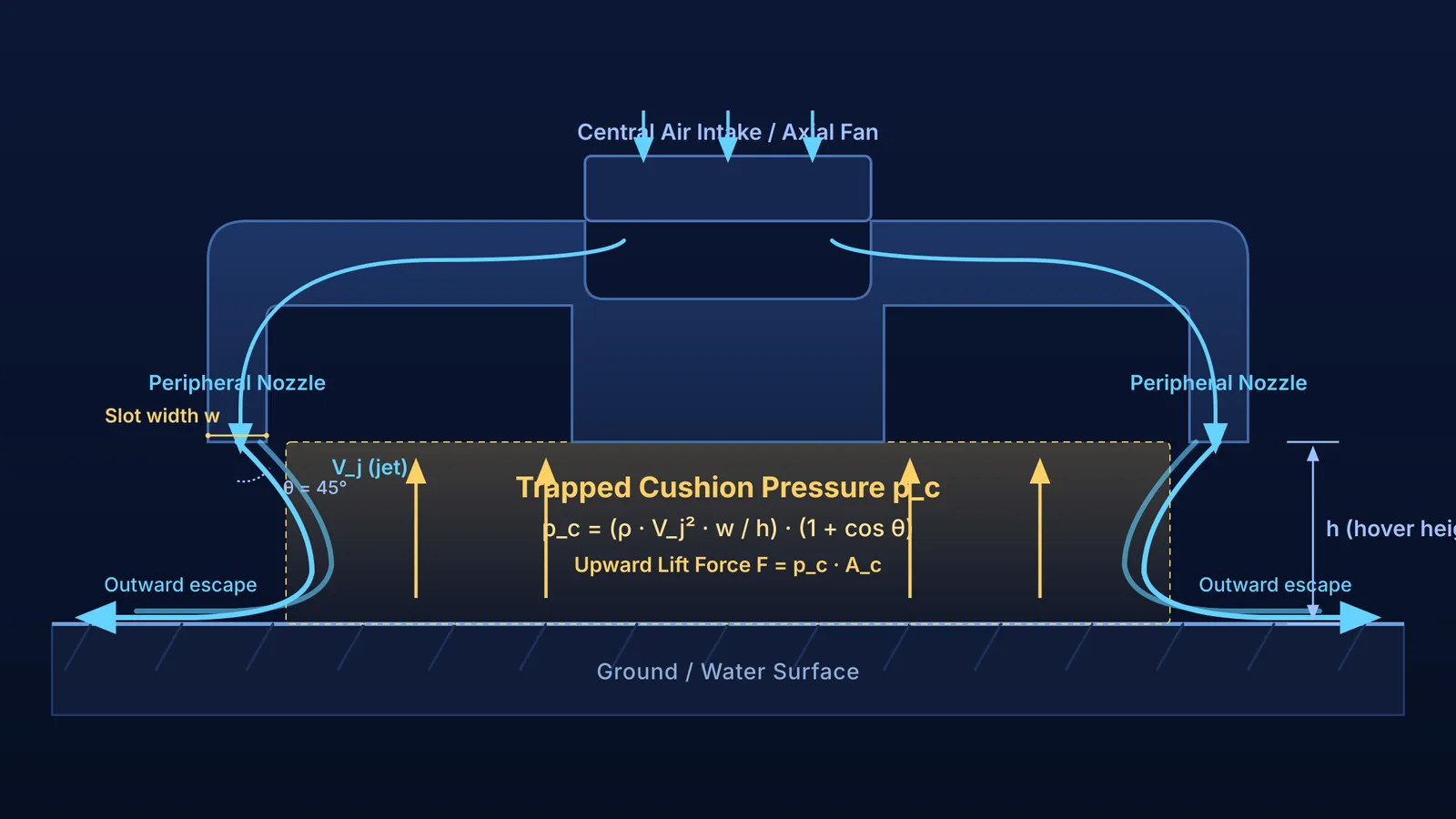
The mechanical advantage of an annular jet relies on momentum conservation, formalised by Cockerell in his 1955 patent specification (Biographical Memoirs of Fellows of the Royal Society). Consider an air jet of density ρ, exit slot width w, and velocity V_j ejected inward at angle θ from the horizontal across hover height h:
Inward momentum flux entering: −ρ × V_j² × w × cos θ per unit perimeter.
Outward momentum flux leaving: +ρ × V_j² × w per unit perimeter.
Net momentum change: ρ × V_j² × w × (1 + cos θ).
Equilibrium: Across hover height h, pressure force p_c × h balances momentum change, giving p_c × h = ρ × V_j² × w × (1 + cos θ).
Rearranging gives the cushion pressure equation: p_c = (ρ × V_j² × w / h) × (1 + cos θ)
Because cushion pressure acts over the full base area A_c, total lift is F = p_c × A_c. In an open plenum, air escapes at full efflux velocity v = √(2 p_c / ρ), demanding continuous airflow. The momentum curtain acts as a fluid seal, holding high static pressure while consuming only a fraction of the mass flow. You can explore how pressure gradients sustain low-friction gliding in how a balloon and CD hovercraft glides without friction, or observe moving air profiles in this fluid flow simulation of speed and pressure.
How did the SR.N1 hovercraft cross the English Channel in 1959?
Cockerell filed British patent GB 854,211 on 12 December 1955 (Biographical Memoirs of Fellows of the Royal Society). Recognizing its military potential, the British government classified the invention as secret in 1956, delaying development until its declassification in 1958.
Once released, the National Research Development Corporation funded the world's first full-scale hovercraft: the Saunders-Roe SR.N1. Built on the Isle of Wight, the 4-tonne craft used a 450-horsepower Alvis Leonides radial engine driving an axial fan (Biographical Memoirs of Fellows of the Royal Society). The fan fed peripheral ducts to maintain the air cushion while expelling air through directional ducts for propulsion.
On 25 July 1959—the 50th anniversary of Louis Blériot's 1909 flight across the English Channel—the SR.N1 crossed from Calais to Dover (Britannica). Piloted by Peter Lamb, with John Chaplin navigating and Cockerell on board as ballast, the craft completed the 22-nautical-mile journey in 2 hours and 3 minutes (Biographical Memoirs of Fellows of the Royal Society), proving that air-cushion vehicles could navigate open maritime swells.
When you tackle fluid mechanics numericals, the Fermi Problem Library provides worked problems with a step-by-step solver that explains the reasoning rather than printing an answer. If dynamic fluid pressure and momentum balances feel abstract on a textbook page, the Fermi Simulation Lab offers interactive simulations for ideas that are easier to see than to read.