

On this page
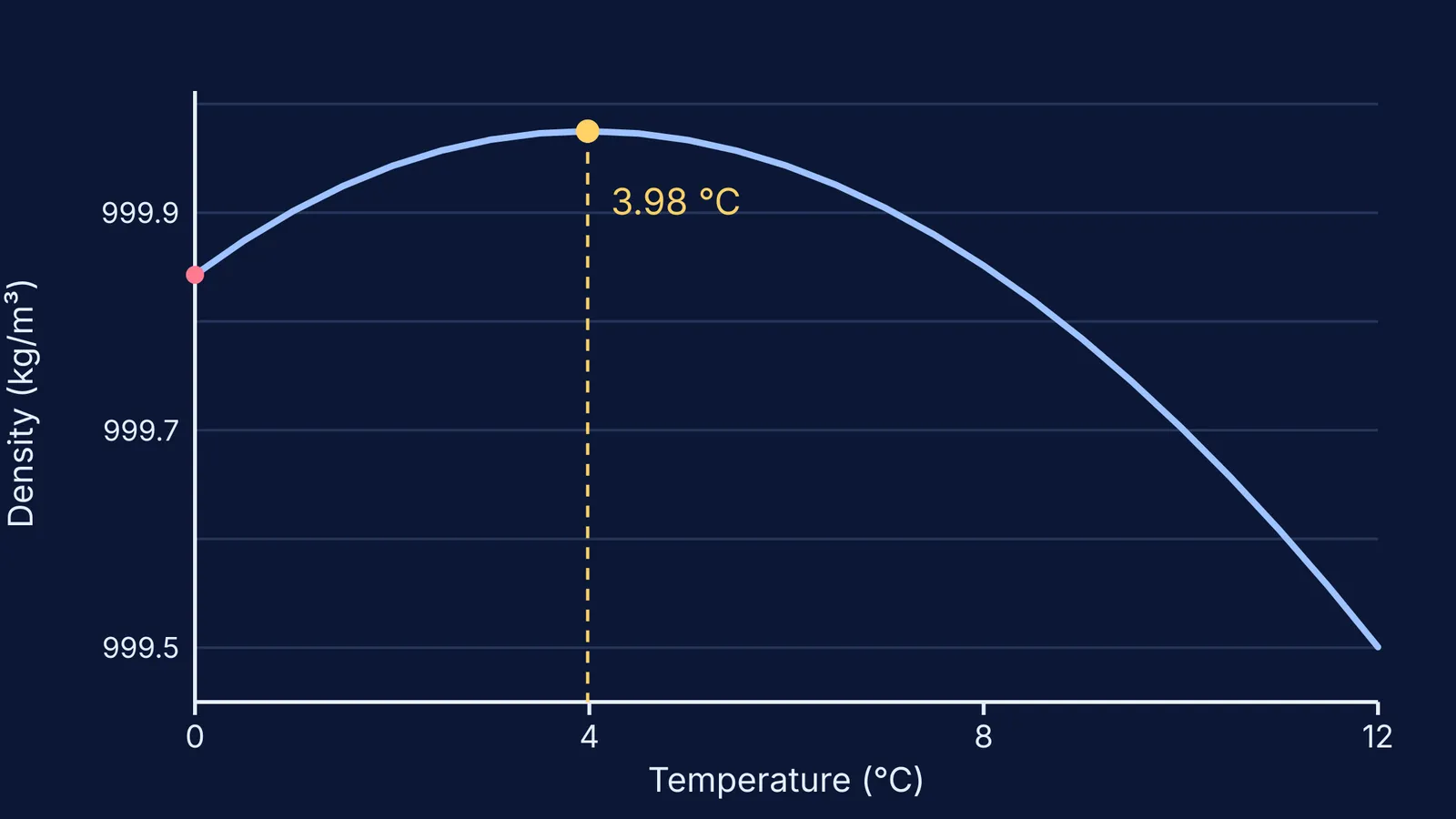
Most liquids get denser as they cool. Water stops just above freezing. In the reference table published in Metrologia by Tanaka and colleagues in 2001, pure water is densest at about 3.98 °C, where a cubic metre has a mass of about 999.97 kg. Cool it further and it expands again. According to the US Geological Survey, the density of water drops by about 9 percent when it freezes, which is why ice floats.
The Indian chemist Charusita Chakravarty spent much of her career asking why water behaves like this. She did it with computer simulations rather than test tubes.
Who was Charusita Chakravarty?
According to her Wikipedia biography, Chakravarty was born in 1964 in Cambridge, Massachusetts, and grew up in Delhi. She studied chemistry at St. Stephen's College, Delhi, and did her PhD at the University of Cambridge under David Clary. She joined the chemistry department at IIT Delhi in 1994 and became a professor there in 1999. She received the Shanti Swarup Bhatnagar Prize in chemical sciences in 2009 and died on 29 March 2016. Her field was theoretical chemistry: liquids, water and hydration, studied with molecular dynamics and Monte Carlo simulations.
Why is water densest at 4 °C?
The short answer is two effects pulling in opposite directions. Water molecules hydrogen-bond to their neighbours in a tetrahedral pattern. That arrangement is open and takes up space. (If hydrogen bonds are new to you, our post on how hydrogen bonding predicts boiling points and solubility covers the basics.)
As water cools, molecules jiggle less, so ordinary liquid packing would make it denser. But cooling also lets more molecules settle into that open tetrahedral pattern, which makes it less dense. Above about 4 °C, the temperature of maximum density given by the US Geological Survey, the first effect wins. Below it, the second one does.
Chakravarty's review with Divya Nayar in Physical Chemistry Chemical Physics (2013) puts the general rule in one line: what liquids with water-like anomalies share is "a density-driven shift in the nature of local order". Squeeze or stretch the liquid and its local arrangement changes; the odd properties follow.
How did Chakravarty use computer simulations to study water?
Her group built virtual boxes of water from standard computer models of the molecule, let them move by the laws of mechanics, and measured how ordered they were at each density and temperature.
An important earlier step was a 2001 Nature study by Errington and Debenedetti, whose simulations found a region where water's order decreases when it is compressed, with its anomalies occurring as a cascade.
Chakravarty's group brought in a thermodynamic quantity: entropy. In a 2006 paper in The Journal of Chemical Physics, Ruchi Sharma, Somendra Nath Chakraborty and Chakravarty studied the excess entropy of liquid silica and a model liquid, both known to have water-like anomalies. The excess entropy is the difference between the entropy of the liquid and that of an ideal gas at the same density and temperature. It can be estimated from how pairs of molecules are arranged, so the authors proposed it as a convenient way to diagnose anomalous liquids.
In 2011, in The Journal of Physical Chemistry B, Manish Agarwal, Mohammad Parvez Alam and Chakravarty mapped the density, entropy, diffusion and structural anomalies of the TIP4P/2005 water model and compared it with four other models. TIP4P/2005's line of temperatures of maximum density came very close to the experimental line between 250 and 275 K. In all five models, anomalous behaviour sat between about 0.85-0.90 g/cm³ and 1.10-1.15 g/cm³.
Her group also reported water-like anomalies in liquid beryllium fluoride, and the 2006 paper covered silica, which shows these oddities are not unique to H2O.
What does the 4 °C maximum mean in real numbers?
Here is a worked example you can do with the Tanaka formula.
Density at 3.98 °C: about 999.97 kg/m³.
Density at 0 °C: about 999.84 kg/m³, from the same formula.
Difference: about 0.13 kg/m³, or 0.13 g for every litre.
So a litre of water at 0 °C is about 0.13 g lighter than a litre at 4 °C.
Tiny, but in a pond chilled from above it decides which water sits on top. As the USGS explains for lakes, denser water sinks below less-dense water. Once the surface cools below 4 °C it is lighter than the water beneath, so it stays up there, and that is where ice forms first. Our Class 6 post on the states of water and evaporation suits a younger sibling.
How can you read a water simulation study?
Use these four questions on any paper like Chakravarty's:
Which model of the molecule was used, and how many were compared?
Which property was measured: density, diffusion, entropy or order?
Over what range of temperature and density?
Where does the model match experiment, and where does it not?
Some ideas are easier to understand when you can watch them change. The Fermi Simulation Lab has interactive simulations for ideas that are easier to see than to read, and the Fermi Concept Library gives each concept in chemistry and physics its own lesson.
For another water story, read how Dixon and Joly showed leaves pull water up tall trees.


