

On this page
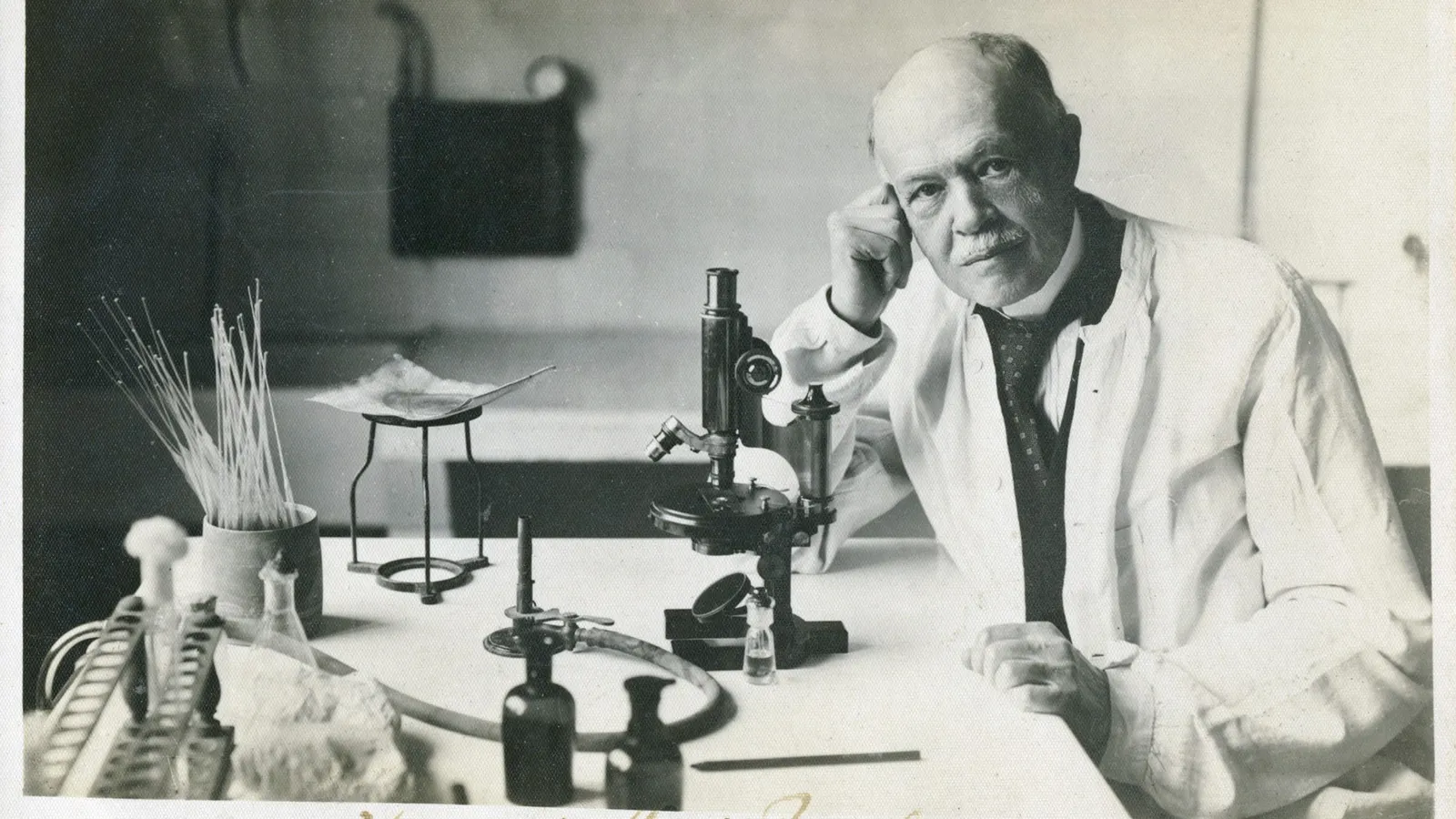
In 1903, the French bacteriologist Charles Nicolle became the Director of the Pasteur Institute in Tunis, North Africa. At the time, epidemic typhus was a devastating and mysterious problem in the region. The disease was highly contagious and often fatal, sweeping through cities and military camps. Yet by 1909, Nicolle had cracked the mystery of how it spread, proving that the human body louse was the invisible carrier. His work not only earned him the 1928 Nobel Prize in Physiology or Medicine but also provided a simple, practical way to stop epidemics in their tracks.
Why does bathing stop the spread of typhus?
Nicolle's breakthrough began with a keen observation at the native hospital in Tunis. He noticed a striking pattern in the way the disease spread. Outside the hospital, typhus was rampant, infecting patients' families, the clerks who admitted them, and the doctors who examined them.
However, once a patient was admitted to the general hospital wards, the contagion suddenly stopped. They could lie in a bed next to a healthy patient without passing on the fever. Nicolle realised that the only thing that happened between the highly contagious waiting room and the safe hospital ward was a simple procedure: patients were stripped of their clothes, shaved, and washed with soap and water.
He deduced that the infectious agent was not carried inside the patient's body in a way that spread through the air, but was instead something hiding in their clothing or on their skin. The most obvious candidate was the body louse (*Pediculus humanus corporis*).
This is a classic example of active problem-solving. When you are stuck on a difficult biology problem, you do not have to wait for a flash of genius. Fermi's AI tutor can work out what you already know and build a plan for the session, so you sit down to a clear next step instead of a blank page.
What was the chimpanzee experiment?
To prove his hypothesis, Nicolle needed an animal model, as experimenting on humans was not an option. In June 1909, he successfully infected a chimpanzee with blood taken from a human typhus patient. He chose a chimpanzee because he thought an anthropoid ape would be more susceptible than other species.
Once the chimpanzee fell ill with the characteristic fever, Nicolle inoculated a macaque monkey with its blood. He then allowed lice to feed on the infected macaque and transferred them to healthy macaques. The lice became invariably virulent by the tenth day, and the healthy macaques developed the disease, providing the definitive proof that lice were the vector. He later expanded his work using smaller animals like guinea pigs, which were easier to keep in a laboratory.
Nicolle also discovered that the primary mode of transmission was not the louse's bite itself, but its excrement. The lice excrete large numbers of microbes, and the infection occurs when a person scratches the itchy bite, inadvertently rubbing the louse faeces into the broken skin or mucous membranes.
If you are curious about how diseases are transmitted by vectors, similar stories are found in the work of Alphonse Laveran and the parasite that causes malaria and the discovery of Carlos Chagas: a new parasite, its insect carrier and its disease.
How did his work change public health?
Nicolle's discovery meant that typhus could be prevented with simple hygiene. By delousing populations and heat-treating clothing, armies and cities could stop an outbreak in its tracks. In his Nobel Lecture, Nicolle reflected on this relationship between humans and disease: "Man carries on his skin a parasite, the louse. Civilization rids him of it. Should man regress... the louse begins to multiply again and treats man as he deserves, as a brute beast."
Later on, the fight against insect-borne diseases would evolve to include chemicals, a development pioneered by researchers like Paul Müller and DDT: the insecticide that fought malaria. However, Nicolle's emphasis on basic hygiene remained the first line of defence.
Understanding these historical discoveries is a great way to grasp the fundamentals of biology and epidemiology. You can explore every concept in biology, along with physics and chemistry, in the Fermi Concept Library, where each idea has its own lesson and place in the map.
How can you use the "threshold" framework for problem-solving?
Nicolle solved the typhus mystery using what we can call the "threshold framework": looking for the exact moment a pattern changes. You can apply this same method to your study habits or exam preparation:
Identify the boundary: Where exactly does the problem occur? (e.g., "I get the maths right in homework, but wrong in the exam.")
List the variables: What changes across that boundary? (Time pressure, environment, access to notes.)
Test one variable at a time: Try doing homework under timed conditions to see if the "infection" (the mistakes) returns.
Start mapping out your learning thresholds today.


