

On this page
Why did early waterproof fabrics fail before 1823?
For centuries, weatherproofing clothes meant coating canvas in linseed oil, wax, or tallow. While oiled cloth resisted moisture, it was stiff, greasy, and smelled over time. In humid weather—much like why clothes take so long to dry in the monsoon—traditional woven cloaks soaked up rainwater through capillary action between fibers.
When South American natural rubber (caoutchouc) reached Europe, chemists tested its water-repelling qualities. As documented by Paul E. Hurley in the Journal of Macromolecular Science, early makers smeared raw latex directly onto coats. The results failed. Natural rubber consists of uncrosslinked cis-1,4-polyisoprene chains. In warm weather, raw rubber melted into a sticky gum. In freezing winter winds, the chains aligned and crystallized, turning coats brittle enough to crack. Solvents like turpentine were costly and evaporated slowly.
How did Charles Macintosh make fabric waterproof with naphtha?
The solution arrived when Scottish chemist Charles Macintosh (1766–1843) examined gasworks waste in Glasgow. In 1819, Macintosh contracted with the Glasgow Gas Light Company for its byproduct coal tar and ammoniacal liquid. Distilling the tar produced coal-tar naphtha, a volatile liquid hydrocarbon mixture. In 1818, Edinburgh medical student James Syme had published in *Annals of Philosophy* that naphtha dissolved rubber, though Syme never commercialized his finding.
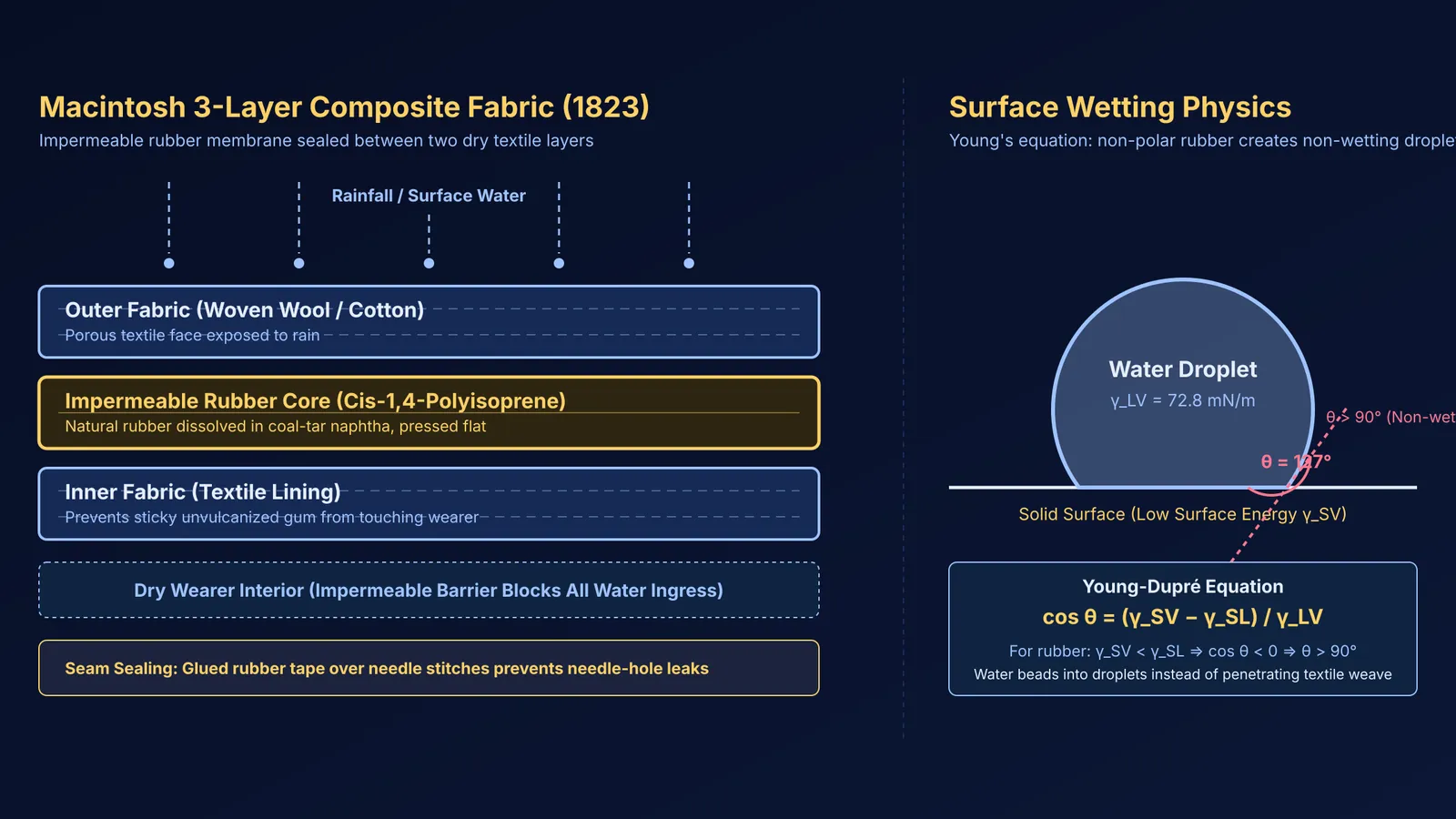
Macintosh recognized the commercial value of this non-polar solvent. Naphtha dissolved natural rubber into a smooth, brushable cement. Rather than coating garments externally, Macintosh created a three-layer sandwich: he brushed the rubber paste onto cloth, let the naphtha partly evaporate until tacky, laid another cloth layer on top, and pressed them flat under heavy rollers.
On June 17, 1823, Macintosh received British Patent No. 4804 for this process, as detailed by H. Schurer in the Transactions of the Newcomen Society. The solvent evaporated through the weave, sealing an impervious rubber membrane inside two dry textile faces. Wearers stayed dry without touching sticky gum.
In 1824, Macintosh partnered with Hugh Hornby Birley to build a Manchester factory, founding Charles Macintosh & Co., as recorded in Encyclopaedia Britannica. According to the Linda Hall Library, Arctic explorer Sir John Franklin equipped every member of his party with two complete outfits of waterproof clothing and wrapped expedition supplies in three layers of Macintosh canvas for his 1825 polar voyage.
What problems did the first Mackintosh raincoats face?
Despite their popularity, the first raincoats—popularly spelled 'Mackintosh' with a 'k'—revealed four practical flaws recorded by H. Schurer in the Transactions of the Newcomen Society:
Needle-hole leaks: Tailors stitched seams with needle and thread, piercing thousands of holes through the rubber core until Macintosh introduced glued, rubber-taped seams.
Trapped sweat: Because the core rubber membrane was completely airtight, perspiration could not escape, soaking wearers from inside.
Oil degradation: Wool oils and body grease dissolved the uncrosslinked polyisoprene core over time.
Thermal stiffness: The rubber core became rigid below 10 °C and softened near heat.
How do engineers test waterproof composite fabrics?
To diagnose failures in polymer laminates, materials engineers test four performance criteria:
Solvent resistance: Verify whether the core elastomer dissolves when exposed to natural body oils or non-polar cleaning agents.
Thermal stability: Test flexibility across freezing winter cold and summer heat to prevent crystallization stiffening and softening.
Seam integrity: Inspect needle punctures along join lines and confirm waterproof sealing tape closes every stitch hole.
Vapor permeability: Assess whether perspiration vapor can diffuse outward while liquid droplets are barred from entering.
How did vulcanization complete Macintosh's waterproof sandwich?
The remaining flaws were resolved through polymer chemistry. In the 1830s, Macintosh collaborated with Thomas Hancock, inventor of the rubber masticator. In 1839, Charles Goodyear in America found that heating rubber with sulfur created cross-links between polymer chains. Hancock independently perfected the method in Britain, patenting vulcanization in 1843, as noted in the Journal of Macromolecular Science.
Vulcanization converted natural rubber into a stable thermoset elastomer. Sulfur bridges locked polyisoprene chains into a flexible network, preventing them from melting in heat or freezing into rigid crystals. When Charles Macintosh & Co. adopted vulcanized rubber, the coats became durable and weatherproof. This manufacturing breakthrough advanced rubber chemistry, paralleling how John Boyd Dunlop invented the pneumatic bicycle tyre and foreshadowing how accidental discoveries shaped conducting plastics.
Understanding how molecular bonds control bulk elasticity and solubility is essential in chemistry. When you want to see how polymer networks respond to temperature and stress, the Fermi Simulation Lab provides interactive simulations for the ideas that are easier to see than to read. To practice multi-step problem solving in organic reactions and polymer chemistry, the Fermi Problem Library offers worked problems with a step-by-step solver that explains the reasoning rather than printing an answer. To explore how intermolecular forces govern solutions, visit the Fermi Concept Library, which covers every concept in physics, chemistry, biology, mathematics and computing, each with its own lesson and its place in the map.


