

On this page
Plastics are usually excellent insulators. We wrap copper wires in rubber and polyvinyl chloride specifically because they stop electricity from escaping. But in the 1970s, a Japanese chemist named Hideki Shirakawa discovered how to break this fundamental rule. He found a way to turn a common organic polymer into a material that conducted electricity like a metal.
The breakthrough earned him the 2000 Nobel Prize in Chemistry, which he shared alongside Alan MacDiarmid and Alan Heeger. Remarkably, this new field of materials science began with an unforeseeable laboratory mistake.
How did Hideki Shirakawa discover conducting polymers?
Shirakawa received his doctorate from the Tokyo Institute of Technology in April 1966. He began working as a research associate there, aiming to understand the exact polymerisation mechanism of polyacetylene using Ziegler-Natta catalysts.
At the time, the standard chemical method produced polyacetylene as a dull, insoluble black powder. However, in the autumn of 1967, a visiting scientist working in his laboratory attempted to make the polymer and instead produced ragged pieces of a shiny, silvery film.
Shirakawa inspected the polymerisation conditions repeatedly to find the cause of this strange result. He eventually discovered that the concentration of the catalyst was a thousand times higher than intended (NobelPrize.org). In his Nobel autobiography, Shirakawa suggested the visitor might have misread the "m" in "mmol" (millimoles), adding molar quantities of the catalyst to the reaction vessel instead.
The massive excess of catalyst accelerated the reaction by roughly a thousand times. The acetylene gas polymerised immediately on the surface of the catalyst, forming a thin, intertwined film rather than a precipitate. The unique Ziegler-Natta catalyst they used remained homogeneously dissolved in organic solvents, which was an essential condition for the film to form.
Why does doped polyacetylene conduct electricity?
The silvery polyacetylene film caught the attention of Alan MacDiarmid, who invited Shirakawa to join him at the University of Pennsylvania in September 1976. There, they worked with physicist Alan Heeger to test the material's unique electrical properties.
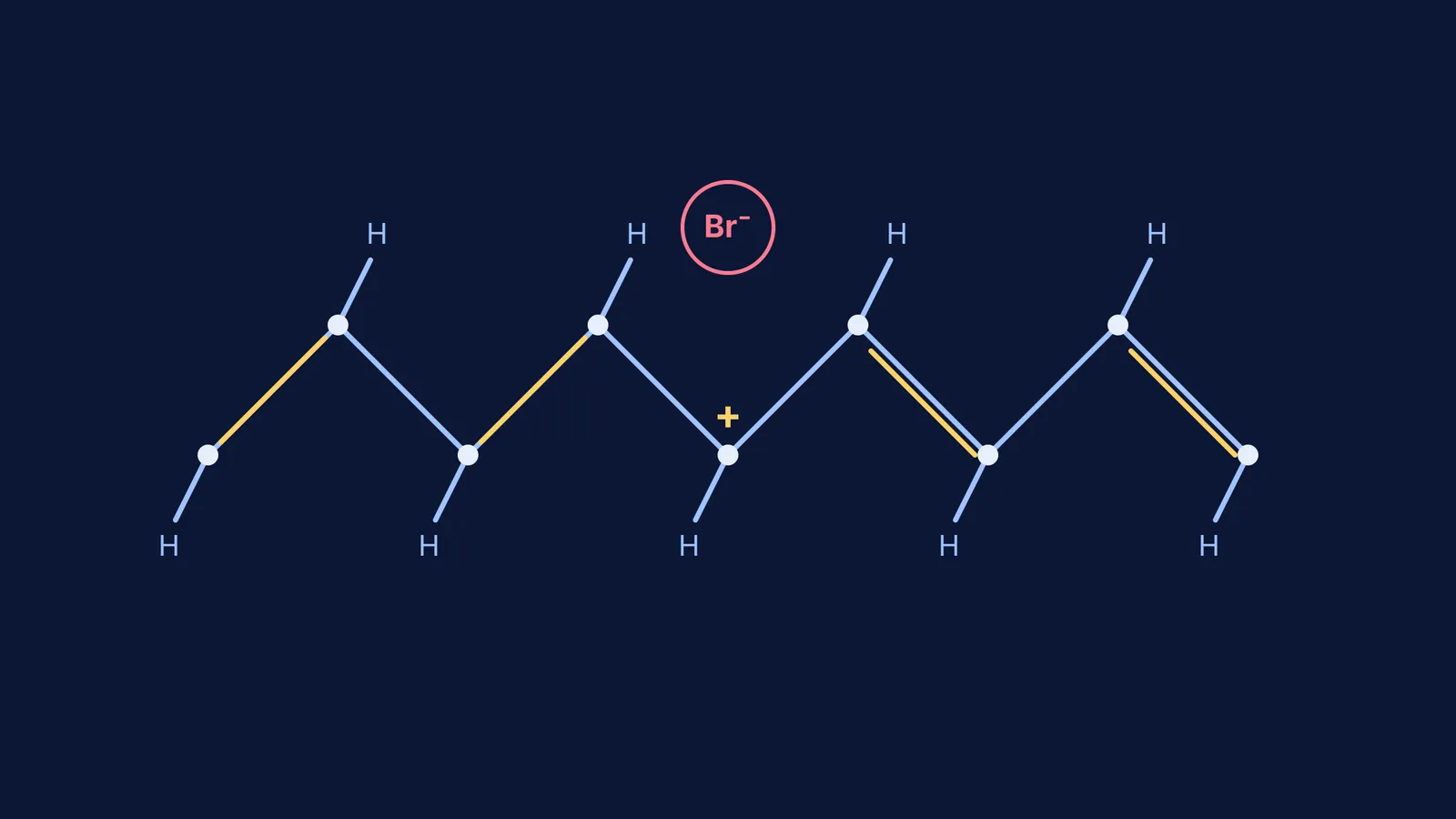
Polyacetylene has alternating single and double carbon bonds along its backbone, a structural feature known as conjugation. In theory, this arrangement allows electrons to move, but pure polyacetylene is still an insulator because the electrons are bound too tightly to the individual atoms. (To see why different materials behave this way, you can review how energy bands in conductors, semiconductors and insulators dictate electron flow).
On November 23, 1976, Shirakawa and postdoctoral fellow C. K. Chiang were measuring the film's electrical conductivity using a four-probe method while exposing it to bromine vapour. The moment the bromine was added, the conductivity jumped so rapidly that the electrometer they were using could not switch ranges fast enough, and the expensive equipment was broken. The bromine acted as a dopant, withdrawing electrons from the polyacetylene chain and creating positively charged holes that could move freely.
The electrical conductivity became ten million times higher than it was before the bromine was added (NobelPrize.org).
How did Shirakawa improve the polymer films?
After returning to Japan in November 1979 as a professor at the University of Tsukuba, Shirakawa continued to push the boundaries of his discovery. Early polyacetylene films were isotropic—their microscopic fibres were tangled together in a random, three-dimensional mess. Because electricity travels best along the straight chains of the polymer, this entanglement severely limited the material's performance.
Shirakawa realised that to study the polymer's true properties, he needed to align the chains. He pioneered a method to synthesise uniaxially oriented films by using a liquid crystal as the solvent during polymerisation (NobelPrize.org). By applying a magnetic field or a flowing current to the liquid crystal, the catalyst oriented itself, and the resulting polyacetylene formed straight, highly aligned fibres. He even managed to create helical structures of polyacetylene by using chiral liquid crystals.
What are conducting polymers used for?
The discovery of conducting polymers opened an entirely new field of materials science, as transformative to chemistry as how the buckyball was found by Kroto, Curl and Smalley. Today, conducting plastics are widely used in anti-static materials, electromagnetic shielding, and the organic light-emitting diodes (OLEDs) found in modern television and smartphone screens. They combine the electronic properties of metals with the lightweight, flexible nature of organic polymers.
If you are studying energy bands, conjugated bonds, or how conductivity works, the Fermi Concept Library holds every concept in physics, chemistry, biology, mathematics and computing, each with its own lesson and its place in the map.
Shirakawa's story is a reminder that scientific progress often comes from paying extremely close attention to anomalies. A simple misread label turned a standard chemical reaction into a Nobel-winning discovery, proving that even our most basic assumptions about materials can sometimes be rewritten.


