On this page
Carolyn Porco is the planetary scientist who led the imaging team on Cassini, the NASA spacecraft that studied Saturn from 2004 until it was deliberately plunged into the planet on 15 September 2017 (NASA Cassini mission page). If you have seen a sharp photo of Saturn's rings or of water spraying from a small icy moon, there is a good chance it came through her team. Below: who she is, what her cameras found, and a Class 11 calculation that checks one discovery.
Who is Carolyn Porco?
Porco earned her PhD at Caltech in 1983 with a dissertation on Voyager discoveries in Saturn's rings, and joined the Voyager imaging team the same year (Edge biography). On Voyager she took part in the flybys of Uranus in 1986 and Neptune in 1989, leading the Rings Working Group at Neptune.
In November 1990 she was selected as leader of the Cassini Imaging Team, and she directs CICLOPS, the imaging operations centre at the Space Science Institute in Boulder, Colorado (Edge biography). Cassini itself launched on 15 October 1997 (NASA), so she was planning its pictures for well over a decade before it reached Saturn.
What did Cassini's cameras see in Saturn's rings?
Cassini carried two cameras: a narrow-angle telescope with a 2 m focal length and a 0.35 degree field of view, and a wide-angle camera with a 0.2 m focal length and a 3.5 degree field of view (Porco et al., Space Science Reviews, 2004).
In its first nine months at Saturn, the imaging system found new moons, narrow diffuse rings inside gaps in the main rings, and fine-scale ring structure (Porco et al., Science, 2005).
One of the best examples is Daphnis, a moon with a mean radius of about 3.8 km, discovered by the Cassini team on 1 May 2005 (NASA Daphnis page). Scientists had predicted a moon there because they saw ripples along the edge of the Keeler Gap. Daphnis' gravity pulls on ring particles and sculpts the gap's edges into waves.
How did Cassini find water jets on Enceladus?
Enceladus is barely 500 km across (NASA). In July 2005, Cassini's cameras took detailed images of its south polar region, and the mission detected a large cloud of water vapour above it.
In 2006, Porco and her co-authors reported in Science that jets of fine icy particles rise from this region, are carried up by water vapour probably venting from underground reservoirs of liquid water, and supply Saturn's E ring (Porco et al., Science, 2006).
Later results built on that: in 2015 the mission concluded a global ocean must lie under the ice, and in 2017 it reported hydrogen in the plume, a sign of hydrothermal activity (NASA). That is why, after 22 dives between Saturn and its rings, Cassini was sent into Saturn: to keep Saturn's moons, particularly Enceladus, pristine for future exploration (NASA release).
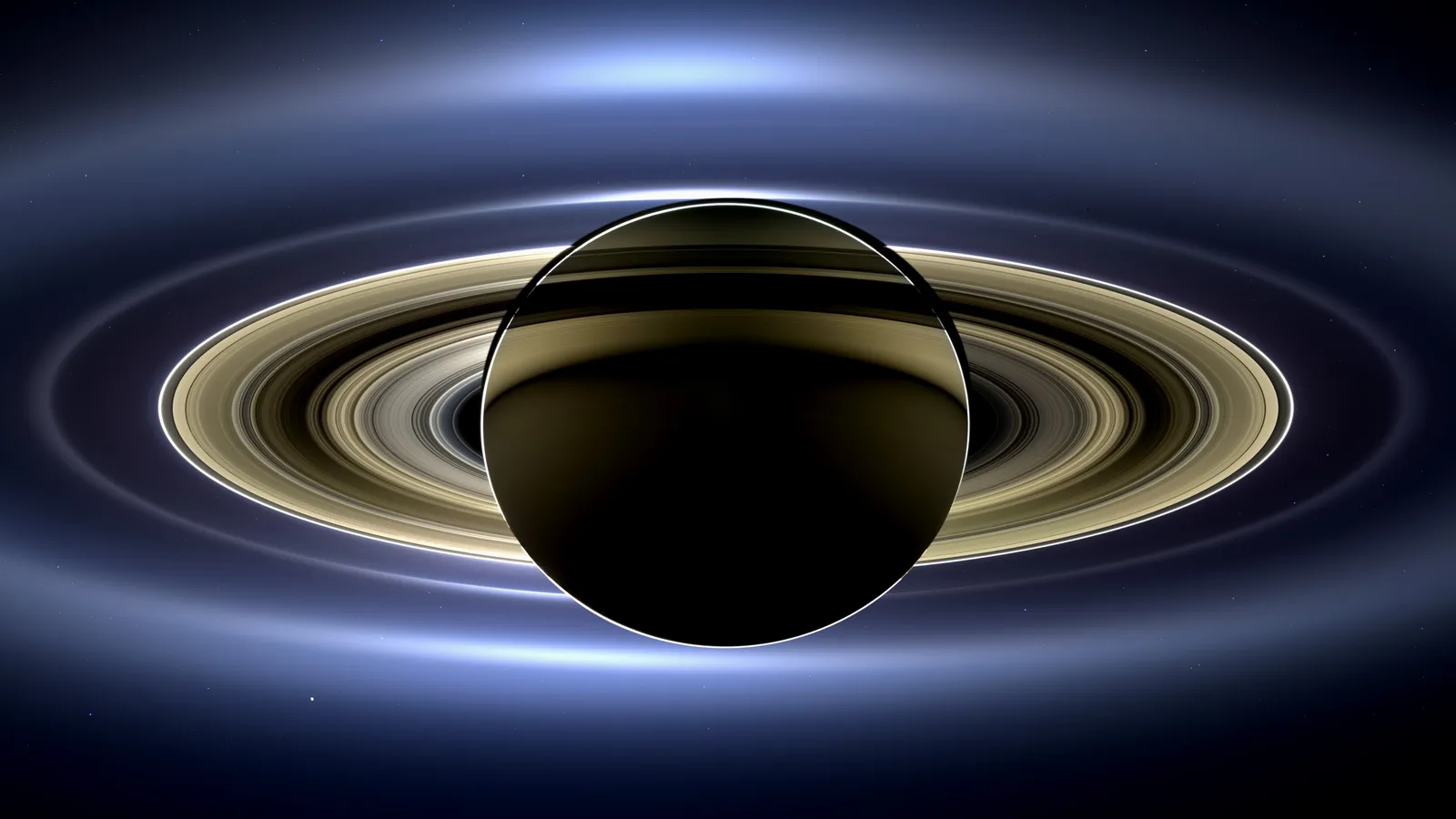
The imaging team also made one of Cassini's best-known pictures, documented on NASA/JPL's PIA17172 page.
Can you check a Cassini discovery with Class 11 physics?
Yes. NASA says Daphnis orbits about 85,000 miles (136,500 km) from Saturn and goes round once every 14 hours (NASA Daphnis page). Saturn's GM is 37.931 million km³/s² (NASA Saturn fact sheet). Check the period with Kepler's third law, T = 2π√(r³/GM):
r³ = (1.365 × 10⁵ km)³ ≈ 2.54 × 10¹⁵ km³.
r³/GM ≈ 2.54 × 10¹⁵ / 3.7931 × 10⁷ ≈ 6.71 × 10⁷ s².
√(6.71 × 10⁷) ≈ 8,190 s, and 2π × 8,190 ≈ 51,400 s.
51,400 s ÷ 3,600 ≈ 14.3 hours, which matches NASA's figure.
Now the waves. Since T grows as r^(3/2), a ring particle 1% closer to Saturn has a period about 1.5% shorter, so it pulls ahead of Daphnis; one 1% farther out falls behind. That is NASA's explanation: waves on the inner edge lead the moon and waves on the outer edge trail it.
If the picture of faster inner orbits is hard to hold in your head, the Fermi Simulation Lab has interactive simulations for ideas that are easier to see than to read. If you get stuck on a step like the r³ arithmetic, the Fermi Problem Library has a step-by-step solver that explains the reasoning rather than printing an answer.
What can students learn from the Cassini imaging story?
You can borrow habits the record shows clearly:
Predict, then look. The Keeler Gap ripples told scientists a moon should be there before Daphnis was seen.
Check with numbers. A 14-hour orbit (NASA Daphnis page) is not just a fact to memorise; you can rebuild it from one law and two values.
Notice the hedges. The 2006 Enceladus abstract says the vapour "probably" comes from liquid water.
Think in decades. From selection in 1990 to arrival in 2004, the team planned for years before the first close-up picture.
Pick one Cassini image this week, find its NASA page, and work out one number in it for yourself.