

On this page
In short In 1983, Carlo Rubbia's UA1 team at CERN announced the discovery of the W and Z bosons, confirming the electroweak theory. These heavy particles carry the weak nuclear force responsible for beta decay.
The four fundamental forces of nature shape everything from the orbit of the planets to the stability of the atom. While gravity and electromagnetism stretch across infinite distances, the weak nuclear force works only deep inside the atomic nucleus. This short range meant its carrier particles had to be extraordinarily heavy. On 25 January 1983, the European Organization for Nuclear Research (CERN) announced the discovery of the W boson, and months later, the Z boson. The discovery by the UA1 experiment, led by Carlo Rubbia, was a landmark in modern physics.
What is the weak force and why does it need heavy carriers?
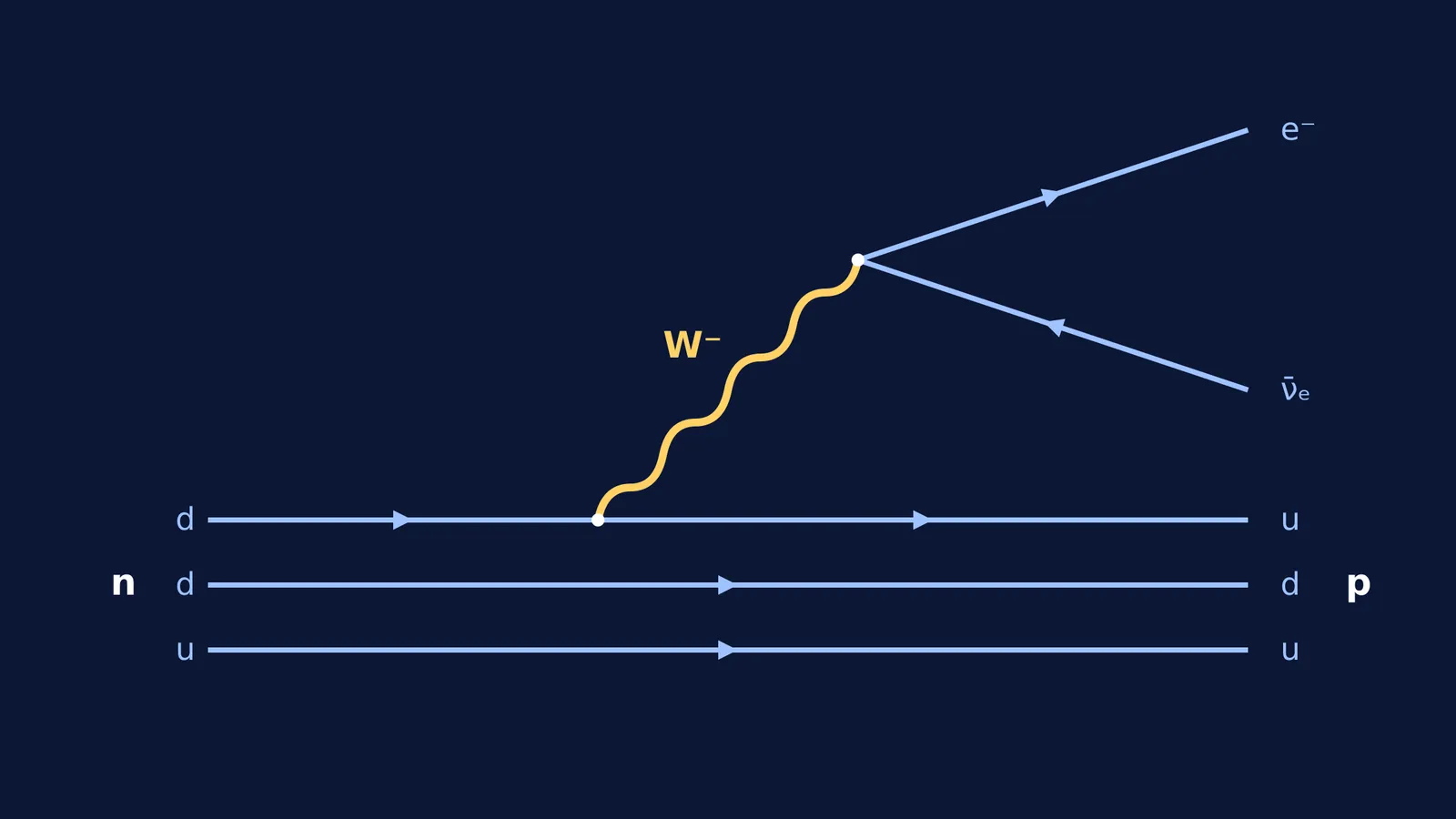
The weak nuclear force is best known for driving beta decay, the process where a neutron turns into a proton, emitting an electron and an antineutrino. This reaction is what powers the fusion in the Sun and forms the heavy elements around us.
But how does a neutron "talk" to the particles it creates? In quantum physics, forces are carried by messenger particles called bosons. Electromagnetism uses massless photons, which is why a magnet can pull a pin from a distance. The weak force, however, operates only across distances smaller than a single proton. To have such a short reach, its carriers had to be incredibly massive.
The W and Z bosons are huge. The Z boson is electrically neutral, while the W boson comes in positive (W⁺) and negative (W⁻) charges. They are so massive that producing them in a laboratory required a leap in engineering.
How did CERN find the W and Z bosons in 1983?
Finding these particles was not as simple as looking through a microscope. To create particles with such high mass, you need to smash things together at enormous energies.
Carlo Rubbia, an Italian physicist at CERN, had a bold idea: convert CERN's existing Super Proton Synchrotron (SPS) accelerator into a proton-antiproton collider. By crashing protons and antiprotons head-on, the collision energy would be high enough to create the W and Z bosons.
This plan faced a major hurdle. Antiprotons are antimatter, and they are difficult to group into a dense, tight beam because they tend to spread out. The Dutch engineer Simon van der Meer solved this with a technique called stochastic cooling, which gently nudged the roaming antiprotons back into a tight beam.
With the beam ready, the UA1 (Underground Area 1) and UA2 experiments began running. On 25 January 1983, CERN announced that the UA1 and UA2 teams had seen the first clear signals of the W boson. A few months later, the neutral Z boson was also found. The discovery was so conclusive that Carlo Rubbia and Simon van der Meer were awarded the Nobel Prize in Physics the very next year, in 1984.
How do you solve beta decay problems in physics exams?
Understanding the weak force is not just history; it is a core part of modern physics questions in JEE and NEET. When you face a problem on calculating the Q value of a nuclear reaction during beta decay, the key is to balance the atomic mass and the atomic number.
Here is a checklist for solving beta-minus (β⁻) decay problems:
Mass number stays the same: In β⁻ decay, a neutron turns into a proton. The total number of nucleons (protons plus neutrons) does not change, so the atomic mass (A) remains constant.
Atomic number goes up by one: Because you gained a proton, the atomic number (Z) increases by 1.
Account for the electron and antineutrino: The decay emits an electron (e⁻) and an electron antineutrino (ν̄ₑ). The antineutrino ensures momentum and energy are conserved.
Check for recoil: When a nucleus emits a particle, the daughter nucleus must recoil. You must decide whether to use energy or momentum conservation to solve for its speed.
If you are struggling to picture how particles change flavour or how conservation laws apply across a decay series, the Fermi Problem Library has worked problems with a step-by-step solver that explains the reasoning rather than printing an answer. When you get stuck, Fermi's AI tutor will work out what you already know and build a plan for the session, so you sit down to a clear next step.
The discovery of the W and Z bosons was a triumph of the Standard Model. Just as Cesar Lattes and his borax plates revealed the pi meson decades earlier, Carlo Rubbia's team used a repurposed collider and brilliant engineering to catch the carriers of the weak force, proving that the forces of nature are more connected than they first appear.


